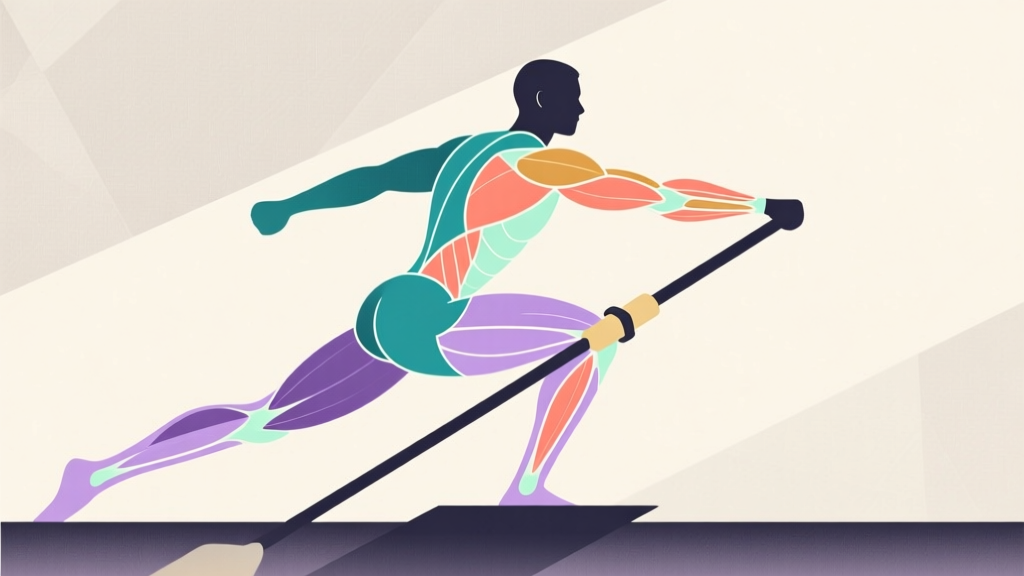
Rowing Machine Muscles Worked: Full-Body Breakdown
A rowing machine provides a full-body workout, engaging approximately 86% of the body's major muscle groups. It primarily works the legs (quadriceps, hamstrings, glutes), back (latissimus dorsi, rhomboids), core (abdominals, obliques), and arms (biceps, forearms), making it one of the most effective cardio and strength-training machines for balanced muscular development.
How a Rowing Machine Engages Your Body
The rowing stroke is divided into four phases: the catch, drive, finish, and recovery. Each phase activates different muscle groups in a coordinated sequence, promoting both cardiovascular endurance and muscular strength. Unlike many cardio machines that focus only on the lower body, rowing integrates upper and lower body movements, resulting in higher caloric burn and improved neuromuscular coordination.
Muscle Groups Activated During Each Phase
- Catch: Hamstrings, calves, and lower back are pre-tensioned; shoulders and arms remain engaged.
- Drive: Power initiates from the legs (quads, glutes), then transfers through the core to the back and arms.
- Finish: Back muscles (lats, rhomboids) and biceps complete the pull; core stabilizes posture.
- Recovery: Muscles lengthen eccentrically; controlled movement maintains stability and breathing rhythm.
Primary Muscle Groups Targeted by Rowing
Rowing is unique in its ability to deliver both aerobic and resistance training benefits. Below is a breakdown of the main muscle groups involved and their roles during the workout.
Legs: The Powerhouse of the Stroke
The legs contribute up to 60% of the total power output during each stroke. Strong leg drive is essential for efficient rowing technique and maximum calorie expenditure.
- Quadriceps: Extend the knee during the drive phase.
- Hamstrings and Glutes: Propel the hips backward and extend the hip joint.
- Calves: Assist in ankle plantarflexion at the catch position.
Back and Upper Body: Pulling Strength and Posture
The back muscles are critical for maintaining proper form and generating pulling force. Overreliance on the arms without back engagement leads to inefficiency and injury risk.
- Latissimus Dorsi: Primary mover in the upper body pull.
- Rhomboids and Trapezius: Retract the scapulae and stabilize the shoulders.
- Erector Spinae: Supports spinal alignment throughout the stroke.
Core: Stability and Force Transfer
The abdominal muscles and obliques act as a bridge between the lower and upper body, ensuring smooth energy transfer and protecting the spine.
- Rectus Abdominis: Engaged during forward lean and stabilization.
- Transverse Abdominis: Provides deep core support.
- Obliques: Assist in rotational stability, especially during high-intensity intervals.
Arms and Shoulders: Final Pull and Control
While the arms contribute less power than the legs or back, they are vital for completing the stroke and controlling the handle path.
- Biceps: Flex the elbows during the final pull.
- Forearms: Maintain grip strength on the handle.
- Deltoids: Stabilize shoulder movement and assist in arm elevation.
Comprehensive Breakdown of Muscle Engagement
To better understand how intensely different muscle groups are activated during rowing, consider the following data based on electromyography (EMG) studies measuring muscle activity during indoor rowing sessions.
| Muscle Group | Relative Activation (% Max) | Phase of Highest Activity | Contribution to Total Power |
|---|---|---|---|
| Quadriceps | 85% | Drive (initial) | 30% |
| Gluteus Maximus | 80% | Mid-Drive | 25% |
| Latissimus Dorsi | 75% | Finish | 20% |
| Biceps Brachii | 65% | Finish | 10% |
| Rectus Abdominis | 50% | Entire Stroke | N/A (stabilizer) |
| Forearm Flexors | 55% | Recovery & Catch | N/A (grip) |
The data shows that the quadriceps and glutes generate the majority of propulsion, confirming that rowing is fundamentally a leg-dominant exercise. However, sustained activation of the lats and biceps highlights significant upper-body involvement, while core muscles remain consistently active to ensure postural control.
Benefits of Full-Body Engagement on a Rowing Machine
Because rowing recruits nearly all major muscle groups, it offers several advantages over isolated cardio equipment like treadmills or stationary bikes.
- Higher Calorie Burn: Engaging more muscles increases metabolic demand—up to 600–800 kcal/hour at moderate to high intensity.
- Improved Cardiovascular Fitness: Sustained effort across large muscle masses enhances heart and lung efficiency.
- Muscle Endurance and Tone: Repeated cycles build stamina and definition without excessive bulk.
- Low-Impact Joint Stress: Smooth, gliding motion reduces strain on knees and hips compared to running.
- Symmetrical Movement Pattern: Bilateral motion promotes balanced strength development and reduces injury risk.
Frequently Asked Questions About Rowing Machine Workouts
Does a rowing machine work your abs?
Yes, a rowing machine actively engages the core muscles, including the rectus abdominis and obliques, throughout each stroke. The core stabilizes the torso during the drive and recovery phases, especially when maintaining proper posture. While not a substitute for targeted ab exercises, consistent rowing contributes to core strength and definition.
Is rowing good for building leg muscles?
Absolutely. The legs provide about 60% of the power during each stroke, with the quadriceps, hamstrings, and glutes heavily recruited. Regular use of a rowing machine can increase leg strength and endurance, particularly when incorporating interval training or increased resistance settings.
Can you get ripped using a rowing machine?
Yes, rowing can help you achieve a lean, toned physique by combining cardiovascular conditioning with resistance training. When paired with proper nutrition and supplementary strength training, rowing accelerates fat loss and muscle definition across the entire body, especially in the back, arms, and legs.
Do rowing machines build back muscles?
Yes, rowing machines significantly engage the latissimus dorsi, rhomboids, and trapezius muscles during the pull phase. Over time, this repeated contraction builds muscular endurance and contributes to a stronger, wider back—similar to seated row exercises in weight training.
Why do I feel rowing mostly in my arms?
If you're feeling rowing mostly in your arms, you may be using improper technique. The majority of power should come from your legs, not your arms. Focus on initiating each stroke with a strong leg drive before engaging your back and arms. Poor sequencing leads to arm fatigue and reduced efficiency.
More Articles
 When Do Swimming Pools Open? Seasonal Guide by Region
 Where to Buy Go Karts: Best Sites & Tips (2025)
 How Long Should You Jump Rope For Optimal Results?
 Who Invented Swimming? Origins & History Explained
 NASCAR Sprint Race This Weekend? No – Here's What's On
 Field Hockey Game Length: Official Durations (2026)
 Golf Ball Compression: Match Ball to Swing Speed
 Most Valuable Sports Franchises in 2026: Rankings and Revenue Breakdown
 How Many Players Are on the Ice in Hockey?
 How High Can You Jump Into Water Safely?