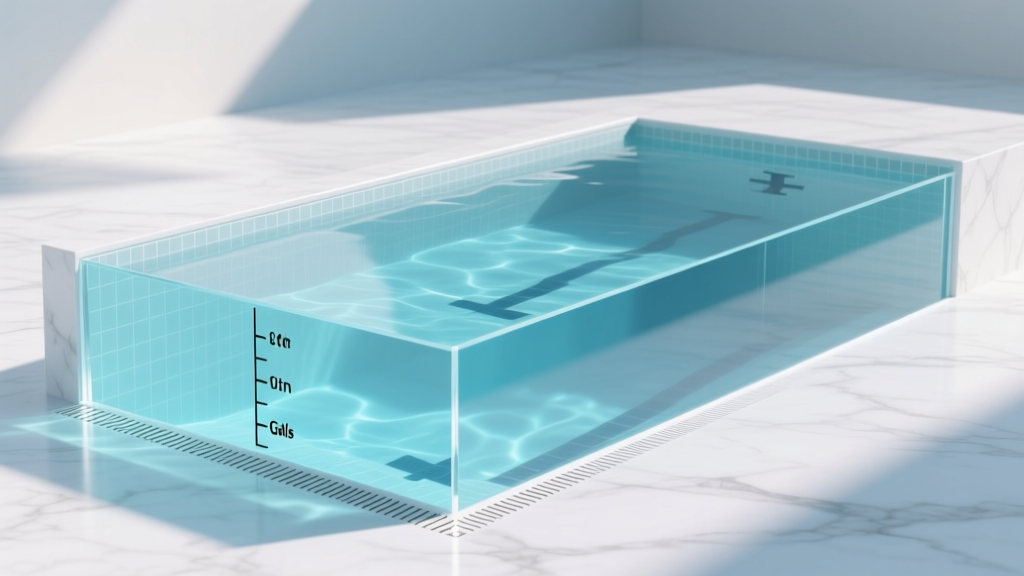
How Much Water in a Swimming Pool? By Size & Type
A standard Olympic-sized swimming pool holds approximately 2,500,000 liters (660,000 gallons) of water. However, the exact amount varies significantly based on pool type, dimensions, and depth. Residential pools typically range from 18,000 to 40,000 gallons, while smaller lap or plunge pools may contain as little as 5,000 gallons.
Understanding Swimming Pool Water Capacity
The volume of water in a swimming pool depends on its size, shape, and intended use. Whether it's a backyard residential pool or a competition-grade facility, knowing the water capacity is essential for proper chemical balance, filtration, heating efficiency, and maintenance planning.
Common Pool Types and Their Uses
- Olympic Competition Pools: Used for professional swimming events.
- Residential In-Ground Pools: Found in private homes, varying in design.
- Above-Ground Pools: Typically smaller and temporary installations.
- Lap Pools: Narrow and long, designed for fitness swimming.
- Plunge Pools: Small, deep pools for cooling off or hydrotherapy.
How to Calculate Water Volume in a Pool
To determine how much water your pool holds, you need accurate measurements and the correct formula based on shape.
Volume Formulas by Pool Shape
- Rectangular Pool: Length × Width × Average Depth × 7.5
- Circular Pool: π × Radius² × Average Depth × 7.5
- Oval Pool: Length × Width × Average Depth × 5.9
- Irregular Shapes: Divide into measurable sections or use a flow meter.
The multiplier (e.g., 7.5) converts cubic feet to U.S. gallons. For liters, multiply cubic meters by 1,000.
Standard Pool Sizes and Water Volumes
Different pools serve different purposes, which influences their dimensions and total water capacity. Below is a detailed comparison of common pool types with real-world data.
| Poll Type | Length (ft) | Width (ft) | Avg. Depth (ft) | Volume (gallons) | Volume (liters) |
|---|---|---|---|---|---|
| Olympic Pool | 164 | 82 | 7 | 660,000 | 2,500,000 |
| Residential Rectangular | 30 | 15 | 5.5 | 18,600 | 70,400 |
| Residential Oval | 27 | 13 | 4.5 | 10,500 | 39,700 |
| Above-Ground Round | 24 | 24 | 4 | 11,894 | 45,000 |
| Lap Pool | 60 | 8 | 5 | 18,000 | 68,100 |
| Plunge Pool | 12 | 8 | 6 | 4,300 | 16,300 |
The data shows that Olympic pools hold over 35 times more water than average residential pools. Lap pools, despite being longer, have lower volume due to narrow width. Above-ground pools often appear large but are shallower, reducing total capacity compared to deeper in-ground models.
Factors That Influence Pool Water Volume
Several variables affect the actual water volume beyond basic dimensions.
- Slope Depth: Many pools slope from shallow to deep ends, requiring average depth calculations.
- Built-in Features: Benches, tanning ledges, and steps displace water, slightly reducing usable volume.
- Tile and Liner Thickness: These take up minor space but matter in precise chemical dosing.
- Overflow Systems: Skimmer-fed pools may not fill to the brim, affecting total volume.
Maintenance Implications of Pool Size
Knowing your pool’s water volume is critical for effective maintenance.
Key Applications Include:
- Chemical Dosing: Adding chlorine, pH adjusters, or algaecides requires precise volume knowledge.
- Filtration System Sizing: Larger volumes demand higher turnover rates and robust pumps.
- Heating Time Estimates: More water = longer heat-up time and higher energy costs.
- Water Replacement Planning: Helps estimate refill time and cost during cleaning or repairs.
Frequently Asked Questions About Swimming Pool Water Volume
How many gallons of water are in an Olympic swimming pool?
An Olympic-sized swimming pool holds approximately 660,000 gallons (2.5 million liters) of water. It measures 50 meters long, 25 meters wide, and at least 2 meters deep, meeting FINA standards for international competitions.
What is the average water capacity of a residential swimming pool?
The average in-ground residential pool contains between 18,000 and 40,000 gallons of water. This varies based on size, shape, and depth, with most family pools falling around 20,000 gallons.
How do I calculate how much water my pool holds?
Measure your pool’s length, width, and average depth. Multiply these together and then by a shape-specific multiplier: 7.5 for rectangular pools, 5.9 for oval, and πr² for round pools. This gives volume in U.S. gallons.
Does the depth of a pool affect how much water it holds?
Yes, depth directly impacts water volume. A deeper pool holds significantly more water even if surface area remains unchanged. Always use average depth (shallow + deep ÷ 2) for accurate calculations.
Why is knowing my pool's water volume important?
Accurate water volume ensures correct chemical balance, efficient filtration, proper heater sizing, and cost-effective water management. Underestimating volume can lead to under-chlorination or equipment strain.
More Articles
 How Fast Can Michael Phelps Swim? Top Speed Revealed
 How Deep Are Olympic Diving Pools? 5m Minimum
 Long Jump World Record: Men's & Women's All-Time Best
 Soccer Positions Explained: All 11 Roles, Formations & Responsibilities (2026)
 Olympic Hurdle Heights by Event & Gender
 Field Hockey Match Duration: Official Times (2026)
 Super Bowl Halftime Show Performers: Complete List from 2010 to 2026
 Team Jump: Science and Strategy Across Sports
 Bungee Jump Deaths: Annual Statistics (2026)
 Who Started Parkour? David Belle's Origin Story