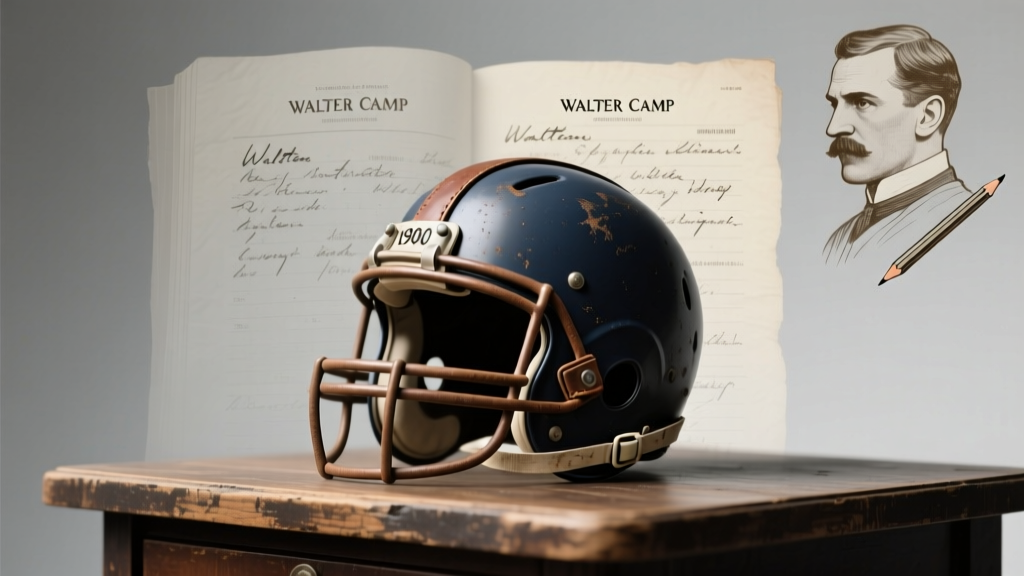
Why Walter Camp Shaped American Football
Walter Camp did not invent football from scratch but is widely regarded as the “Father of American Football” for his pivotal role in shaping its modern rules, structure, and gameplay during the late 19th century, transforming it from a rugby-like game into a distinct sport.
The Origins of American Football
American football evolved from early forms of rugby and soccer played in British universities. In the mid-1800s, colleges in the United States, particularly Harvard, Yale, Princeton, and Columbia, began playing their own versions of these games. These matches lacked standardized rules, leading to chaotic and often dangerous contests.
Early Forms of the Game
- Before Walter Camp, American football resembled English rugby.
- Teams used carrying, kicking, and scrummaging with minimal standardization.
- The Intercollegiate Football Association (IFA), formed in 1876, adopted rugby rules as a baseline.
- There was no line of scrimmage, downs system, or defined scoring.
Walter Camp's Contributions to Football
Walter Camp, a Yale alumnus and former player, became the most influential figure in codifying American football between 1876 and the early 1900s. His innovations distinguished the sport from rugby and laid the foundation for today’s game.
Key Rule Changes Introduced by Camp
- Line of Scrimmage (1880): Replaced the rugby scrum, allowing teams to start each play from an organized formation.
- Down-and-Distance System (1882): Introduced the concept of gaining 5 yards in 3 downs (later adjusted to 10 yards in 4 downs).
- Center Snap: Instituted the snap from center to quarterback to begin each play.
- Scoring Adjustments: Standardized point values for touchdowns (originally 4, later 6), field goals, and safeties.
- Reduced Team Size: Advocated reducing players per side from 15 to 11, enhancing speed and strategy.
Why Did Walter Camp Push for These Changes?
Camp sought to make the game more structured, strategic, and less reliant on brute strength and mob-style play. He believed that introducing measurable progress (downs) and set formations would elevate football into a disciplined, intellectually engaging sport suitable for collegiate competition.
| Rule Innovation | Year Introduced | Impact on Game |
|---|---|---|
| Line of Scrimmage | 1880 | Replaced chaotic scrums with orderly play starts |
| Down-and-Distance System | 1882 | Introduced strategic planning and offensive pacing |
| Center Snap | 1880 | Enabled coordinated offensive plays |
| Team Size Reduced to 11 | 1880 | Increased speed and spacing on field |
| Standardized Scoring | 1883 | Created consistent method to determine winners |
The data shows that between 1880 and 1883, Walter Camp led five foundational changes that redefined football’s mechanics. These rules shifted the sport from a mass-mob contest to a structured, tactical game emphasizing strategy over sheer physical dominance. The introduction of downs and the line of scrimmage were especially transformative, creating the rhythm and progression central to modern football.
Legacy and Recognition
Walter Camp's influence extended beyond rulemaking. He served on the Rules Committee for decades, coached at Yale, and selected the first All-America team in 1889, helping popularize star athletes and national recognition. His annual football guides disseminated standardized rules across colleges.
National Impact
- Camp’s rules were adopted nationwide by the early 20th century.
- His advocacy helped prevent football’s ban due to injury concerns under President Roosevelt.
- The Walter Camp Football Foundation continues to honor excellence in college football.
Frequently Asked Questions About Walter Camp and Football
Why is Walter Camp called the Father of American Football?
Walter Camp earned the title “Father of American Football” because he single-handedly designed the core structural rules—such as the line of scrimmage, down-and-distance system, and 11-player teams—that transformed rugby-style play into a unique, strategic sport now known as American football.
Did Walter Camp invent football entirely?
No, Walter Camp did not invent football from nothing. He refined existing rugby and soccer-inspired games played in U.S. colleges. His contributions were evolutionary rather than revolutionary, but they were so impactful that they defined the sport’s identity.
What year did Walter Camp introduce the line of scrimmage?
Walter Camp introduced the line of scrimmage in 1880, replacing the rugby-style scrum and establishing a fixed starting point for each play, which brought order and strategy to the game.
How did Walter Camp change scoring in football?
In 1883, Camp helped standardize football scoring, assigning specific point values: 2 points for a safety, 4 points for a touchdown (increased to 6 later), and 5 points for a field goal (later reduced). This created consistency across competitions.
Was Walter Camp involved in coaching or player selection?
Yes, Walter Camp coached Yale from 1888 to 1892, winning multiple championships. He also selected the first All-America team in 1889, recognizing outstanding college players and contributing to the sport’s growing popularity and media coverage.
More Articles
 Speed Tools Compared for Sports Sites
 How Much Do Skateboards Cost in 2025?
 When Is Ski Season in Japan? Dates & Tips
 When Did Snowboarding Become Popular? Key Milestones
 Bike Saddle Height: The 109% Rule
 How High Is Skydiving? Typical Jump Altitudes Explained
 Best Hiking Boots: Top Stores & Online Retailers (2026)
 Why Is Pilates So Expensive? Cost Breakdown & Value
 Sports Strategy: Tactics That Work in 2026
 What Does the Ironman Triathlon Consist Of?