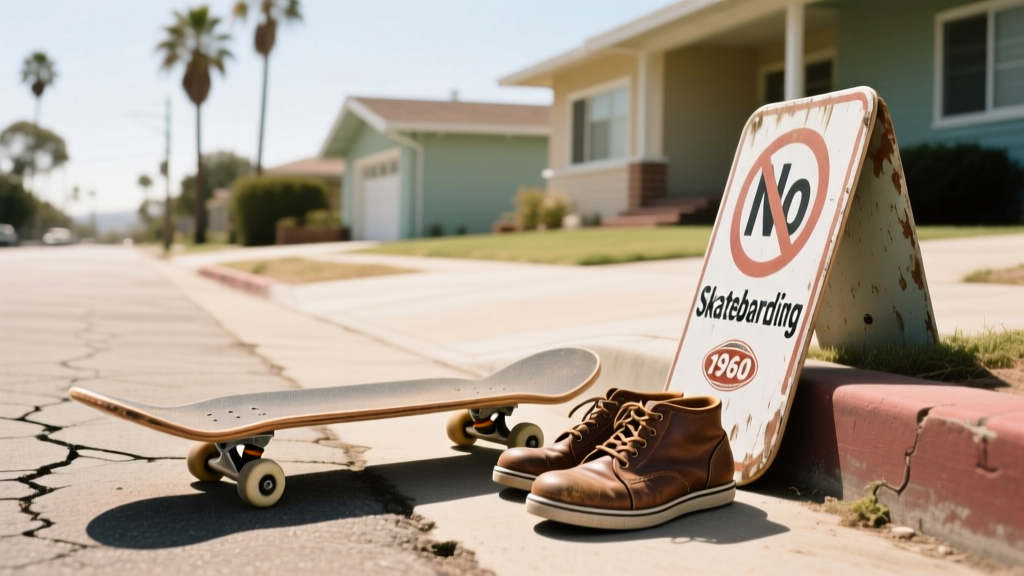
Where Did Skateboarding Originate? | History & Origins
Skateboarding originated in California, USA, during the late 1940s and early 1950s, when surfers sought a land-based alternative to riding waves, leading to the creation of 'sidewalk surfing.'
The Birth of Skateboarding: A Californian Innovation
Skateboarding emerged in Southern California as a creative offshoot of surfing culture. In the post-World War II era, young surfers wanted to practice their balance and maneuvers when ocean conditions were flat. They began attaching roller skate wheels to wooden planks, creating rudimentary boards that could mimic the motion of surfing on pavement.
This innovation gave rise to what was initially called sidewalk surfing, a term that captured the essence of carving turns on urban streets just as one would on waves. The first commercially available skateboards appeared in the 1950s, but it wasn't until the 1960s that the sport gained wider recognition.
Key Factors Behind Skateboarding's Emergence
- Surfing culture dominance in 1950s California
- Limited access to consistent ocean swells
- Availability of mass-produced roller skate components
- Youth desire for mobile, independent recreation
Evolution Through the Decades
From its humble beginnings, skateboarding evolved rapidly through distinct eras, each marked by technological advances and cultural shifts.
1960s: First Wave of Popularity
The first skateboards were sold by companies like Makaha and Hobie. Magazines such as Surfing began covering sidewalk surfing, and organized competitions started appearing. However, limited board design and safety concerns led to a decline by the end of the decade.
1970s: The Urethane Revolution
The invention of polyurethane wheels by Frank Nasworthy in 1972 transformed skateboarding. These wheels provided superior grip and smoother rides, enabling more complex maneuvers. Concurrently, tighter trucks and parabolic fiberglass boards improved control, paving the way for vertical skating in empty pools.
1980s–1990s: Street Skating Takes Over
With the rise of skaters like Tony Alva, Rodney Mullen, and later, Tony Hawk, street skating became dominant. Flip tricks, grinds, and technical flat-ground skills defined this era. Independent truck company innovations and durable maple decks supported increasingly aggressive styles.
Global Expansion and Olympic Recognition
By the 2000s, skateboarding had become a global youth movement. Events like the X Games elevated its profile, while brands like Element, Thrasher, and Supreme helped shape its identity beyond sport into lifestyle and fashion.
In 2020 (held in 2021 due to pandemic), skateboarding made its Olympic debut at the Tokyo Games, featuring park and street disciplines. This marked a historic milestone for a culture once seen as rebellious and anti-establishment.
| Decade | Key Innovation | Notable Figures | Estimated Global Skaters (Million) | Cultural Impact |
|---|---|---|---|---|
| 1950s | Wooden plank + metal wheels | Unknown pioneers | 0.1 | Niche surf derivative |
| 1960s | Commercial boards (Makaha, Hobie) | Tony Alva (early teen) | 0.5 | Media coverage begins |
| 1970s | Urethane wheels, tight trucks | Frank Nasworthy, Alan Grafton | 3 | Born in pools; Z-Boys revolution |
| 1980s | Maple ply decks, precision trucks | Rodney Mullen, Stacy Peralta | 8 | Street skating codified |
| 1990s | Lightweight composites, griptape | Tony Hawk, Mark Gonzales | 15 | Mainstream media presence |
| 2000s | Digital media, video games | Eric Koston, Nyjah Huston | 20 | X Games, global brands |
| 2010s | Social media virality | Leticia Bufoni, Shane O'Neill | 30 | Olympic inclusion announced |
| 2020s | Modular tech, eco-materials | Yuto Horigome, Rayssa Leal | 40+ | Olympic medal events |
The data shows exponential growth in participation over seven decades, with a pivotal acceleration beginning in the 1970s after urethane wheel adoption. By the 2020s, over 40 million people worldwide identify as regular skateboarders, reflecting both technological accessibility and cultural normalization.
Frequently Asked Questions About Where Skateboarding Originated
Where did skateboarding originate?
Skateboarding originated in California, USA, in the late 1940s and early 1950s, developed by surfers looking for a way to 'surf' on land during flat wave conditions.
Who invented skateboarding?
No single person invented skateboarding, but early adopters were California surfers who attached roller skate wheels to wooden boards. The first mass-produced boards came from companies like Makaha in the 1960s.
Why was skateboarding created?
Skateboarding was created as a form of 'sidewalk surfing' by surfers who wanted to maintain their balance and stoke on days when the ocean was calm. It served as both recreation and training.
How did skateboarding spread globally?
Skateboarding spread through media exposure—magazines, videos, and later the internet. The X Games, Tony Hawk’s Pro Skater game, and social media accelerated its international reach from the 1990s onward.
Is skateboarding American in origin?
Yes, skateboarding is distinctly American in origin, born out of Southern California's surf culture. Its development, terminology, and early industry were all rooted in the United States before spreading worldwide.
More Articles
 How Far Do You Swim in a Triathlon? Distances by Event
 Tennis String Tension: Power vs Control
 How Much Do CrossFit Classes Cost in 2025?
 What VLT for Ski Goggles? Optimal Range Explained
 Can Siri Start a CrossFit Workout on Apple Watch?
 Where Is the Surfing Olympics 2024? Location and Schedule
 Skiing vs Snowboarding: Which Is Easier for Beginners?
 When Was the Skateboard Invented? History & Evolution
 How Long Is NFL Training Camp? Duration & Schedule Explained
 Sports Brands vs Athletic Performance