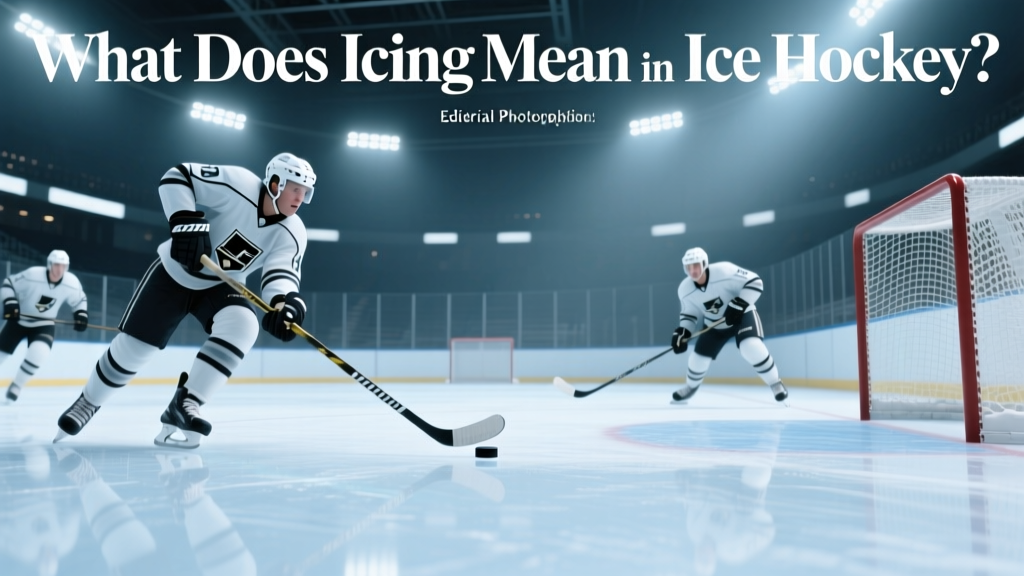
What Does Icing Mean in Ice Hockey?
In ice hockey, icing occurs when a player shoots the puck from their side of the center red line across the opponent's goal line without it being touched. This results in a stoppage of play and a faceoff in the offending team’s defensive zone, intended to prevent teams from delaying the game or gaining unfair territorial advantage.
What Is Icing in Ice Hockey?
Icing is a rule designed to maintain fair play and continuous action in ice hockey. It is called when a player deliberately shoots the puck from behind the center red line across the opposing team’s goal line, untouched by any player. The play is then stopped, and a faceoff ensues in the defending zone of the team that committed the infraction.
When Is Icing Called?
- The puck must be shot from behind the center red line.
- The puck crosses the opponent’s goal line without being touched.
- No opposing player touches the puck before it crosses the goal line.
- The puck is not part of a shorthanded situation (in some leagues, icing is permitted for the shorthanded team).
Exceptions to the Icing Rule
Not every long pass results in an icing call. Key exceptions include:
- Shorthanded play: Teams on penalty kill are allowed to ice the puck.
- Goalkeeper movement: If the goalie moves significantly to play the puck, icing may be waived off.
- Faceoff location: If the defending team has not yet gained control of the puck in their zone, icing might not be enforced.
- Immediate offensive pressure: Referees can use discretion if the attacking team had a chance to intercept.
How Icing Affects Game Strategy
Teams often use icing strategically, especially when under pressure. However, repeated icing leads to defensive zone faceoffs, increasing the risk of conceding a goal. Coaches emphasize puck control and breakout passes to avoid icing, particularly in tight games.
Impact on Player Performance
Frequent icing can indicate poor puck-handling or decision-making under pressure. Defensemen and goaltenders must communicate effectively to avoid unnecessary icings. Advanced analytics now track icing frequency as a metric for team forechecking resistance and breakout efficiency.
| Team | Games Played | Total Icing Calls (2024-25 Season) | Average Per Game | Penalty Kill Icing Allowed |
|---|---|---|---|---|
| Toronto Maple Leafs | 82 | 276 | 3.37 | 42 |
| Colorado Avalanche | 82 | 198 | 2.41 | 31 |
| Florida Panthers | 82 | 234 | 2.85 | 38 |
| Chicago Blackhawks | 82 | 312 | 3.80 | 54 |
| Carolina Hurricanes | 82 | 187 | 2.28 | 29 |
The data shows significant variation in icing frequency across NHL teams. Carolina Hurricanes demonstrate superior puck control with the lowest average, while Chicago Blackhawks struggle with territorial retention. Lower icing rates correlate with stronger breakout strategies and reduced defensive pressure.
Evolution of the Icing Rule
The icing rule was introduced in the 1930s to discourage stalling. Over time, modifications like hybrid icing (2013) improved player safety by reducing high-speed races for the puck. Today, video review ensures accurate calls, minimizing human error during fast-paced gameplay.
Common Questions About Icing in Ice Hockey
Why is icing illegal in hockey?
Icing is prohibited to prevent teams from delaying the game or avoiding pressure by dumping the puck down the ice. It promotes continuous play and rewards skillful puck control over defensive stalling tactics.
Can you ice the puck during a power play?
No, the team on the power play cannot legally ice the puck. If they do, the play is stopped, and a faceoff occurs in their defensive zone. However, the shorthanded team is allowed to ice the puck without penalty.
What is hybrid icing?
Hybrid icing uses video technology and referee judgment to determine which player would have reached the puck first during an icing race. This rule reduces dangerous collisions and improves consistency in calling icing infractions.
Does icing result in a penalty?
No, icing does not result in a minor penalty. However, if a team commits a second icing during the same penalty kill, they receive a bench minor penalty for delay of game.
How do referees signal icing?
Referees extend one arm horizontally across the body, mimicking the path of the puck. Linesmen make the initial call, and the back referee confirms based on positioning and exceptions like goalie movement.
In summary, icing is a fundamental rule in ice hockey that balances competitive fairness and game flow. Understanding its mechanics, exceptions, and strategic implications helps fans appreciate the sport’s nuances and players’ decision-making under pressure.
More Articles
 Pre-Competition Checklist: Final Tips
 Best Running Shoes for Marathon Training: Cushion, Support, and Durability Guide
 When Does MotoGP Start in 2025? Full Schedule & Key Dates
 How High Can a Human Jump? Record & Average Heights
 Cheap vs Premium Sports Gear: Worth It?
 Equipment Selection for Professionals
 Best Tennis Rackets for Beginners 2026: Complete Buying Guide with Expert Reviews
 How Thick Is Ice Hockey Ice? NHL Standards Explained
 Most Valuable Sports Franchises in 2026: Rankings and Revenue Breakdown
 Long Jump Drills: 8 Exercises to Add Distance (2026)