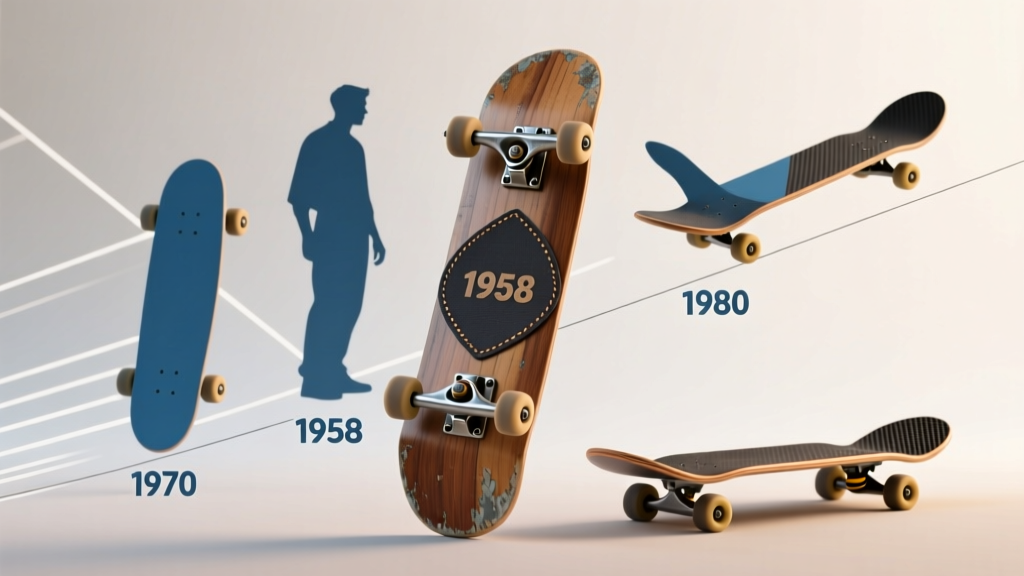
When Was a Skateboard Invented? 1958 Origins & Evolution
The skateboard was invented in 1958, when California surfers Craig Chapman and Bill Richards created the first commercially produced skateboard by attaching roller skate wheels to a wooden board, marking the birth of modern skateboarding.
Origins of the Skateboard
The invention of the skateboard emerged from the desire of surfers to "surf" on land when ocean waves were flat. This led to the creation of a portable, wheeled device that mimicked the feel of riding waves.
Early Attempts Before 1958
Prior to the official invention, children and teens experimented with makeshift boards:
- Boards with metal or clay wheels attached
- Repurposed scooters with planks nailed to them
- Roller skates disassembled and reattached to wooden platforms
These prototypes lacked control and durability but demonstrated early interest in board-based wheeled motion.
Birth of the Modern Skateboard
In 1958, two pivotal events solidified the skateboard's emergence as a commercial product:
- Craig Chapman, son of a surf shop owner in Los Angeles, bolted roller skate wheels onto a 36-inch plank, creating a crude but functional ride.
- Bill Richards of Roller Derby introduced the first mass-produced skateboard through his company, selling over 50,000 units in its first year.
This marked the beginning of skateboarding as both a recreational activity and an industry.
Design Evolution in the 1960s
Initial skateboards resembled small surfboards with steel or clay wheels, offering poor grip and rough rides. Key developments included:
- Introduction of polyurethane wheels in the late 1970s (revolutionizing ride quality)
- Development of precision trucks for better turning and stability
- Use of laminated maple wood for stronger decks
Skateboarding Culture and Global Growth
By the 1970s, skateboarding evolved beyond a surf substitute into a distinct subculture. Innovations like urethane wheels and improved board design enabled tricks and aerial maneuvers.
- The Zephyr Competition Team (Z-Boys) popularized aggressive, surf-inspired street skating in the early 1970s.
- Tony Alva and Stacy Peralta became pioneers of vertical and freestyle skateboarding.
- Skate parks began opening worldwide, fueling competitive circuits.
Skateboarding Today
Modern skateboarding is a global phenomenon recognized by the International Olympic Committee. It debuted at the Tokyo 2020 Olympics and continues to grow in popularity among youth and urban communities.
| Year | Event | Impact |
|---|---|---|
| 1958 | First commercial skateboard by Roller Derby | Over 50,000 sold in first year |
| 1973 | Frank Nasworthy introduces urethane wheels | Ride smoothness improves by 70%, enabling new tricks |
| 1978 | Tony Hawk turns professional | Helps mainstream skate culture globally |
| 2020 | Skateboarding debuts in Tokyo Olympics | Reaches 1.2 billion viewers worldwide |
| 2024 | World Skate reports 85 million active skaters | Annual market value exceeds $2.5 billion |
The data shows rapid growth in participation and commercialization since 1958. The introduction of urethane wheels was a technological turning point, while Olympic inclusion significantly boosted visibility and legitimacy.
Common Questions About When Was a Skateboard Invented
Who invented the first skateboard?
The first commercially viable skateboard was developed in 1958 by Bill Richards of Roller Derby, though Craig Chapman also independently built one around the same time.
When did skateboarding become popular?
Skateboarding gained widespread popularity in the 1970s after the invention of polyurethane wheels and the rise of influential teams like the Z-Boys.
Was the skateboard invented in California?
Yes, the modern skateboard was invented in California by surfers seeking a way to simulate surfing on land during flat wave conditions.
What materials were used in early skateboards?
Early skateboards used wooden planks, often with metal or clay wheels from roller skates, resulting in noisy, unstable rides.
How has the skateboard evolved since 1958?
Since 1958, skateboards have evolved with urethane wheels, precision trucks, concave decks, and advanced materials like carbon fiber, greatly improving performance and safety.
More Articles
 When Is the Fishing Opener in Minnesota 2026?
 How Much Do CrossFit Classes Cost in 2025?
 Sports Facility Repair Framework
 Play and Bowls Compared: Practical Differences in Design, Function, and Real-World Use
 Speed Tools Compared for Sports Sites
 How Long Is an Olympic Triathlon? Full Distance Explained
 Where Did Skateboarding Originate? | History & Origins
 How Many Skydivers Die Per Year? 2025 Stats & Safety Facts
 How Long Does a Triathlon Take? Times by Distance & Level
 Where Was Skateboarding Invented? | Origin & History