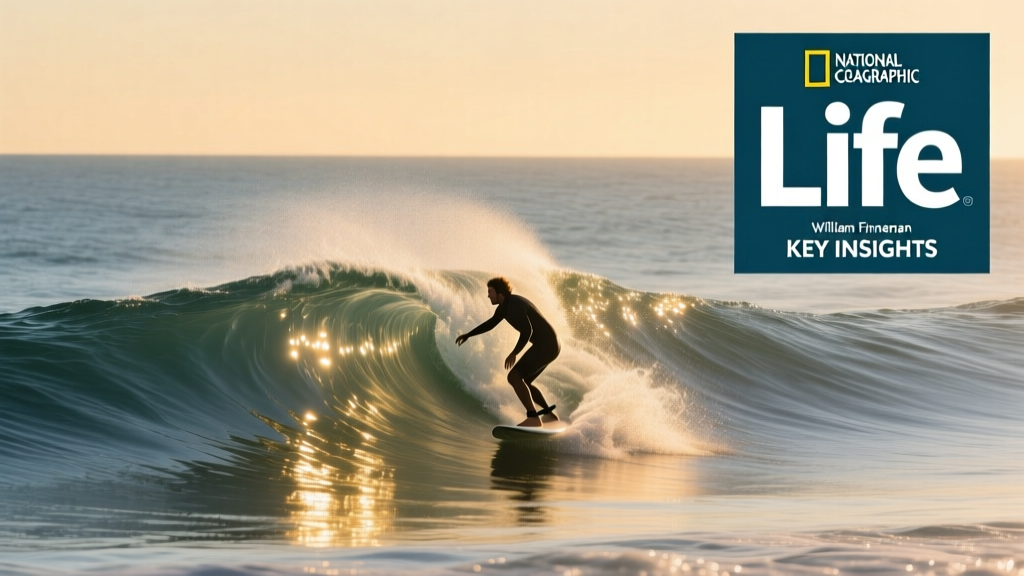
A Surfing Life by William Finnegan: Key Insights
A Surfing Life by William Finnegan is a Pulitzer Prize-winning memoir that masterfully blends personal narrative, global travel, and deep cultural insight through the lens of surfing. Published in 2015, the book chronicles Finnegan’s lifelong passion for waves, from his childhood in California to dangerous swells in South Africa, Indonesia, and beyond. It stands as one of the most critically acclaimed sports memoirs of the 21st century.
The Story Behind ‘Barbarian Days’: A Literary Triumph in Surfing
In Barbarian Days: A Surfing Life, William Finnegan doesn’t just write about riding waves—he uses surfing as a prism to explore identity, risk, beauty, and transformation. The memoir, which won the 2016 Pulitzer Prize for Biography or Autobiography, transcends the sport to become a profound meditation on what it means to pursue a passion across decades.
Why ‘Barbarian Days’ Resonates Beyond the Surf Community
- Blends lyrical prose with raw honesty about aging and ambition
- Offers vivid depictions of surf culture across continents
- Explores geopolitical contexts where Finnegan surfs, including apartheid-era South Africa
- Reveals the physical and psychological demands of big-wave surfing
- Documents the evolution of surf gear, from wooden boards to high-performance shortboards
William Finnegan: From Surfer to Pulitzer Winner
A staff writer at The New Yorker since 1987, Finnegan brought journalistic rigor to his memoir. His career in long-form journalism informed the depth and precision of Barbarian Days. Unlike typical sports autobiographies, this work reads like literary nonfiction, earning praise from authors like David Foster Wallace and Michiko Kakutani of The New York Times.
Key Themes in Finnegan’s Memoir
- Obsession and Mastery: The pursuit of the perfect wave as a metaphor for life’s elusive goals
- Cultural Immersion: How surfing opened doors to remote communities and political realities
- Mortality and Aging: Returning to challenging breaks in midlife and confronting physical limits
- Authenticity vs. Commercialization: Critiquing the corporatization of surf culture
Global Surf Destinations in ‘A Surfing Life’
Finnegan’s journey spans the globe, each location offering more than just waves—they serve as backdrops for personal growth and social observation.
| Location | Significance in Book | Notable Wave Type | Time Period | Cultural/Political Context |
|---|---|---|---|---|
| San Francisco, CA | Early teenage introduction to cold-water surfing | Beach breaks, inconsistent swell | 1960s | Counterculture emergence |
| Honolulu, HI | Refinement of skills; exposure to elite surf culture | Reef breaks (e.g., Waikiki) | 1970s | Tourism-driven development |
| Durban, South Africa | Teaching job during apartheid; dangerous waves and racial tension | Powerful point breaks | 1980s | Apartheid regime, political unrest |
| Fiji | Discovery of pristine, uncrowded reefs | Heavy reef breaks (e.g., Cloudbreak) | 1990s | Early eco-tourism, indigenous relations |
| Indonesia (Mentawai Islands) | Quest for perfect, isolated waves | World-class left-handers | 2000s | Rapid commercialization, local displacement |
The table illustrates how Finnegan’s surf travels are interwoven with historical and cultural shifts. His time in South Africa during apartheid adds moral complexity, while later trips to Indonesia highlight the environmental and ethical costs of surf tourism. These layers elevate the memoir beyond mere adventure writing.
Surfing Technique and Philosophy in Finnegan’s Writing
Finnegan doesn’t merely describe waves—he dissects them. He writes with technical precision about paddle timing, drop angles, and board design, yet always ties these details to emotional states.
What Makes Finnegan’s Surf Writing Unique?
- Combines sensory detail with introspection
- Rejects machismo often found in surf literature
- Focuses on fear, failure, and humility as much as triumph
- Presents surfing as a lifelong learning process, not a youthful escapade
Critical Reception and Legacy of ‘A Surfing Life’
Upon release, Barbarian Days received near-universal acclaim. It was named one of the best books of 2015 by The New York Times, Time, and The Guardian. Its Pulitzer win marked a rare honor for a book centered on sport.
- Named one of Time magazine’s 100 best nonfiction books since 1923
- Translated into over 15 languages
- Adapted into a documentary film in development (as of 2024)
- Influenced a new generation of literary sports writing
Frequently Asked Questions About 'A Surfing Life' by William Finnegan
What is ‘A Surfing Life’ by William Finnegan about?
A Surfing Life, officially titled Barbarian Days: A Surfing Life, is a memoir chronicling William Finnegan’s lifelong relationship with surfing. It details his experiences across the world’s oceans, blending personal growth, cultural commentary, and poetic descriptions of wave-riding into a critically acclaimed narrative.
Did ‘Barbarian Days’ win any awards?
Yes, Barbarian Days won the 2016 Pulitzer Prize for Biography or Autobiography. It was also a finalist for the National Book Critics Circle Award and named a top book of the year by numerous publications including The New York Times, Time, and The Guardian.
Is ‘Barbarian Days’ only for surfers?
No, while surfers may appreciate the technical details, the book’s themes of passion, identity, aging, and self-discovery make it accessible and compelling to general readers. Its literary quality has earned praise from critics outside the sports world.
Where does William Finnegan surf in the book?
Finnegan surfs in locations including California, Hawaii, Fiji, French Polynesia, Australia, South Africa, and Indonesia. Each destination serves as both a physical and emotional milestone in his journey, often reflecting broader social or political conditions.
Why is ‘Barbarian Days’ considered a classic?
The book is regarded as a classic due to its exceptional prose, emotional depth, and intellectual richness. It transcends the genre of sports memoir by weaving personal narrative with global insight, making it a landmark in contemporary nonfiction writing.
More Articles
 Swimming Breathing Techniques for Freestyle: Beginner Guide to Bilateral Breathing
 How Long Is a Triathlon in Miles?
 How Far Do You Swim in a Triathlon? Distances by Event
 Should I Ski or Snowboard? Find Your Best Fit
 Sports Nutrition for Athletes: A Beginner Guide to Fueling Performance and Recovery
 Seasonal Wardrobe Alignment for Athletes
 How High Is Skydiving? Typical Jump Altitudes Explained
 Why Olympic Surfing Is in Tahiti for 2024
 Bike Saddle Height: The 109% Rule
 Break In Running Shoes Without Blisters