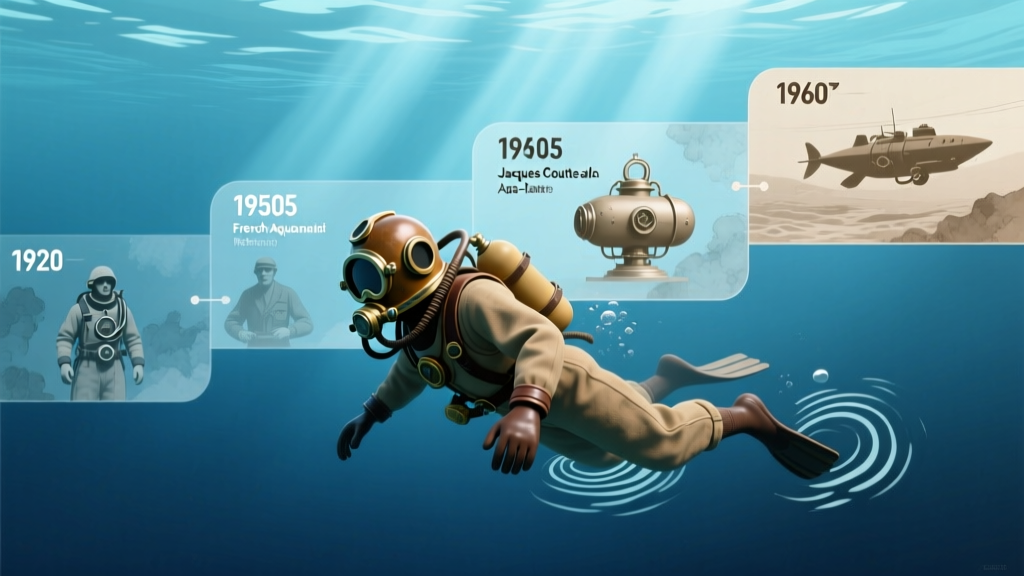
When Was Scuba Diving Invented? Key Facts & History
Scuba diving was invented in 1943 when Jacques-Yves Cousteau and Émile Gagnan developed the first successful open-circuit self-contained underwater breathing apparatus, known as the Aqua-Lung. This invention revolutionized underwater exploration and laid the foundation for modern recreational and technical diving.
The Origins of Scuba Diving
The concept of breathing underwater dates back centuries, but it wasn't until the 20th century that a practical and reliable scuba system emerged. Early attempts involved cumbersome helmets and air pumps, limiting mobility and depth. The real breakthrough came during World War II, when French naval officer Jacques-Yves Cousteau and engineer Émile Gagnan collaborated to create a demand regulator that delivered air only when the diver inhaled, making underwater breathing efficient and safe.
Key Milestones in Scuba Development
- 1878: Henry Fleuss develops an early rebreather using compressed oxygen.
- 1916: Christian J. Lambertsen patents the first SCUBA unit (Self-Contained Underwater Breathing Apparatus).
- 1943: Cousteau and Gagnan debut the Aqua-Lung in Marseille, France.
- 1956: First edition of Skin Diver Magazine launches, popularizing recreational diving.
- 1960s: Advancements in buoyancy compensators (BCDs) and dive computers improve safety.
How the Aqua-Lung Changed Diving Forever
The Aqua-Lung was revolutionary because it allowed divers to move freely without being tethered to a surface air supply. Unlike previous systems, it used compressed air from a tank and a regulator to deliver breathable air on demand. This innovation made deep, prolonged dives possible and opened marine exploration to scientists, military personnel, and eventually, recreational enthusiasts.
Components of the Original Aqua-Lung
- High-pressure air cylinder (typically 200 bar)
- Dual-hose regulator system
- Full-face mask or mouthpiece
- Weight belt for buoyancy control
Evolution of Modern Scuba Equipment
Since 1943, scuba gear has undergone significant improvements in safety, comfort, and functionality. Today’s regulators are single-hose designs, more efficient and less prone to freezing. Buoyancy compensator devices (BCDs), dive computers, and wetsuits have enhanced diver control and extended bottom times.
| Year | Invention | Inventor(s) | Impact |
|---|---|---|---|
| 1878 | Fleuss Rebreather | Henry Fleuss | First practical closed-circuit system; used in salvage operations |
| 1943 | Aqua-Lung | Cousteau & Gagnan | First successful open-circuit scuba; foundation of modern diving |
| 1952 | Single-Hose Regulator | Edward Lanphier | Improved airflow and comfort; became industry standard |
| 1968 | First Dive Computer | Oceanautes Inc. | Reduced decompression sickness risk through real-time monitoring |
| 1980s | Modern BCD | Multiple manufacturers | Enhanced buoyancy control and equipment integration |
The table highlights key technological leaps in scuba diving history. The 1943 Aqua-Lung remains the most pivotal invention, directly enabling all subsequent advancements. Later innovations like dive computers and BCDs built upon this foundation to make diving safer and more accessible worldwide.
Global Impact and Popularity of Scuba Diving
From its military and scientific roots, scuba diving evolved into a global recreational activity. Organizations like PADI (Professional Association of Diving Instructors), founded in 1966, standardized training and certification, contributing to over 6 million certified divers by 2025. Popular destinations include the Great Barrier Reef, Red Sea, and Caribbean islands.
Frequently Asked Questions About Scuba Diving Invention
Who invented scuba diving?
While early concepts existed, Jacques-Yves Cousteau and Émile Gagnan are credited with inventing the first practical scuba system in 1943—the Aqua-Lung—which marked the birth of modern scuba diving.
When was the Aqua-Lung created?
The Aqua-Lung was developed and first tested in 1943 by Jacques-Yves Cousteau and Émile Gagnan in France. It became commercially available in 1946.
What does SCUBA stand for?
SCUBA stands for Self-Contained Underwater Breathing Apparatus. The term was coined by U.S. Navy frogmen in the 1950s to describe portable diving systems.
Was scuba diving used in World War II?
Yes, rudimentary scuba gear based on rebreathers was used by military divers for covert operations during WWII. The Italian navy's frogmen and British clearance divers employed early closed-circuit systems before the Aqua-Lung's invention.
How has scuba diving technology evolved since 1943?
Since 1943, scuba technology has advanced with single-hose regulators, buoyancy compensators, dive computers, nitrox compatibility, and drysuit insulation. These improvements have increased safety, dive duration, and accessibility for non-professionals.
More Articles
 Golf Ball Compression: Match Ball to Swing Speed
 How Many Players on an Ice Hockey Team? Full Breakdown
 How Fast Can a Human Swim? Top Speeds Revealed
 Volleyball Gear: Performance and Durability
 How Long Are Ice Hockey Games? Full Breakdown
 What Time Is the NASCAR Race Today? 2025 Schedule & TV Info
 Home Workout Plan for Runners (No Gear)
 How Deep Is Water for Water Polo? Official Depth Explained
 Who Invented Ice Hockey? The True Origin Story
 How Much Does a Jet Ski Weigh? Full Breakdown by Model