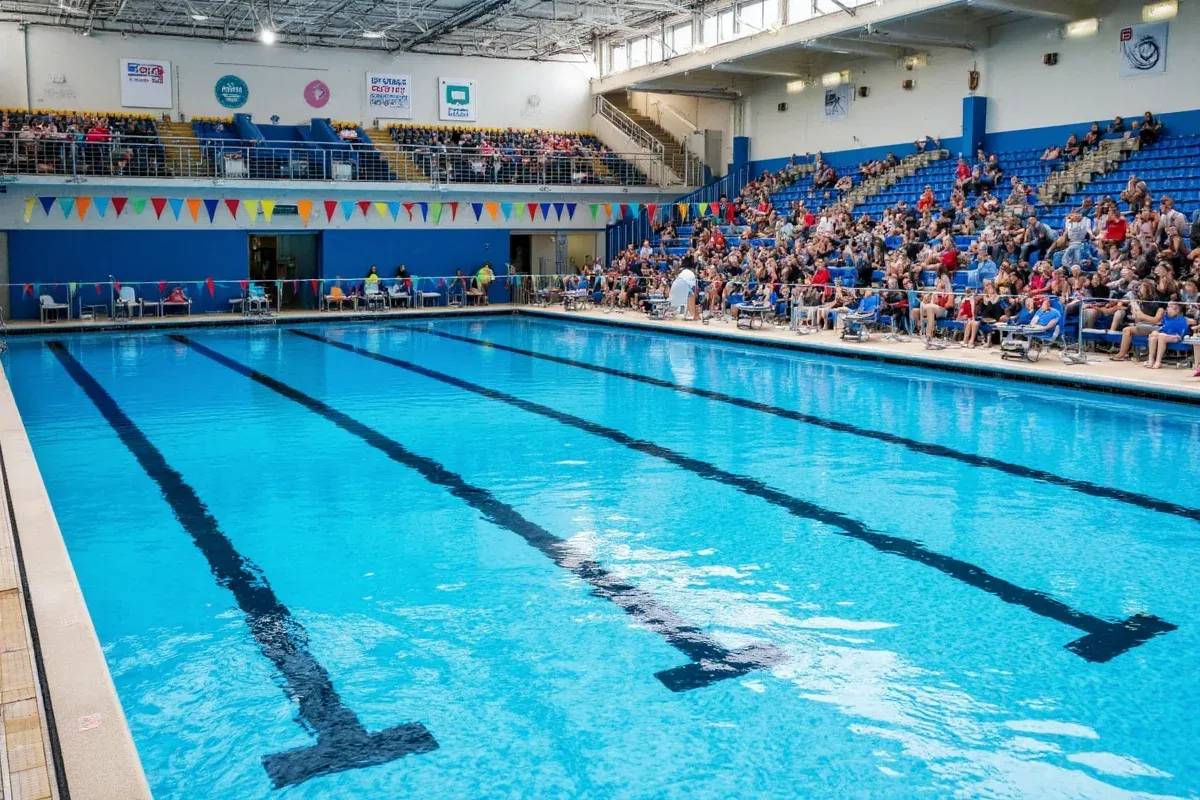
Olympic Swimming Pool Dimensions Explained
Olympic swimming pools are standardized at 50 meters in length, 25 meters in width, and a minimum depth of 2 meters, creating a total volume of approximately 2.5 million liters. These dimensions ensure fair competition across international events regulated by World Aquatics (formerly FINA).
Standard Dimensions of Olympic Swimming Pools
The size of an Olympic swimming pool is strictly defined to maintain consistency in global competitions. These pools are used during the Summer Olympics and other elite-level events such as the World Aquatics Championships.
Key Measurement Specifications
- Length: 50 meters (164 feet)
- Width: 25 meters (82 feet)
- Depth: Minimum 2 meters (6.6 feet), recommended 3 meters for diving events
- Lane count: 10 lanes (8 competition lanes + 1 buffer lane on each side)
- Lane width: 2.5 meters (8.2 feet) each
- Water temperature: Maintained between 25°C and 28°C (77–82°F)
Purpose of Standardization
Uniform pool dimensions are critical for several reasons:
- Ensuring fairness in competition times and records
- Allowing accurate comparison of athlete performance across different venues
- Supporting synchronized training environments for elite swimmers
- Meeting World Aquatics certification requirements
Differences Between Olympic and Other Pool Types
Not all competitive pools are Olympic-sized. Understanding the distinctions helps clarify usage contexts.
| Poll Type | Length | Width | Lanes | Common Use |
|---|---|---|---|---|
| Olympic (Long Course) | 50 m | 25 m | 10 | Summer Olympics, World Championships |
| Short Course (Indoor) | 25 m | Variable | 6–8 | National competitions, school meets |
| US High School/College | 25 yards (~22.9 m) | Variable | 6–10 | Scholastic swimming in the USA |
| Training Pool | Varies | Varies | 4–8 | Recreational and developmental programs |
The data shows that only long course pools meet full Olympic specifications. Short course pools (25m) are often used during winter seasons but require separate record keeping due to reduced turn frequency affecting speed. The United States frequently uses 25-yard pools, which are shorter than both metric standards, further complicating time comparisons.
Volume and Water Management
An Olympic-sized pool holds roughly 2.5 million liters (about 660,000 gallons) of water. This large volume requires advanced filtration, chemical balancing, and heating systems to maintain optimal conditions.
- Filtration cycles typically turnover the entire volume every 6 hours
- Chlorine levels are kept between 1.0 and 3.0 ppm
- pH is maintained near neutral (7.2–7.8)
- Automated monitoring systems track water quality in real-time
Design Features Enhancing Performance
Beyond size, modern Olympic pools incorporate engineering innovations to support peak athletic performance.
Wave Reduction Systems
- Gutters on all sides absorb wave energy
- Lane ropes with specialized designs minimize turbulence
- Overflow channels prevent surface ripple buildup
Starting Blocks and Touch Pads
- Adjustable starting platforms with rear footrests
- Pressure-sensitive touch pads for precise timing
- Underwater cameras verify false starts and turns
Common Questions About Olympic Swimming Pools
How big is an Olympic swimming pool in feet?
An Olympic swimming pool measures 164 feet long, 82 feet wide, and at least 6.6 feet deep. This equals approximately 50 meters by 25 meters by 2 meters in metric units.
How many laps in an Olympic pool make a mile?
In a 50-meter Olympic pool, one mile (1,609 meters) equals about 32.2 lengths or 16.1 laps (where one lap is down and back). Competitive swimmers often refer to 1,500 meters as "the mile" in events.
Are all Olympic pools the same depth?
While the minimum depth is 2 meters, most Olympic pools are deeper—typically around 3 meters—to reduce waves and improve swimmer performance. Deeper water minimizes turbulence from strokes and turns.
Can public pools be Olympic-sized?
Some public aquatic centers do feature Olympic-sized pools, though they are expensive to build and maintain. More commonly, public facilities use smaller configurations for recreation and learn-to-swim programs.
Why are Olympic pools 50 meters long?
The 50-meter length has been standard since the early 20th century to align with metric-based international competition rules. It allows consistent event distances and record validation under World Aquatics regulations.
More Articles
 Which Florida Springs Can I Swim In? Top 6 Spots
 Long Jump Technique Breakdown: Approach, Takeoff, Flight & Landing (2026)
 When Was Scuba Diving Invented? Key Facts & History
 Where Was Ice Hockey Invented? The True Origin
 Can Sprints Build Muscle? Science-Backed Answer
 Volleyball Gear: Performance and Durability
 Best Running Shoes for Flat Feet (2026)
 How Long Should I Jump Rope? Expert Guidelines
 Tennis Racket String Tension Guide
 What Does Goal Oriented Mean? Definition & Examples