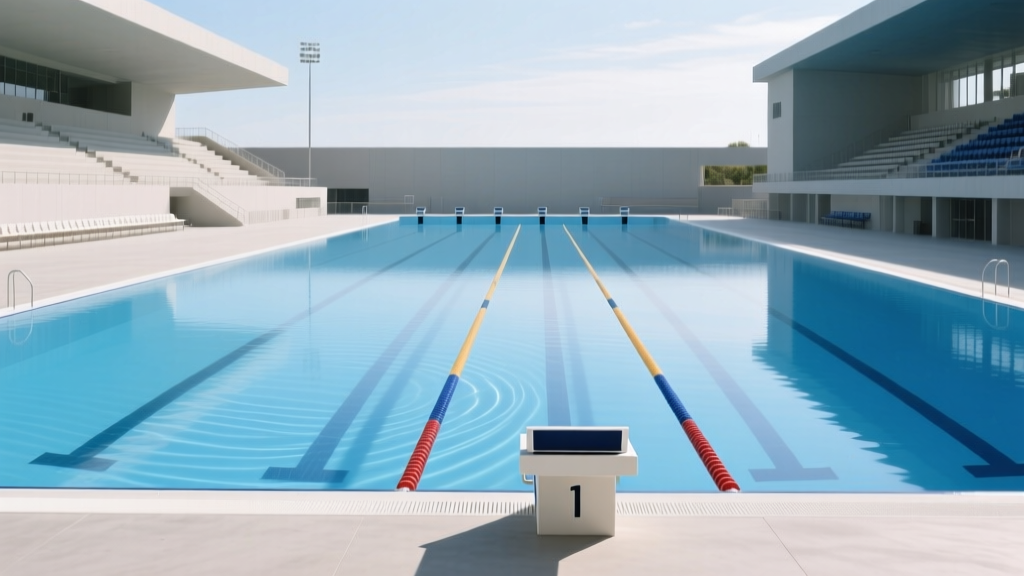
How Much Water Is in an Olympic-Sized Swimming Pool?
An Olympic-sized swimming pool contains exactly 2,500,000 liters (660,430 gallons) of water. This standard volume is based on a pool measuring 50 meters in length, 25 meters in width, and a minimum depth of 2 meters, as defined by the International Swimming Federation (FINA). The precise dimensions ensure consistency across international competitions, including the Olympic Games.
Understanding Olympic-Sized Pool Dimensions
The size of an Olympic swimming pool is strictly regulated to maintain fairness and uniformity in competitive swimming. These pools are used not only during the Olympics but also in World Championships and other elite-level events sanctioned by FINA.
Standard Measurements
- Length: 50 meters (164 feet)
- Width: 25 meters (82 feet) \li>
- Depth: Minimum 2 meters (6.6 feet), though many modern pools are 3 meters deep
- Lanes: 10 lanes total, with 8 used for competition and 1 meter of space on each side
- Water Temperature: Maintained between 25–28°C (77–82°F)
Calculating the Total Water Volume
The total water capacity of an Olympic pool is derived from its three-dimensional measurements. Using the formula for volume — length × width × depth — we can calculate the exact amount of water required to fill it.
Volume Calculation Example
For a standard 50m × 25m × 2m pool:
50 m × 25 m × 2 m = 2,500 cubic meters
Since 1 cubic meter equals 1,000 liters:
2,500 m³ × 1,000 = 2,500,000 liters
This is equivalent to:
- 660,430 US gallons
- 549,923 imperial gallons
- Approximately 1 million bottles of 2.5-liter soda
Detailed Water Capacity Comparison Table
| Pool Type | Length (m) | Width (m) | Depth (m) | Volume (Liters) | Volume (US Gallons) |
|---|---|---|---|---|---|
| Olympic Standard (FINA) | 50 | 25 | 2.0 | 2,500,000 | 660,430 |
| Olympic Training Pool | 50 | 21 | 2.0 | 2,100,000 | 554,761 |
| Short Course (25m) | 25 | 25 | 2.0 | 1,250,000 | 330,215 |
| High School Competitive | 25 | 12 | 1.8 | 540,000 | 142,674 |
| Recreational Public Pool | 25 | 10 | 1.5 | 375,000 | 99,065 |
The data shows that Olympic-sized pools hold more than double the volume of short-course competition pools. Depth and lane width significantly impact total water volume, even when length remains constant. Modern Olympic venues often use deeper pools (up to 3 meters) to reduce wave turbulence, which can increase total volume to 3,750,000 liters.
Frequently Asked Questions About Olympic-Sized Pools
How much does it cost to fill an Olympic-sized swimming pool?
The cost varies by location and local water rates. In the U.S., average water costs range from $0.002 to $0.005 per gallon. Filling a 660,430-gallon Olympic pool would cost approximately $1,320 to $3,300. Maintenance, filtration, heating, and chemical treatment add significantly to long-term expenses.
How many lanes are in an Olympic swimming pool?
An Olympic swimming pool has 10 lanes, each 2.5 meters wide. However, only 8 lanes are used during competition to minimize wave interference from swimmers near the edges. The outer lanes act as buffers to improve water stability.
What is the water temperature in an Olympic pool?
FINA regulations require Olympic pool water temperatures to be maintained between 25°C and 28°C (77°F to 82°F). This range ensures athlete comfort, prevents overheating, and optimizes performance while reducing the risk of muscle cramps.
How deep is an Olympic swimming pool?
The minimum depth for an Olympic pool is 2 meters (6.6 feet), but many modern facilities build pools up to 3 meters (9.8 feet) deep. Greater depth reduces surface turbulence and wave reflection, improving swimmer speed and safety.
How long does it take to fill an Olympic-sized pool?
Using a standard municipal water supply (flow rate ~50 gallons per minute), filling a 660,430-gallon Olympic pool takes approximately 9 days of continuous flow. High-flow systems at major venues can reduce this time significantly using industrial pumps and multiple inlets.
More Articles
 Soccer Positions Explained: All 11 Roles, Formations & Responsibilities (2026)
 Why Do Swimmers Wear Swim Caps? Key Reasons Explained
 World Rules Essentials: The Foundational Standards That Shape Global Trade, Safety, and Digital Infrastructure
 How Fast Do Olympic Swimmers Swim? Speeds Revealed
 How Much Does It Cost to Maintain a Swimming Pool?
 How Fast Do Race Walkers Walk? Elite Speeds Revealed
 Long Jump World Record History: From 1864 to Mike Powell's 8.95m (2026)
 Where Was Ice Hockey Invented? The True Origin
 Bungee Jumping Safety Checklist: 12 Must-Verify Items (2026)
 Why Fighting Is Allowed in Ice Hockey Explained