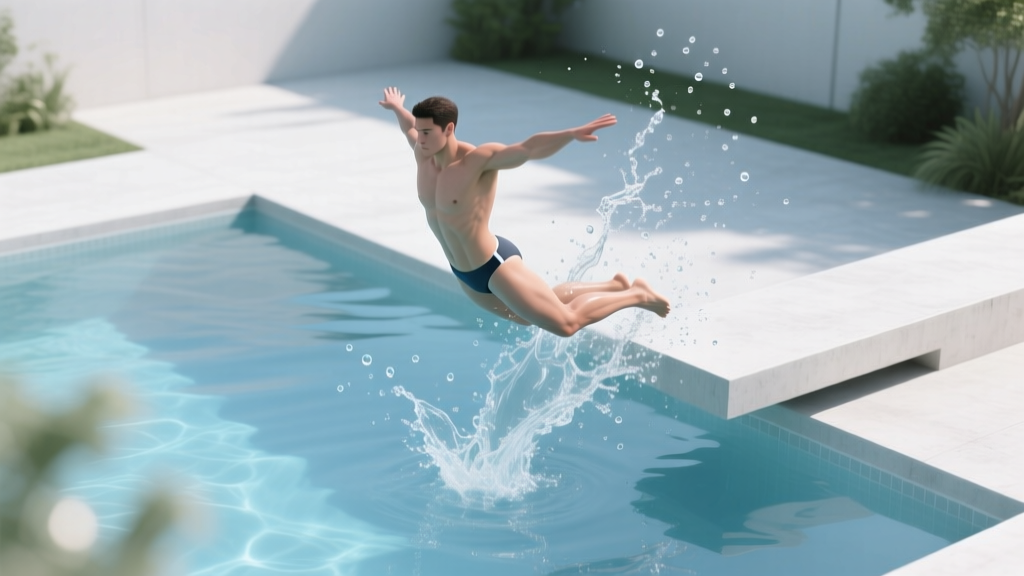
How High Can You Jump Into Water Safely?
Most trained athletes and experienced jumpers can safely jump into water from heights of up to 20 meters (65 feet), while world-class cliff divers regularly leap from 27 meters (89 feet) with proper technique and water conditions.
Understanding Safe Jumping Heights into Water
The maximum height from which a person can jump into water depends on skill level, entry technique, water depth, and environmental conditions. While recreational jumpers should limit jumps to under 10 meters (33 feet), elite divers train to handle drops exceeding 25 meters.
Factors That Influence Safe Jump Heights
Jumping from extreme heights introduces serious risks. Several key variables determine whether a jump is safe:
- Water Depth: Minimum depth should be at least 4.5 meters (15 feet) for 10-meter jumps, increasing proportionally with height.
- Entry Technique: Feet-first or streamlined dive entries reduce impact force significantly compared to flat entries.
- Surface Conditions: Calm, clear water without hidden obstacles is essential for safety.
- Physical Conditioning: Strong core and leg muscles help absorb impact and maintain control during descent.
- Training and Experience: Professional instruction drastically reduces injury risk.
World Records and Professional Standards
Cliff diving has become a regulated sport governed by the Red Bull Cliff Diving World Series and FINA. These organizations set safety standards and showcase human limits in aerial-to-water transitions.
Record-Breaking Jumps
Laso Schaller holds the official world record for the highest dive into water, jumping from 58.8 meters (192.9 feet) in 2015—a feat performed under strict safety protocols and deep-water conditions.
| Jumper | Height (m) | Height (ft) | Year | Location |
|---|---|---|---|---|
| Laso Schaller | 58.8 | 192.9 | 2015 | Maggiore Lake, Switzerland |
| Levente Győri | 38.8 | 127.3 | 2023 | Danube River, Hungary |
| Gary Hunt | 27.5 | 90.2 | 2022 | Red Bull Cliff Diving, UK |
| Rellie Kaputin | 25.0 | 82.0 | 2021 | Papua New Guinea National Team |
| Average Recreational Jump | 5–10 | 16–33 | N/A | Global Estimate |
The data shows a stark contrast between professional and recreational jump heights. Even among professionals, only a few attempt jumps above 35 meters, requiring specialized training and emergency support. The majority of competitive dives remain under 30 meters to balance spectacle and safety.
Techniques for Minimizing Impact
Proper body positioning is critical when entering water at high velocity. At 27 meters, a diver hits the water at approximately 85 km/h (53 mph).
- Feet-First Entry: Used for survival jumps; legs together, toes pointed, arms overhead.
- Head-First Streamline: Common in cliff diving; arms locked, body tight, minimal surface area.
- Controlled Rotation: Allows divers to adjust position mid-air for optimal entry angle.
Improper form—even at 10 meters—can result in severe bruising, spinal injuries, or loss of consciousness due to sudden deceleration.
Safety Guidelines for High Dives
To prevent injury, follow these expert-recommended rules:
- Never jump into unknown or shallow water.
- Ensure at least 4.5 meters (15 ft) of depth per 10 meters of height.
- Use spotters and rescue personnel for jumps over 15 meters.
- Avoid alcohol or drugs before attempting any high jump.
- Train under supervision before progressing beyond 5 meters.
Frequently Asked Questions About Jumping Into Water From Height
How high can you jump into water without getting injured?
With proper technique, most people can safely jump from 10 meters (33 feet) into sufficiently deep water. Untrained individuals should not exceed 5 meters (16 feet) to avoid injury risks such as spinal compression or concussions.
What is the highest recorded dive into water?
The highest recorded dive into water was performed by Laso Schaller from 58.8 meters (192.9 feet) in 2015. This jump required extensive preparation, precise entry technique, and over 10 meters of water depth for safety.
Does water feel like concrete when you fall from a height?
Yes, at speeds achieved from falls above 15 meters, water offers little immediate give and can feel similar to hitting concrete if the body surface area is large (e.g., belly flop). Proper streamlined entries are essential to displace water and reduce impact force.
How deep does water need to be for a 20-meter jump?
For a 20-meter jump, a minimum depth of 6 meters (20 feet) is recommended. Additional depth may be needed depending on entry speed and angle. Turbulent or aerated water can also increase safe penetration distance.
Can you survive a jump from 100 meters into water?
Survival from a 100-meter jump is extremely unlikely. Terminal velocity is reached around 50 meters, and even perfect entry would generate forces far beyond what the human body can withstand, likely causing fatal internal trauma.
More Articles
 How Much Do F1 Drivers Earn in 2025?
 When Was Ice Hockey Invented? Origins & History
 How Long Is a Professional Ice Hockey Game?
 How Many Yards in a Mile Swim? Exact Conversion
 Olympic Shot Put Weight: Men's and Women's Standards
 Gear Buying Guide: How to Choose the Right Fit
 Olympic Diving Pool Depth: How Deep Is It?
 History of the Olympic Games: From Ancient Greece to Modern Era
 How Thick Is Hockey Ice? NHL Standard Revealed
 When Do Rockefeller Ice Skating Tickets Go on Sale?