How High Are Hurdles in the Olympics? By Event & Gender
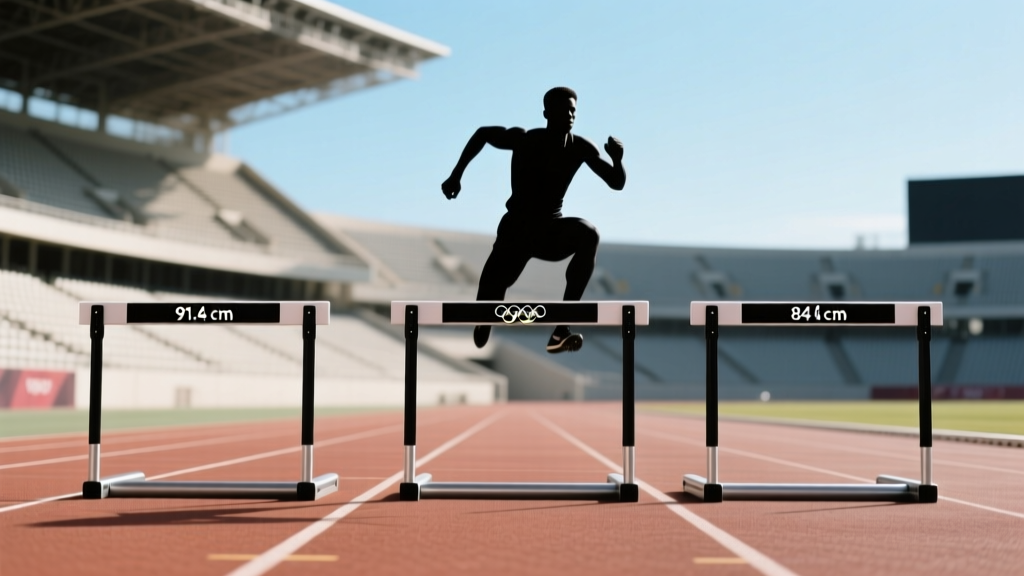
The height of hurdles in Olympic track and field events varies by gender and race distance. For men, the 110-meter hurdles use 1.067 meters (42 inches) tall hurdles, while the 400-meter hurdles feature 91.4 cm (36 inches) hurdles. Women compete in the 100-meter hurdles at a height of 83.8 cm (33 inches) and the 400-meter hurdles at 76.2 cm (30 inches).
Olympic Hurdle Heights by Event
Hurdling is a precision sport requiring speed, rhythm, and technique. The standard hurdle heights are strictly regulated by World Athletics (formerly IAAF) and used consistently in the Olympic Games. These heights ensure fair competition across all international events.
Men's Olympic Hurdle Events
- 110-meter hurdles: 1.067 meters (42 inches)
- 400-meter hurdles: 0.914 meters (36 inches)
These races test explosive speed and technical consistency. The 110m hurdles are sprint hurdles with fewer, taller barriers, while the 400m hurdles demand endurance and refined stride patterns between lower but more numerous hurdles.
Women's Olympic Hurdle Events
- 100-meter hurdles: 0.838 meters (33 inches)
- 400-meter hurdles: 0.762 meters (30 inches)
The women's 100m hurdles replaced the 80m event in 1972 and has since become a showcase of power and precision. The 400m hurdles, introduced for women in 1984, challenge aerobic capacity alongside hurdling technique.
| Event | Gender | Hurdle Height (meters) | Hurdle Height (inches) | Number of Hurdles | Distance Between Hurdles (m) |
|---|---|---|---|---|---|
| 110m Hurdles | Men | 1.067 | 42 | 10 | 9.14 |
| 400m Hurdles | Men | 0.914 | 36 | 10 | 35 |
| 100m Hurdles | Women | 0.838 | 33 | 10 | 8.5 |
| 400m Hurdles | Women | 0.762 | 30 | 10 | 35 |
The data shows that while both men and women clear 10 hurdles per race, the spacing and heights differ significantly based on event design. Men's sprint hurdles are taller and spaced closer together than women's 100m hurdles, reflecting biomechanical differences and historical standardization. The 400m hurdle spacing is identical between genders, allowing for comparable pacing strategies despite differing hurdle heights.
Evolution of Hurdle Heights in the Olympics
Hurdle dimensions have evolved to balance safety, athleticism, and competitive fairness. Early 20th-century hurdles were heavier and less forgiving. Modern hurdles are weighted at the base to tip safely when struck, reducing injury risk. The current standardized heights were solidified by World Athletics in the late 20th century and remain unchanged since the 1980s for women's 400m hurdles and earlier for men's events.
Key Factors Influencing Hurdle Design
- Safety: Lightweight, tipping design prevents athlete injury.
- Consistency: Uniform height and spacing ensure fair global competition.
- Performance Optimization: Heights allow elite athletes to maintain stride efficiency.
Training Techniques for Olympic Hurdle Clearance
Elite hurdlers train extensively on lead and trail leg mechanics, stride counting, and rhythm development. Coaches use video analysis and laser timing to refine approach patterns. Proper clearance technique minimizes air time and maintains forward momentum.
Common Drills Used by Olympians
- Lead leg drive drills
- Trail leg snap drills
- Three-step rhythm ladders
- Low-resistance sprint-over-hurdle sessions
Frequently Asked Questions About Olympic Hurdle Heights
How high are the hurdles in the men’s 110-meter race?
The hurdles in the men’s 110-meter hurdles are 1.067 meters (42 inches) high, set evenly across the track with 9.14 meters between each.
Why are women’s 100m hurdles lower than men’s 110m hurdles?
Women’s 100m hurdles are lower (83.8 cm vs. 106.7 cm) due to physiological differences in average height, stride length, and power output, ensuring optimal racing dynamics and safety.
Are 400-meter hurdle heights the same for men and women?
No, men’s 400m hurdles are 91.4 cm (36 inches) high, while women’s are 76.2 cm (30 inches), reflecting adjustments for performance and biomechanics.
Have Olympic hurdle heights changed over time?
Yes, early hurdles were adjustable and heavier. Standardized heights were adopted in the 20th century. The women’s 80m hurdles (76.2 cm) were replaced by the 100m (83.8 cm) in 1972, and the women’s 400m hurdles became Olympic in 1984 at 76.2 cm.
How far apart are the hurdles in Olympic races?
In the 110m/100m hurdles, hurdles are spaced 9.14m (men) and 8.5m (women) apart. In the 400m hurdles, they are 35 meters apart for both genders, with a longer first quarter to account for acceleration.
More Articles
 Best Sports for Weight Loss: 10 High-Calorie-Burning Activities Ranked
 Road Cycling Safety: 15 Essential Tips to Avoid Accidents (2026)
 How Fast Are K1 Speed Karts? Top Speed Revealed
 What Muscles Does Seated Row Work? (Back & More)
 What Time Is the NASCAR Race Today? 2025 Schedule & TV Info
 How Thick Is Hockey Rink Ice? Standard Measurements
 Dimensions vs Team: How Structural Design and Human Collaboration Shape Modern Software Delivery
 How Fast Do MotoGP Bikes Go? Top Speeds & Records
 How Many Players on a Hockey Team on the Ice?
 Did Saquon Barkley Get Fined for Backward Hurdle?