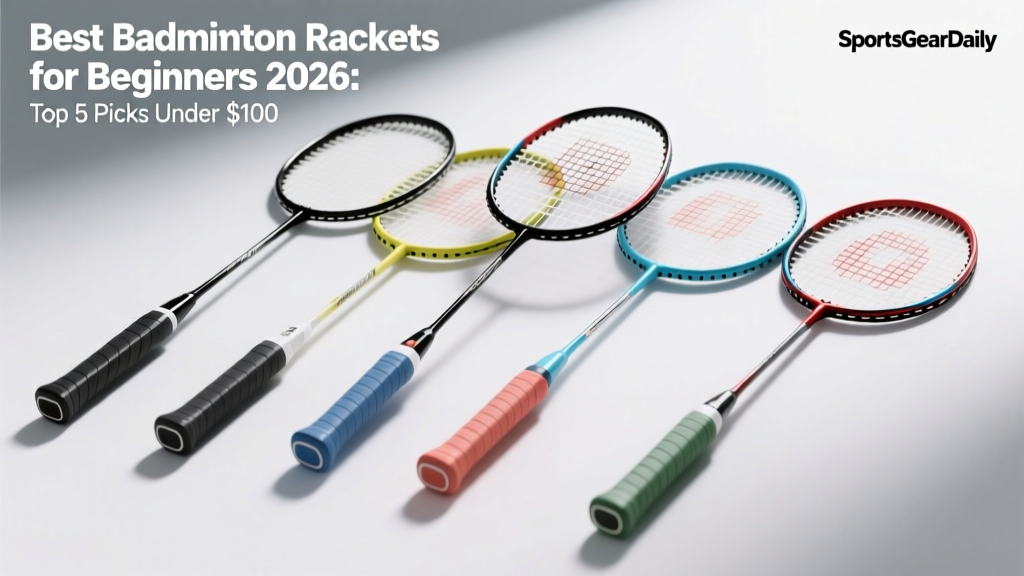
Best Badminton Rackets for Beginners 2026: Top 5 Picks Under $100
Why the Right Racket Matters for Beginners
Choosing the right badminton racket as a beginner can make the difference between a frustrating experience and a fun, rewarding one. A racket that is too heavy will tire your arm quickly, while one that is too light may not give you enough power for clears and smashes. The ideal beginner racket strikes a balance between maneuverability and power, allowing you to focus on developing proper technique rather than fighting your equipment.
In this guide, we have tested over 20 rackets in the sub-$100 price range to bring you our top 5 picks. Each racket has been evaluated on weight, balance point, grip comfort, string tension range, frame durability, and overall feel during actual gameplay. Whether you play casually in the backyard or are joining a local club, these rackets will serve you well as you develop your skills.
Badminton is one of the fastest racket sports in the world, with shuttlecocks reaching speeds over 300 mph in professional play. While beginners will not reach those speeds, having a racket that responds quickly to your swing is essential for building confidence and improving your reaction time on the court.
Key Factors to Consider When Buying a Beginner Racket
Weight is the single most important factor for beginners. Rackets typically range from 75 to 95 grams, and beginners should aim for the lighter end of this spectrum, around 80 to 85 grams. A lighter racket reduces fatigue during long playing sessions and makes it easier to execute quick defensive shots and net play. Most rackets are labeled with a weight category: 3U (85-89g), 4U (80-84g), or 5U (75-79g). For beginners, 4U is usually the sweet spot.
Balance refers to how the weight is distributed along the racket. Head-heavy rackets provide more power for smashes but are harder to maneuver quickly. Head-light rackets offer better control and faster reactions but less raw power. Even-balance rackets provide a mix of both, making them ideal for beginners who are still discovering their playing style.
Grip size is another critical factor. Most rackets come with a G4 or G5 grip size, where G5 is slightly smaller. Players with smaller hands generally prefer G5, while those with larger hands may find G4 more comfortable. You can always add an overgrip to increase the grip size slightly, but you cannot reduce the base grip size, so err on the smaller side if you are unsure.
String tension affects both power and control. Lower tension (18-22 lbs) provides a larger sweet spot and more power, which is beneficial for beginners. Higher tension (24+ lbs) offers better control but requires more precise technique. Most beginner rackets come pre-strung at around 20-22 lbs, which is a good starting point.
Our Top 5 Picks for 2026
1. Yonex Nanoray 10F (approx. $65): This is our top overall pick for beginners. At 83 grams (4U), it offers an excellent balance of speed and power. The head-light balance makes it incredibly easy to maneuver, and the isometric head shape enlarges the sweet spot by 10 percent compared to conventional round frames. The Nanoray 10F comes pre-strung with Yonex BG65 strings at 20 lbs, which provides a good mix of durability and repulsion.
2. Li-Ning Windstorm 72 (approx. $55): A fantastic budget option that punches above its weight class. At just 78 grams (5U), it is one of the lightest rackets in our test, making it perfect for players who prioritize speed and quick reactions. The super-light design reduces wrist fatigue significantly, though beginners should note that the very light weight means less inherent power on clears and smashes.
3. Victor Brave JR 6000 (approx. $45): The most affordable option on our list, the Brave JR 6000 is a solid entry-level racket with an even balance and comfortable grip. At 85 grams (3U), it is slightly heavier than our top picks but provides more stability on off-center hits. The graphite shaft offers decent flex for generating power without sacrificing too much control.
4. Yonex Astrox 88D Play (approx. $80): For beginners who already know they prefer a more attacking style, the Astrox 88D Play offers a head-heavy balance that adds power to smashes and clears. At 84 grams, it is still manageable for most beginners, and the Rotational Generator System helps distribute weight for improved racket handling during fast exchanges.
5. Carlton Kinesis Rapid (approx. $70): This racket features Carlton's Vortex Geometry shaft, which reduces air resistance for faster swing speeds. At 84 grams with an even balance, it offers versatility across all areas of the court. The Kinesis Rapid is particularly well-suited for doubles play where quick reactions at the net are essential.
How to Test a Racket Before Buying
If possible, try before you buy. Many badminton clubs and sporting goods stores offer demo programs where you can test rackets on court. When testing, pay attention to how the racket feels during different types of shots: clears from the baseline, drop shots at the net, drives in mid-court, and defensive blocks. A good beginner racket should feel comfortable across all these shot types without requiring excessive effort.
If you cannot test in person, check the return policy of the retailer. Many online stores offer a 30-day return window, which gives you enough time to play a few sessions and determine whether the racket suits your style. Keep the original packaging and avoid marking the racket until you are sure you want to keep it.
Remember that as a beginner, your technique will improve rapidly over the first few months. A racket that feels perfect today may feel too basic in six months as your skills develop. This is perfectly normal, and many players go through two or three rackets before finding their long-term preference. Start with one of our recommended beginner rackets and upgrade when you feel ready.
Maintenance Tips to Extend Racket Life
Proper care will keep your racket performing well for years. Always store your racket in a protective cover or case to prevent frame damage. Avoid leaving it in extreme temperatures, such as in a car on a hot day, as this can affect string tension and frame integrity. Replace your grip when it becomes worn or slippery, as a degraded grip can lead to the racket slipping during play and potentially causing injury.
Strings should be replaced every 2-3 months for regular players, or immediately if you notice fraying or broken strings. Playing with dead strings significantly affects shot quality and can lead to improper technique as you compensate for the reduced repulsion. Most sports shops offer restringing services for $15-25, and you can choose different string types to fine-tune your racket's feel as your skills progress.
More Articles
 Best Running Shoes for Marathon Training: Cushion, Support, and Durability Guide
 How Many People Are on an Ice Hockey Team?
 How Fast Can Humans Swim? Top Speeds Revealed
 How High Can a Human Jump? Record & Average Heights
 How Much Are MotoGP Bikes? 2025 Pricing & Costs
 How Deep Is Water for Water Polo? Official Depth Explained
 Where to Buy Swimming Noodles in 2025
 Did Saquon Barkley Get Fined for Backward Hurdle?
 Fastest Jet Ski in the World: Top Speeds & Models
 Launch Framework: Zero to First Project Guide