
How Fast Can Humans Swim? Top Speeds Revealed
The fastest humans can swim at speeds of up to 6.2 miles per hour (10 km/h), achieved by elite sprinters like Caeleb Dressel and Michael Phelps during short-distance races such as the 50-meter freestyle. This peak speed is maintained only for brief bursts due to the high energy cost of moving through water, which offers significantly more resistance than air.
How Fast Can Humans Swim? Understanding Peak and Average Speeds
Human swimming speed varies widely based on skill level, stroke type, distance, and physiological factors. While recreational swimmers typically move at 1–2 mph (1.6–3.2 km/h), elite competitive swimmers reach much higher velocities over short distances. The current world-record pace in the 50-meter freestyle translates to approximately 5.5–6.2 mph (8.9–10 km/h).
Factors Influencing Swimming Speed
- Stroke Efficiency: Freestyle (front crawl) is the fastest stroke due to its continuous motion and streamlined body position.
- Muscle Composition: Swimmers with a higher percentage of fast-twitch muscle fibers generate more explosive power.
- Hydrodynamics: Body shape, flexibility, and technique affect drag; minimizing resistance increases speed.
- Training Intensity: Elite athletes undergo years of specialized training focusing on starts, turns, and underwater dolphin kicks.
- Buoyancy and Lung Capacity: Greater lung volume improves floatation and reduces effort needed to stay near the surface.
World-Class Swimming Speeds: Records and Performances
Olympic-level swimmers achieve remarkable speeds in sprint events. The men's 50-meter freestyle world record, set by Caeleb Dressel at 20.16 seconds during the 2021 World Championships, equates to an average speed of about 5.58 mph (8.98 km/h). Over longer distances, speeds naturally decrease due to aerobic limitations.
Comparison Across Strokes
Different strokes yield different maximum speeds. Freestyle remains the fastest, followed by butterfly, backstroke, and breaststroke. The technical demands and body positioning in each stroke influence propulsion and drag.
| Stroke | Event | World Record Time | Average Speed (mph) | Average Speed (km/h) | Swimmer | Year |
|---|---|---|---|---|---|---|
| Freestyle | 50m Men | 20.16 s | 5.58 | 8.98 | Caeleb Dressel | 2021 |
| Butterfly | 100m Men | 49.45 s | 4.53 | 7.29 | Caeleb Dressel | 2021 |
| Backstroke | 100m Men | 51.81 s | 4.35 | 6.99 | Ryan Murphy | 2016 |
| Breaststroke | 100m Men | 56.88 s | 3.95 | 6.36 | Adam Peaty | 2019 |
| Freestyle | 50m Women | 23.61 s | 4.78 | 7.69 | Sarah Sjöström | 2017 |
| Breaststroke | 100m Women | 1:04.13 | 3.51 | 5.65 | Lilly King | 2017 |
The data shows that freestyle remains the fastest stroke across genders, with male swimmers achieving higher peak speeds overall. Adam Peaty's dominance in breaststroke highlights how technique and strength can push boundaries even in the slowest competitive stroke. Speed decreases as event distance increases due to metabolic fatigue and pacing strategies.
Biomechanics Behind Human Swimming Speed
Swimming speed is limited by water's density, which is about 800 times greater than air. Propulsion comes primarily from arm pull force and kick efficiency, while minimizing frontal drag is critical. Elite swimmers optimize their stroke length and rate (typically 60–80 strokes per minute in sprint freestyle) to balance speed and energy conservation.
Underwater Phases and Dolphin Kicking
Many top swimmers are faster underwater than on the surface due to reduced wave drag. After starts and turns, elite athletes use powerful dolphin kicks for up to 15 meters (the legal limit in most races), often reaching transient speeds exceeding 6 mph (9.7 km/h).
Training Methods to Increase Swimming Speed
Improving swimming speed requires a combination of technique refinement, strength development, and cardiovascular conditioning.
- Technique Drills: Catch-up drills, fingertip drag, and single-arm swimming improve stroke mechanics.
- Sprint Intervals: Short, maximal-effort sets (e.g., 10 x 25 meters at race pace) build explosive speed.
- Resistance Training: Using parachutes, paddles, or bands increases power output.
- Plyometrics: Dryland exercises enhance start and turn explosiveness.
- Video Analysis: Coaches use underwater footage to correct inefficiencies.
Frequently Asked Questions About Human Swimming Speed
What is the fastest speed a human has ever swum?
The fastest recorded swimming speed was achieved by Caeleb Dressel during his 50-meter freestyle world record in 2021, averaging 5.58 mph (8.98 km/h). Transient peak speeds during underwater phases may exceed 6.2 mph (10 km/h).
Can humans swim faster than sharks?
No, humans cannot swim faster than most sharks. The average shark swims at 25 mph (40 km/h), with short bursts over 35 mph (56 km/h). Even the fastest human swimmers max out around 6.2 mph (10 km/h), making escape from a shark impossible by speed alone.
Why are some people able to swim faster than others?
Swimming speed depends on body composition, limb length, muscle fiber type, lung capacity, technique proficiency, and training background. Longer limbs and torsos provide mechanical advantages, while superior technique reduces drag and increases propulsion efficiency.
Does height affect swimming speed?
Yes, taller swimmers often have advantages due to longer arms and larger surface area for propulsion. However, shorter swimmers can excel through superior technique, faster stroke rates, and better buoyancy control. Success depends on overall biomechanical efficiency, not height alone.
How fast do Olympic swimmers swim compared to average adults?
Olympic swimmers average 5–6 mph (8–9.7 km/h) in sprints, while the average adult swims at 1–2 mph (1.6–3.2 km/h). This means elite swimmers are roughly 3–5 times faster, thanks to advanced training, physiology, and technique.
More Articles
 The Best Safety Story: How a Single Decision Saved 247 Lives at DuPont’s La Porte Facility
 How Much Do Go Karts Cost in 2025?
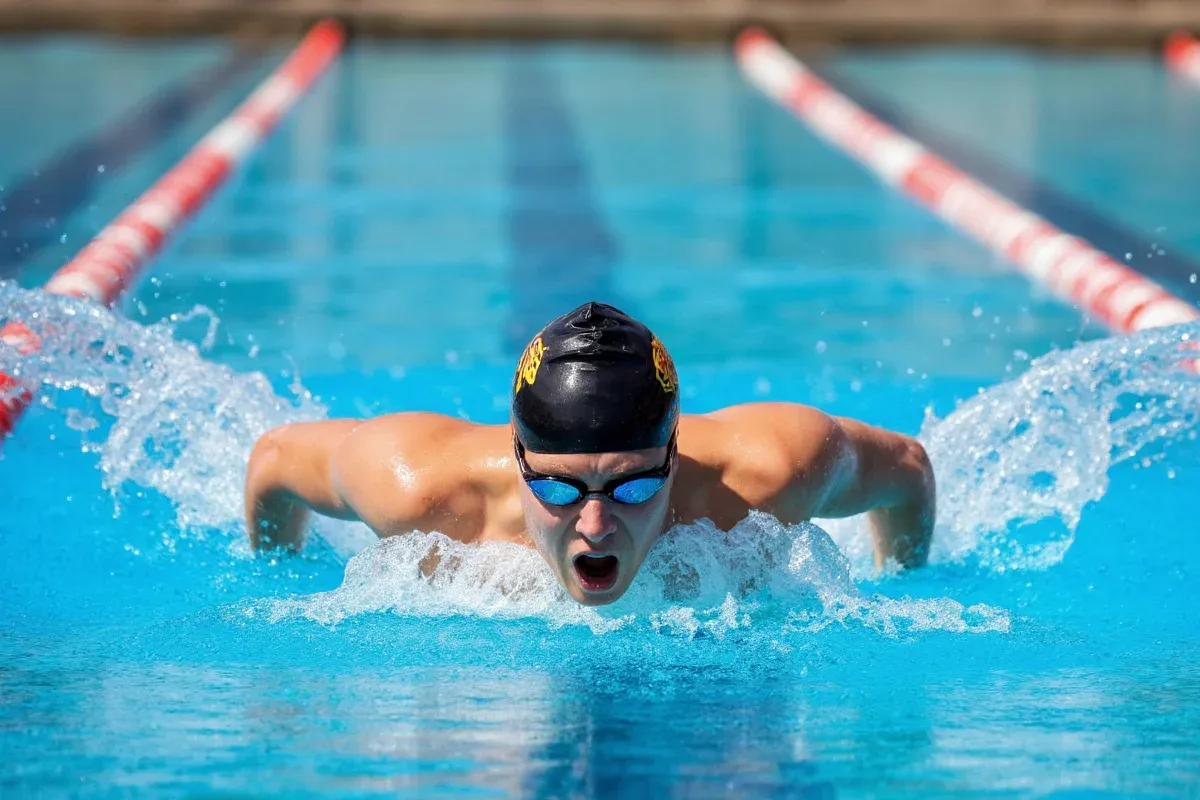 Can Swimming Build Muscle? Science-Backed Answer
 How Much Does a Jet Ski Weigh? Full Breakdown by Model
 How Fast Can Racewalkers Walk? Elite Speeds Revealed
 The Last Common Mistakes: Critical Oversights That Sabotage Projects, Campaigns, and Operations
 How Much Is Ice Skating? Full Cost Breakdown 2025
 How High Can You Jump in Water? Real Data & Techniques
 Olympic Shot Put Weight: Men's and Women's Standards
 Bungee Jumping Death Rate: 1 in 500,000 (2026)