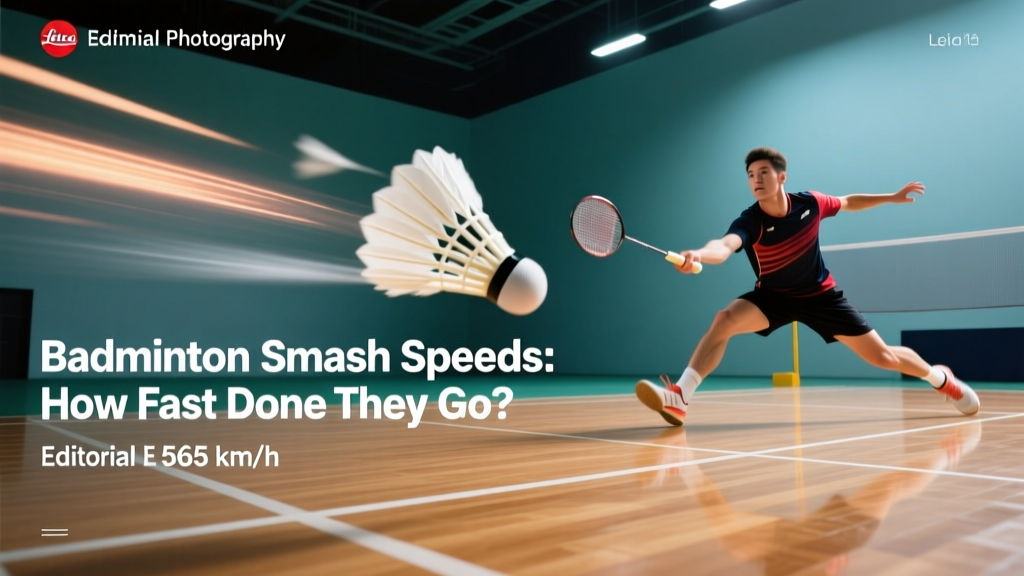
Badminton Smash Speeds: How Fast Do They Go?
Badminton is the fastest racket sport in the world, with shuttlecocks regularly reaching speeds over 300 km/h (186 mph) during smashes. The official world record stands at 565 km/h (351 mph), achieved by Malaysian player Tan Boon Heong in a controlled test environment.
How Fast Do Shuttlecocks Travel in Badminton?
The speed of a shuttlecock in badminton varies depending on the type of stroke, player skill level, and game context. However, professional players consistently generate extreme velocities, especially during offensive smashes.
Types of Strokes and Their Typical Speeds
- Smash: The fastest stroke, used to finish points; often exceeds 300 km/h at elite levels.
- Clear: A defensive or attacking lift; typically ranges from 70–120 km/h.
- Drop Shot: A soft, controlled shot; usually under 60 km/h.
- Drive: A fast, flat rally shot; averages 100–150 km/h.
World Record Smash Speeds
The fastest recorded shuttlecock speed was clocked during a special test conducted by Yonex and the Malaysian Badminton Association. While not achieved in match play, it demonstrates the peak potential of human power and racket technology.
| Player | Nationality | Speed (km/h) | Speed (mph) | Year | Context |
|---|---|---|---|---|---|
| Tan Boon Heong | Malaysia | 565 | 351 | 2017 | Controlled test (Yonex experiment) |
| Marc Zwiebler | Germany | 493 | 306 | 2013 | BWF All England Open |
| Lee Chong Wei | Malaysia | 417 | 259 | 2015 | FIBA Charity Exhibition |
| Kento Momota | Japan | 400 | 249 | 2019 | Indonesia Masters |
| Lin Dan | China | 370 | 230 | 2010 | All England Open |
The data shows that elite male singles players generate the highest smash speeds, with Tan Boon Heong's 565 km/h record far surpassing in-game measurements. Most competitive smashes range between 300–400 km/h, highlighting both physical prowess and advanced racket design. Female players also achieve impressive speeds, typically within 250–350 km/h range in top-level competition.
Factors That Influence Shuttlecock Speed
Several elements contribute to how fast a shuttlecock travels during a rally:
Racket Technology
Modern rackets are made from lightweight carbon fiber composites, allowing faster swing speeds and greater energy transfer. Innovations like aerodynamic frame shapes and high-tension strings enhance power output.
Shuttlecock Design
- Feather vs. Synthetic: Feather shuttlecocks (usually goose or duck) offer better flight stability and are used in professional matches, enabling higher speeds.
- Skirt Material: Natural feathers deform slightly on impact, creating a trampoline effect that increases velocity.
Player Technique and Strength
Elite players use full kinetic chain mechanics — engaging legs, core, shoulders, and wrist — to maximize smash power. Wrist snap at contact adds significant angular velocity.
Comparison With Other Racket Sports
Badminton produces the fastest recorded object speeds among all racket sports, outpacing even tennis and squash.
- Tennis: Fastest serve: 263 km/h (Samuel Groth, 2012)
- Squash: Fastest recorded shot: 282 km/h (Damien Villa)
- Table Tennis: Top speed: ~170 km/h
- Badminton: Peak smash: 565 km/h
This comparison underscores badminton’s unique combination of light projectile mass and explosive striking technique, resulting in unmatched acceleration.
FAQs About Badminton Smash Speeds
What is the fastest recorded badminton smash speed?
The fastest recorded badminton smash reached 565 km/h (351 mph), achieved by Malaysian player Tan Boon Heong during a 2017 experiment sponsored by Yonex. This was not in an official match but under controlled conditions designed to measure maximum possible speed.
How fast do professional players smash in actual matches?
In live competition, top players typically smash between 300–400 km/h. For example, Kento Momota and Lee Chong Wei have recorded in-game smashes above 400 km/h during major tournaments like the Indonesia Masters and All England Open.
Why can badminton produce such high speeds compared to other sports?
Badminton’s shuttlecock has very low mass (around 5 grams), allowing rapid acceleration when struck. Combined with powerful overhead smashes and advanced racket materials, this enables extraordinary speeds unmatched in heavier-ball sports like tennis or squash.
Do feather or plastic shuttlecocks go faster?
Feather shuttlecocks generally travel faster and maintain better aerodynamics than synthetic ones. Their natural flexibility allows for more efficient energy transfer upon impact, making them the preferred choice for elite players seeking maximum speed and control.
Can amateur players reach high smash speeds?
Average club-level players typically generate smash speeds between 150–250 km/h. While significantly slower than professionals, this still makes badminton one of the fastest-reactive sports. Proper technique and training can help amateurs improve their power and consistency.
More Articles
 Super Bowl Host Cities & Stadiums (2026)
 Performance vs Sports: Overlapping Principles
 Oldest WWE Wrestler: Who Holds the Record?
 Who Owns PING Golf? Company Ownership Explained
 How Many Boards on a Bowling Lane? (39 Explained)
 Who Won Super Bowl 2005? Patriots Beat Eagles 24-21
 Rose Bowl 2026 Time: What Time Is It Tomorrow?
 Super Bowl 1980 Winner: Steelers 4th Title
 When Was Cricket Invented? Origins & History
 Where Is the Rose Bowl Game Held? Venue & History