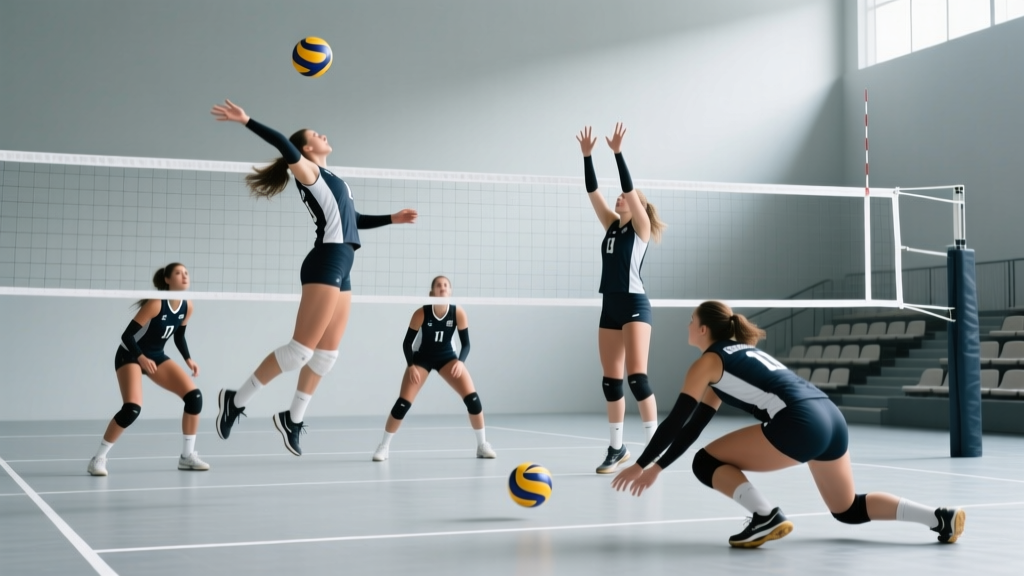
Volleyball Positions Explained: Roles & Responsibilities
In volleyball, there are six primary positions on the court: setter, outside hitter, middle blocker, opposite hitter, libero, and defensive specialist. Each role has distinct responsibilities in offense, defense, and serve-receive, contributing to team strategy and success.
Understanding Volleyball Positions
Volleyball is a fast-paced team sport that relies heavily on specialized player roles. Each of the six standard positions plays a critical part in both offensive and defensive systems. Understanding these roles helps players, coaches, and fans appreciate the complexity and coordination required for high-level play.
Key Responsibilities by Position
- Setter: Orchestrates the offense, delivers precise sets to hitters.
- Outside Hitter: Primary attacker from the left side, often receives the majority of sets.
- Middle Blocker: Dominates the net, blocks opponent attacks, and executes quick attacks.
- Opposite Hitter: Attacks from the right side, often used as a back-row option and strong back-row hitter.
- Libero: Defensive specialist, wears a different color jersey, cannot attack or set from the front row.
- Defensive Specialist (DS): Substitutes for back-row players, excels in digging and passing.
Breakdown of Each Volleyball Position
1. Setter – The Playmaker
The setter is often considered the quarterback of the volleyball team. They are responsible for receiving the second touch and delivering accurate sets to attackers. A skilled setter reads the defense and chooses optimal hitting options. Setters typically have excellent hand-eye coordination and decision-making under pressure.
2. Outside Hitter – The Go-To Attacker
Positioned on the left side of the net, the outside hitter is usually the most versatile offensive weapon. They attack from various zones, handle tough first contacts, and often participate in serve-receive. Top outside hitters combine height, power, and consistency.
3. Middle Blocker – The Net Anchor
Operating in the center of the net, middle blockers are crucial for both blocking and quick attacks (e.g., “quick sets” or “slides”). They must be fast, agile, and capable of reading opposing setters. Their vertical jump and timing are essential for shutting down attacks.
4. Opposite Hitter – The Right-Side Power
The opposite hitter lines up across from the setter and primarily attacks from the right side. This position often faces fewer double blocks and can deliver powerful cross-court or line shots. They also frequently substitute out in the back row, allowing the setter to stay in the front row.
5. Libero – The Defensive Specialist
The libero wears a contrasting jersey and specializes in back-row defense. They cannot rotate into the front row or complete an attack from above the net. However, they excel in serve-receive and digging hard-driven spikes. The libero enhances team stability and ball control.
6. Defensive Specialist (DS) – Strategic Back-Row Support
Similar to the libero but with more flexibility in substitution rules, the DS strengthens the back row during critical rallies. While not always present in every team’s system, the DS is valuable in collegiate and professional levels where rotation management is key.
Volleyball Positions and Performance Metrics
| Position | Average Height (Men - cm) | Average Height (Women - cm) | Kills per Set (Elite Level) | Blocks per Set (Elite Level) |
|---|---|---|---|---|
| Setter | 190 | 178 | 1.8 | 0.6 |
| Outside Hitter | 198 | 185 | 3.9 | 0.8 |
| Middle Blocker | 205 | 190 | 3.2 | 1.4 |
| Opposite Hitter | 200 | 188 | 3.7 | 1.0 |
| Libero | 185 | 172 | 0.3 | 0.1 |
| Defensive Specialist | 183 | 170 | 0.4 | 0.2 |
The data shows that middle blockers average the highest number of blocks per set due to their net presence, while outside hitters lead in kills, reflecting their primary attacking role. Height correlates strongly with front-row positions, especially among middle blockers and opposites, highlighting physical demands at elite levels.
Frequently Asked Questions About Volleyball Positions
What is the most important position in volleyball?
The setter is often considered the most important position because they control the tempo and distribution of the offense. A skilled setter maximizes the effectiveness of all hitters and adapts strategy in real time based on defensive alignment.
Can a libero attack the ball?
No, a libero cannot complete an attack if the ball is entirely above the height of the net at contact. They are allowed to attack from behind the 3-meter line, but only if the ball is below the net height when contacted. Their primary role remains defensive.
What is the difference between a libero and a defensive specialist?
The libero wears a different jersey and follows strict substitution limits (cannot serve or rotate into the front row). A defensive specialist (DS) can replace any back-row player without restriction and may serve, but cannot be involved in certain rotations like the libero. Both focus on defense and serve-receive.
Which position jumps the highest in volleyball?
Middle blockers and outside hitters typically have the highest vertical jumps, often exceeding 330 cm (10'10") in elite men's volleyball. This explosive power enables them to spike over blockers and finish points at the net.
How many substitutions are allowed in indoor volleyball?
In FIVB and NCAA rules, teams are allowed 15 substitutions per set. The libero and defensive specialist can be substituted freely within back-row positions without counting toward this limit, making them strategic assets for maintaining performance.
More Articles
 Jerry Rice Super Bowl Wins: How Many?
 When Did Rey Mysterio Start Wrestling? Career Timeline
 Who Is Home Team in Super Bowl 2025? 49ers at Levi's Stadium
 Who Has Won the Most Golf Majors? Nicklaus Leads with 18
 What Year Did the Dallas Cowboys Win the Super Bowl?
 Where to Buy Billiard Sticks in 2025 | Top Trusted Retailers
 How Many Minor League Baseball Players Are There? (2025)
 Who Is the Heavyweight Champion of Boxing in 2025?
 How Many Super Bowl Games Have Been Played? (2025 Update)
 When Did the Oakland Raiders Win the Super Bowl?