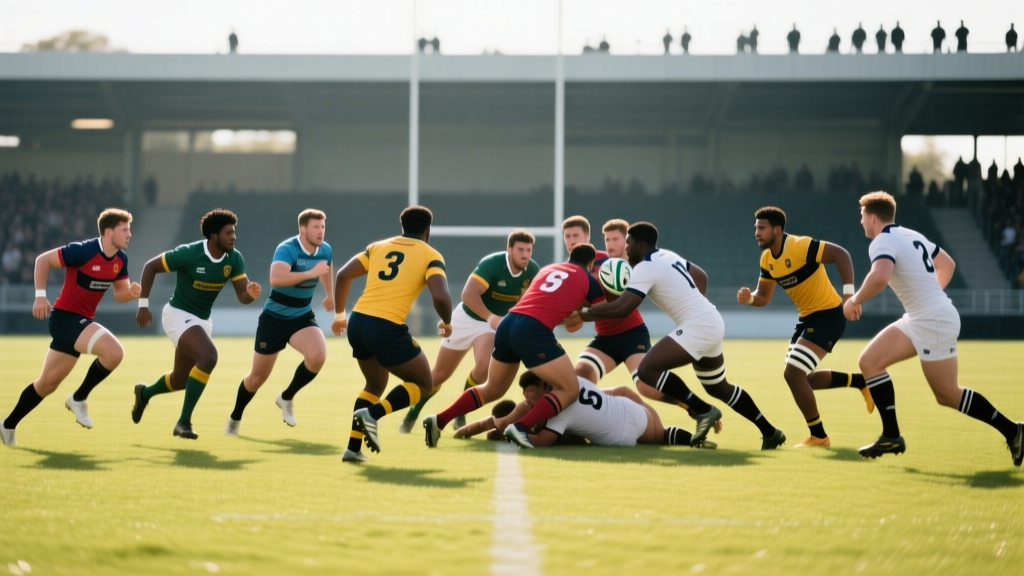
How Many People in a Rugby Team? Full Breakdown
In a standard rugby union match, each team consists of 15 players on the field, divided into 8 forwards and 7 backs. In rugby sevens, a variant of the sport, each team has 7 players. Substitutions are allowed, with up to 8 substitutes in rugby union and 5 in rugby sevens, depending on competition rules.
Understanding Rugby Team Composition
Rugby is a dynamic team sport played globally, known for its physical intensity and strategic depth. The number of players on a rugby team varies depending on the format being played. The two primary forms are rugby union and rugby sevens, both governed by World Rugby but differing significantly in team size and gameplay.
Rugby Union: The Traditional Format
Rugby union is the most widely recognized version of the sport, featuring 15 players per team on the field at any given time. These players are categorized into two main groups:
- Forwards (Numbered 1–8): Responsible for set-pieces like scrums and lineouts. They are typically stronger and more physically built.
- Backs (Numbered 9–15): Focus on speed, agility, and ball distribution. They execute attacking plays and defensive coverage.
Teams are also allowed up to 8 substitute players, making a full squad 23 players in professional matches such as those in the Six Nations or Rugby World Cup.
Rugby Sevens: Fast-Paced and Compact
Rugby sevens is a faster, shorter version of the game, popularized by the HSBC World Rugby Sevens Series and included in the Olympic Games since 2016. Each team fields only 7 players—3 forwards and 4 backs—and matches consist of two 7-minute halves.
- Smaller squads: Typically 12 players (7 starters + 5 substitutes).
- Greater emphasis on speed, endurance, and open-space play.
- Rotational substitutions are common due to high-intensity gameplay.
Variations Across Age Groups and Formats
Rugby is adapted for different age groups and skill levels, often reducing player numbers to suit developmental needs.
Youth and Junior Rugby
To ensure safety and skill development, younger players compete in modified formats:
- Under-7 to Under-12: Uses mini rugby or tag rugby with 5–9 players per side.
- Under-13 to Under-16: Gradually increases to 10 or 12 players before transitioning to full 15-a-side.
Touch Rugby and Social Formats
Casual and recreational versions include:
- Touch rugby: 6 players per team, no tackling.
- Beach rugby: 5 or 7 players, played on sand.
- Wheelchair rugby: 4 players per team, mixed-gender, Paralympic sport.
Detailed Breakdown of Player Roles
Understanding the roles within a 15-player rugby union team enhances appreciation of the sport’s complexity.
Forwards (1–8)
| Jersey Number | Position | Primary Role |
|---|---|---|
| 1 | Loosehead Prop | Anchors scrum on left side; provides stability |
| 2 | Hooker | Throws ball in scrum; key lineout thrower |
| 3 | Tighthead Prop | Anchors scrum on right side; powerful pusher |
| 4 & 5 | Locks | Primary jumpers in lineouts; tall and strong |
| 6 | Blindside Flanker | Defensive enforcer; supports breakdowns |
| 7 | Openside Flanker | Ball thief; fastest forward |
| 8 | No. 8 | Controls ball at back of scrum; links forwards and backs |
Backs (9–15)
| Jersey Number | Position | Primary Role |
|---|---|---|
| 9 | Scrum-Half | Links forwards and backs; passes from base of ruck |
| 10 | Fly-Half | Team's playmaker; directs attack and kicks |
| 11 & 14 | Wingers | Fast finishers; score tries on the edges |
| 12 & 13 | Centres | Break defensive lines; strong runners |
| 15 | Fullback | Last line of defense; counters attacks; reliable kicker |
Team Size Regulations by Competition
Different tournaments and leagues enforce specific squad sizes and substitution rules. The table below outlines real-world data from major competitions.
| Competition | Players on Field | Total Squad Size | Substitutes Allowed | Format |
|---|---|---|---|---|
| Rugby World Cup (Men) | 15 | 33 | 8 | Rugby Union |
| Six Nations Championship | 15 | 23 | 8 | Rugby Union |
| HSBC World Rugby Sevens Series | 7 | 12 | 5 | Rugby Sevens |
| Olympic Games Rugby (Men/Women) | 7 | 12 | 5 | Rugby Sevens |
| Super Rugby Pacific | 15 | 23 | 8 | Rugby Union |
The data shows that elite rugby union competitions maintain a consistent squad size of 23 players, allowing for 8 substitutes. In contrast, rugby sevens limits squads to 12 players with 5 available replacements, reflecting the sport’s fast-paced nature and need for rotational fitness. The Rugby World Cup features larger traveling squads (33) to accommodate injuries and training needs over extended tournaments.
Frequently Asked Questions About Rugby Team Size
How many players are on a rugby team during a match?
In rugby union, each team has 15 players on the field. In rugby sevens, each team fields 7 players. Both formats allow substitutes, with up to 8 in union and 5 in sevens, depending on the competition.
Why does rugby have 15 players per team?
The 15-player structure evolved historically to balance attack and defense across the field. It allows specialized roles in both forwards and backs, creating a strategic and physically demanding game suited to large pitches.
Can a rugby team play with fewer than 15 players?
Yes. If players are injured or sent off, teams can continue with fewer than 15. However, if a team drops below 7 players, the match is forfeited. Temporary absences (e.g., for blood bins) are covered by substitutes.
What is the difference between rugby union and rugby sevens team size?
Rugby union teams have 15 players on the field and up to 8 substitutes. Rugby sevens teams have 7 players on the field and 5 substitutes. Sevens emphasizes speed and endurance due to fewer players covering the same field size.
How many players are on a women's rugby team?
Women's rugby follows the same team structure as men's. In rugby union, 15 players per team; in rugby sevens, 7 players. Major events like the Women's Rugby World Cup and Olympic rugby use these standards.
More Articles
 How Many Super Bowls Have the Broncos Been To?
 2025 Pro Bowl Score: AFC 36, NFC 33 Final Results
 Who Won 2014 Super Bowl? Seahawks Beat Broncos 43-8
 Has Josh Allen Been to the Super Bowl? Not Yet
 When Was the First Super Bowl Played? Full History & Facts
 How Old Is Golfer Dustin Johnson in 2025?
 Can Am Badminton: Top North American Tournament Explained
 Who Won Super Bowl in 1990? 49ers Dominated Broncos
 What Baseball Team Is the Guardians? | Cleveland MLB Info
 How Many People Can Bowl on One Lane? (Max Players)