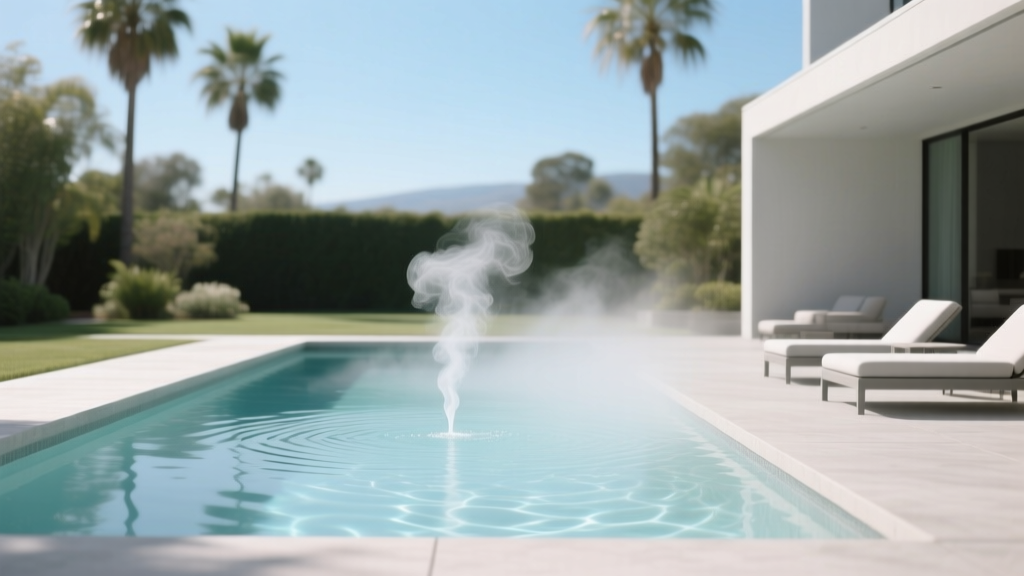
How Much Water Evaporates from a Swimming Pool?
How Much Water Evaporates from a Swimming Pool?
On average, a standard residential swimming pool loses about 0.25 to 0.5 inches (6 to 13 mm) of water per day due to evaporation, which translates to roughly 15,000 to 30,000 gallons (57,000 to 114,000 liters) annually depending on climate, pool size, and usage. This means evaporation accounts for the largest portion of outdoor pool water loss—often more than leaks or splash-out.
Factors That Influence Pool Water Evaporation
Evaporation rates vary significantly based on environmental and operational conditions. Understanding these factors helps pool owners manage water consumption, reduce costs, and maintain optimal chemical balance.
Key Variables Affecting Evaporation
- Ambient temperature: Warmer air increases evaporation rates, especially in dry climates.
- Humidity: Lower relative humidity allows faster moisture transfer into the air.
- Wind speed: Air movement over the pool surface accelerates evaporation.
- Water temperature: Heated pools lose more water, as warm water molecules escape more easily.
- Pool usage: Splashing and agitation increase surface exposure and evaporation.
- Exposure to sunlight: Direct solar radiation raises water temperature and promotes vaporization.
Daily vs. Annual Evaporation Estimates by Climate Zone
To quantify typical water loss, the following table presents real-world evaporation data across different U.S. regions, based on studies conducted by the National Weather Service and pool industry research.
| Climate Zone | Avg. Daily Evap. (inches) | Avg. Monthly Loss (gallons) | Avg. Annual Loss (gallons) | Pool Size Assumed |
|---|---|---|---|---|
| Desert Southwest (e.g., Phoenix, AZ) | 0.50 | 1,200 | 14,400 | 300 sq ft |
| Southern California (e.g., Los Angeles) | 0.35 | 840 | 10,080 | 300 sq ft |
| Humid Southeast (e.g., Atlanta, GA) | 0.30 | 720 | 8,640 | 300 sq ft |
| Moderate Midwest (e.g., Chicago, IL) | 0.25 | 600 | 7,200 | 300 sq ft |
| Cool Northwest (e.g., Seattle, WA) | 0.15 | 360 | 4,320 | 300 sq ft |
The data shows that arid regions experience up to three times higher annual evaporation compared to cooler, humid areas. For example, a pool in Phoenix may lose over 14,000 gallons per year, while one in Seattle loses less than half that amount. These differences highlight the importance of regional climate considerations in water management planning.
How to Measure Evaporation from Your Pool
Pool owners can perform a simple bucket test to distinguish between normal evaporation and potential leaks:
- Fill a 5-gallon bucket with pool water and mark the water level.
- Place the bucket on the pool step so it's exposed to the same sun and wind.
- Run the pool normally for 24–48 hours without topping off.
- Compare water loss in the bucket versus the pool.
If both drop similarly, the loss is likely due to evaporation. If the pool loses significantly more water, a leak may be present.
Ways to Reduce Pool Water Evaporation
Reducing evaporation not only conserves water but also saves energy and chemicals. Effective strategies include:
- Use a pool cover: Reduces evaporation by 30–95%, depending on type and usage frequency.
- Install a liquid solar cover: Invisible chemical layer that slows evaporation when used nightly.
- Shield from wind: Install windbreaks like fences, hedges, or glass enclosures.
- Turn off water features at night: Fountains and waterfalls increase surface agitation and evaporation.
- Lower water temperature: Use a chiller or reduce heater settings when not in use.
Frequently Asked Questions About Pool Evaporation
How do I know if my pool is losing water from evaporation or a leak?
Perform a bucket test: place a marked bucket of pool water on the step and compare water loss after 48 hours. If both drop similarly, it’s evaporation. If the pool drops more, suspect a leak.
Does a heated pool lose more water to evaporation?
Yes. Heating increases water temperature, which directly boosts evaporation rates. A heated pool can lose up to twice as much water as an unheated one in the same environment.
Can rainwater offset evaporation losses in a swimming pool?
Rain can temporarily refill a pool, but it doesn’t fully offset seasonal evaporation. Plus, heavy rain may dilute chemicals and require rebalancing of pH and sanitizer levels.
Do indoor pools evaporate as much water as outdoor pools?
Indoor pools still evaporate significant water—often more due to controlled heating and lower humidity indoors. However, dehumidification systems capture moisture, reducing net water loss but increasing energy use.
How much water does a pool lose during winter?
Even in winter, evaporation continues. Uncovered pools in mild climates can lose 0.1 to 0.25 inches per week. Using a winter cover can reduce this by up to 90%.
More Articles
 Who Invented Field Hockey? Origins & History Explained
 History of the Olympic Games: From Ancient Greece to Modern Era
 How Much Water in a Swimming Pool? By Size & Type
 Why Is There a Libero in Volleyball? Rules, Purpose & History Explained (2026)
 Did Nick Diaz Swim to Alcatraz? Truth Behind the Myth
 How Many Meters Is an Olympic Swimming Pool?
 Where to Buy Swim Shorts: Best Online & In-Store Options
 Sports Stats Guide: Practical Frameworks and Benchmarks
 How Many Yards in a Mile Swimming? Exact Numbers
 When Did Michael Phelps Start Swimming? Key Facts