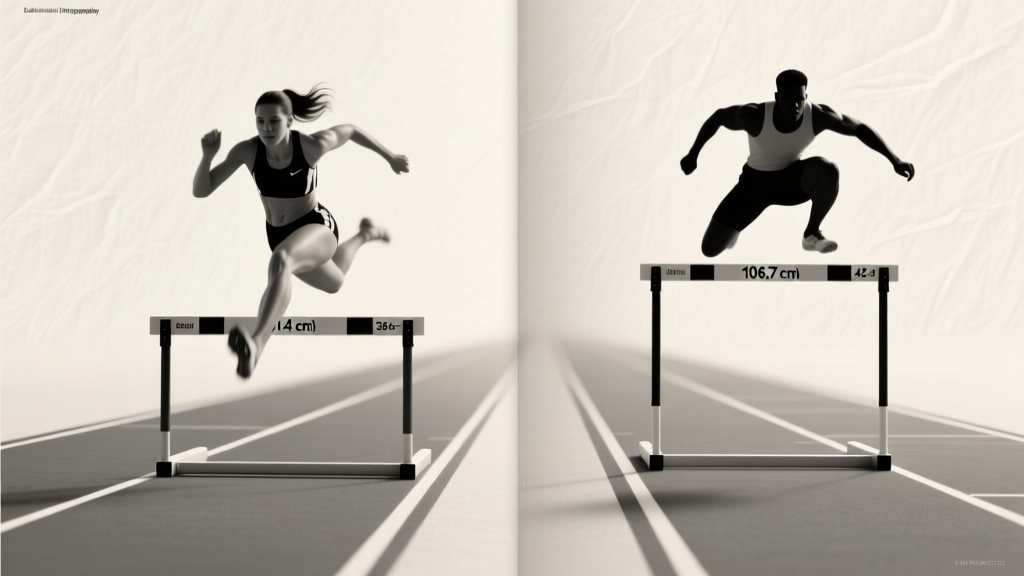
Olympic Hurdle Heights by Event & Gender
Olympic hurdle heights vary by event and gender: 1.067m (42in) for men's 110m, 0.838m (33in) for women's 100m, and 0.914m (36in) for both men's and women's 400m hurdles.
Hurdle Heights in Olympic Track and Field Events
The height of hurdles in the Olympics depends on the specific race, athlete gender, and competition level. Sprint hurdles differ significantly from intermediate hurdles, with standardized heights set by World Athletics (formerly IAAF). These measurements ensure fairness and consistency across international competitions, including the Summer Games.
Breakdown of Olympic Hurdling Events
There are three primary hurdling events in modern Olympic athletics: men’s 110m hurdles, women’s 100m hurdles, and the 400m hurdles for both genders. Each has distinct technical demands influenced by hurdle height, spacing, and number of barriers.
Men's 110-Meter Hurdles
- Hurdle height: 1.067 meters (42 inches)
- Number of hurdles: 10
- Distance between hurdles: 9.14 meters
- Start to first hurdle: 13.72 meters
- Last hurdle to finish: 14.02 meters
This event is one of the most physically demanding sprint hurdles, requiring explosive speed, precise stride control, and advanced technique over high barriers.
Women's 100-Meter Hurdles
- Hurdle height: 0.838 meters (33 inches)
- Number of hurdles: 10
- Distance between hurdles: 8.5 meters
- Start to first hurdle: 13 meters
- Last hurdle to finish: 10.5 meters
Introduced in 1932 (as 80m), the current 100m format has been standard since 1972. The lower height accommodates biomechanical differences while maintaining competitive intensity.
400-Meter Hurdles (Men and Women)
- Hurdle height: 0.914 meters (36 inches)
- Number of hurdles: 10
- Distance between hurdles: 35 meters
- Start to first hurdle: 45 meters
- Last hurdle to finish: 40 meters
This endurance-based event combines aerobic capacity with technical precision. The 36-inch height strikes a balance between challenge and sustainability over four laps of technical running.
Detailed Comparison of Olympic Hurdle Specifications
| Event | Gender | Hurdle Height (m) | Hurdle Height (in) | Number of Hurdles | Spacing (m) |
|---|---|---|---|---|---|
| 110m Hurdles | Men | 1.067 | 42 | 10 | 9.14 |
| 100m Hurdles | Women | 0.838 | 33 | 10 | 8.5 |
| 400m Hurdles | Men | 0.914 | 36 | 10 | 35 |
| 400m Hurdles | Women | 0.914 | 36 | 10 | 35 |
The data shows that men’s sprint hurdles are the tallest at 1.067m, while women’s sprint hurdles are 23cm lower. The 400m hurdles use a uniform 0.914m height across genders, reflecting a compromise between sprint clearance and endurance pacing. Spacing patterns also reflect event-specific strategies—shorter intervals in sprints demand faster leg cycles.
Evolution of Hurdle Heights in the Olympics
Hurdle dimensions have evolved to enhance safety, performance, and gender equity. Early 20th-century hurdles were heavier and taller relative to athlete capability. The shift to lightweight, tip-resistant designs in the 1930s allowed more aggressive techniques. Women’s events transitioned from 80m to 100m in 1972, aligning with increased participation and performance standards.
Key Rule Changes Influencing Hurdle Design
- 1935: Introduction of L-shaped hurdles that fall forward when struck
- 1969: Women’s hurdle height standardized at 84cm (later adjusted to 83.8cm)
- 1977: Adoption of metric spacing in all events
- 2000s: Enhanced track surfaces improving clearance efficiency
Frequently Asked Questions About Olympic Hurdle Heights
How high are the hurdles in the men’s 110m Olympic race?
The hurdles in the men’s 110-meter hurdles are set at 1.067 meters (42 inches) tall, making them the highest barriers in Olympic track hurdling events.
Why are women’s 100m hurdles lower than men’s 110m hurdles?
Women’s 100m hurdles are lower (0.838m vs. 1.067m) due to historical, physiological, and biomechanical considerations, including average stride length and power-to-weight ratios, allowing optimal racing rhythm and injury prevention.
Are 400m hurdle heights the same for men and women?
Yes, both men and women compete over 400m hurdles set at 0.914 meters (36 inches), a standard established to balance technical difficulty with endurance requirements across genders.
Have Olympic hurdle heights changed over time?
Yes, hurdle heights and configurations have evolved. For example, women raced 80m hurdles at 76.2cm until 1969, when it was increased to 83.8cm and extended to 100m in 1972, reflecting advances in athleticism and gender parity.
What happens if an athlete knocks down a hurdle in the Olympics?
Athletes are not disqualified for knocking down hurdles as long as they do not intentionally kick or step over them. However, contact slows runners and disrupts rhythm, often costing valuable time.
More Articles
 How Many Feet Is a Swim Lap? Exact Distances Explained
 How Many Laps to Swim a Mile? By Pool Size
 Best Home Gym Equipment Under $500: 2026 Budget Setup Guide
 Ideal Swimming Water Temperature: What’s Comfortable?
 How Much Does Go-Karting Cost in 2025?
 Rowing Machine Muscles Worked: Full-Body Breakdown
 Who Invented Ice Hockey? The True Origin Story
 Where to Purchase Swim Caps: Best Online & In-Store Options
 How Cold Are Ice Skating Rinks? Expert Breakdown
 Did Nick Diaz Swim to Alcatraz? Truth Behind the Myth