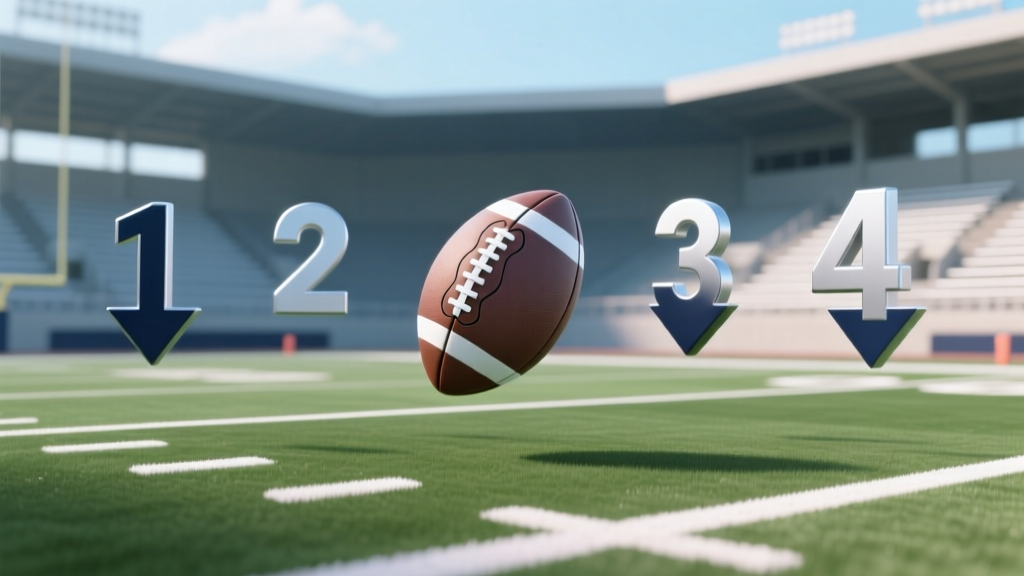
How Many Downs in Football? 4 Key Facts Explained
In American football, there are four downs in a series, and the offense must gain at least 10 yards within those four downs to earn a new set of downs. If they succeed, the down count resets; if not, possession turns over to the opposing team.
Understanding the Concept of Downs in Football
The term "downs" refers to the sequence of plays that an offensive team gets to advance the ball and maintain possession. Each down is essentially a single play. The goal is to move the ball forward and achieve a first down by gaining 10 yards. This system creates structure and strategy in how teams approach offensive drives.
How the Down System Works
- The offense starts with 1st and 10, meaning it's the first down and 10 yards are needed for a new series.
- If they gain 5 yards on the first play, the next play is 2nd and 5.
- A complete 10-yard gain results in a first down, resetting the count to 1st and 10.
- If no first down is achieved after four attempts, the opposing team gains possession.
Strategic Use of Each Down
Teams use different strategies depending on which down they are on. Understanding these patterns helps fans and players anticipate plays.
1st Down Strategy
On 1st down, teams often balance between running and passing plays. Because there’s less pressure, coaches may test the defense or establish the run game early.
2nd Down Scenarios
Depending on yardage, 2nd down can be favorable (e.g., 2nd and short) or challenging (e.g., 2nd and long). Coaches adjust play-calling accordingly—passing more on long yardage, running on short.
3rd Down: The Critical Yardage Play
3rd down is often the most decisive. Success here extends the drive. Teams classify 3rd downs as:
- 3rd and short (1–3 yards): Often run-heavy or quick passes.
- 3rd and medium (4–7 yards): Balanced mix of runs and passes.
- 3rd and long (8+ yards): Typically pass-heavy, relying on deep throws or slants.
4th Down Decisions: Go, Punt, or Kick?
Traditionally, teams punt or attempt a field goal on 4th down. However, modern analytics have encouraged more aggressive "go-for-it" decisions, especially in favorable field position.
| Season | League | Avg. Plays per Drive | 3rd Down Conversion Rate | 4th Down Attempts per Game |
|---|---|---|---|---|
| 2020 | NFL | 6.1 | 39.2% | 0.7 |
| 2021 | NFL | 6.3 | 40.1% | 0.9 |
| 2022 | NFL | 6.4 | 40.8% | 1.1 |
| 2023 | NFL | 6.5 | 41.3% | 1.3 |
| 2024 | NFL | 6.6 | 42.0% | 1.5 |
The data shows a clear trend: NFL offenses are becoming more efficient, with longer drives and higher third-down conversion rates. Additionally, 4th down attempts are rising year-over-year, reflecting a shift toward aggressive, analytics-driven coaching strategies.
Key Rules Affecting Downs
- Penalties: Can extend a down (e.g., defensive holding gives an extra down) or reset it.
- Turnovers: Fumbles or interceptions end the down and possession immediately.
- End of Half: Clock rules affect how many downs can be run before time expires.
- Measurement: Officials use chains to verify if 10 yards were gained for a first down.
Frequently Asked Questions About Football Downs
How many downs are there in American football?
There are four downs in American football. The offense must gain 10 yards within these four downs to retain possession and earn a new set of downs.
What happens if a team doesn't get a first down?
If a team fails to gain 10 yards within four downs, possession of the ball turns over to the opposing team at the spot of the tackle or incomplete pass.
Can you punt on any down?
No, punting is typically done on 4th down. While legal on earlier downs, it is extremely rare and strategically unwise, as it surrenders possession unnecessarily.
Why is it called a 'down' in football?
The term 'down' likely comes from early football when the ball was literally "downed" after a tackle. It now refers to each numbered play in a series of four attempts.
Do college and NFL football have the same number of downs?
Yes, both college (NCAA) and professional (NFL) football use the same rule: four downs to gain 10 yards. The timing and some clock rules differ, but the down structure is identical.
More Articles
 Who Is the Tallest Footballer in the World?
 How Many Overtimes in College Football?
 Where Are the Eagles Football Team From?
 Where Did Football Start? Origins and History
 College Football 25 Teams & Conferences (2026)
 Bo Nix College Football: Where He Played
 How Many College Football Teams Play in a Dome? (2025)
 Who Plays Football on Saturday? College Teams Dominate
 How Long Is NFL Football Season? Full Breakdown
 How Much Does an NFL Football Coach Make?