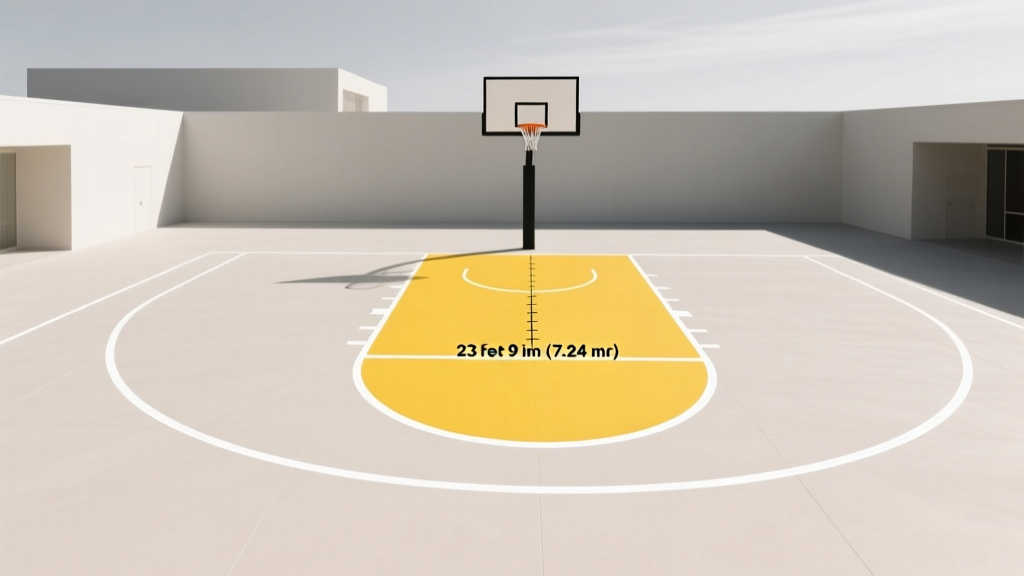
How Far Is the 3-Point Line in Basketball?
The distance of the 3-point line in basketball varies by league and location on the court. In the NBA, the arc spans 23 feet 9 inches at its furthest point and 22 feet in the corners. The WNBA and FIBA use a 22 feet 1.75 inch line, while NCAA men's basketball measures 22 feet 1.75 inches and NCAA women's uses the same as the WNBA. High school courts typically feature a 19 feet 9 inch arc.
Understanding the 3-Point Line Across Basketball Leagues
The 3-point line is a critical boundary in modern basketball, defining the minimum distance from which a successful shot earns three points instead of two. However, there is no universal standard for its distance—the measurement differs significantly across leagues, levels of play, and even specific court positions.
Key Factors Influencing 3-Point Distance
- League regulations: NBA, WNBA, FIBA, NCAA, and high school (NFHS) each set their own standards.
- Court geometry: The line is not a perfect circle but an arc with straight extensions toward the sidelines.
- Corner measurements: The shortest distance to the basket occurs in the corners due to the straight extension of the baseline.
- Basket offset: The distance is measured from the center of the basket to the outer edge of the line.
NBA 3-Point Line Dimensions
The National Basketball Association features one of the deepest 3-point lines in professional basketball. Introduced in the 1979–80 season, the arc has undergone minor adjustments over time.
- The top-of-the-key distance is 23 feet 9 inches (7.24 meters).
- In the corners, the distance shortens to 22 feet (6.70 meters) due to the alignment with the baseline.
- The radius of the arc is consistent from the center until it intersects with the sideline extensions.
This asymmetry creates strategic shooting advantages in the corners, making them popular spots for elite shooters and offensive schemes emphasizing spacing.
WNBA and International (FIBA) Standards
The Women's National Basketball Association aligns its 3-point distance with FIBA (International Basketball Federation), promoting consistency in international competition.
- FIBA and WNBA both use a uniform distance of 22 feet 1.75 inches (6.75 meters).
- Unlike the NBA, the FIBA arc does not dip as dramatically in the corners—maintaining near-consistent curvature.
- This distance was adopted by the WNBA in 2013, shortening from the previous NBA-equivalent line.
The standardized FIBA line simplifies global tournament setups and ensures uniformity across national teams and club competitions.
NCAA Men’s and Women’s 3-Point Distances
College basketball in the United States follows rules set by the National Collegiate Athletic Association (NCAA), with slight differences between genders.
NCAA Men’s Basketball
Since the 2019–20 season, NCAA men have used the FIBA distance: 22 feet 1.75 inches. This change brought college hoops closer in alignment with international and professional standards, increasing offensive spacing demands.
NCAA Women’s Basketball
Women’s college basketball adopted the same 3-point line distance as the WNBA and FIBA—22 feet 1.75 inches—starting in the 2021–22 season. Prior to this, the line was shorter, measuring 20 feet 9 inches.
High School Basketball (NFHS) 3-Point Line
High school basketball in the U.S. follows guidelines from the National Federation of State High School Associations (NFHS). The 3-point line is significantly closer than in higher levels.
- Distance: 19 feet 9 inches (6.02 meters) from the center of the basket.
- The line is a continuous arc without corner exceptions like in the NBA.
- This shorter distance accommodates younger players’ physical development and skill level.
Some states or tournaments may opt for longer lines, but NFHS rules permit only the 19'9" standard unless otherwise specified.
Comparative Analysis of 3-Point Line Distances
| League / Organization | Distance (feet/inches) | Distance (meters) | Corner Distance (ft/in) | Year Adopted |
|---|---|---|---|---|
| NBA | 23' 9" (top), 22' (corners) | 7.24 / 6.70 | 22' 0" | 1979 |
| WNBA | 22' 1.75" | 6.75 | ~21' 8" | 2013 |
| FIBA | 22' 1.75" | 6.75 | 21' 8" | 1984 (men), 2010 (women) |
| NCAA Men | 22' 1.75" | 6.75 | 21' 8" | 2019 |
| NCAA Women | 22' 1.75" | 6.75 | 21' 8" | 2021 |
| NFHS (High School) | 19' 9" | 6.02 | 19' 9" | 1987 |
The data shows a clear progression in 3-point line depth from high school to professional and international levels. The NBA maintains the deepest line at the top of the key, while all other major leagues now standardize at 22' 1.75". The convergence of NCAA, WNBA, and FIBA distances reflects a global trend toward uniformity in competitive balance and skill development.
Strategic Impact of 3-Point Line Distance
The evolution of the 3-point line has transformed basketball strategy across all levels. Deeper lines require greater shooting accuracy and physical conditioning, influencing team composition and offensive systems.
- Spacing: A deeper line forces defenses to cover more ground, opening driving lanes.
- Player development: Shooters must train for consistency from longer ranges.
- Tactical design: Coaches prioritize corner 3s in the NBA due to the reduced distance.
- Pace and scoring: Teams with elite shooters often adopt faster tempos to generate 3-point opportunities.
The shift to longer lines in college and women’s basketball has increased the value of versatile wings and floor spacers, mirroring trends seen in the NBA.
Frequently Asked Questions About the 3-Point Line
How far is the 3-point line in the NBA?
The NBA 3-point line is 23 feet 9 inches from the basket at the top of the key and 22 feet in the corners. This difference arises from the geometric layout of the court and the alignment of the arc with the baseline.
Is the 3-point line the same in the WNBA as in the NBA?
No, the WNBA uses a shorter 3-point line than the NBA. It measures 22 feet 1.75 inches, matching the FIBA standard, whereas the NBA line extends to 23 feet 9 inches at its maximum.
What is the FIBA 3-point distance?
The FIBA 3-point line is set at 22 feet 1.75 inches (6.75 meters) from the center of the basket. This standard applies to international competitions, including the Olympics and World Cup, for both men and women.
Has the NCAA always used the current 3-point line distance?
No. The NCAA men’s 3-point line was extended to 22 feet 1.75 inches in 2019, and the women’s line was moved to the same distance in 2021. Before these changes, both were significantly shorter, especially in women’s basketball.
Why is the 3-point line closer in the corners in the NBA?
The NBA 3-point line is closer in the corners because the arc intersects with the baseline, creating a shorter straight-line distance. This results in a 22-foot shot in the corners versus 23 feet 9 inches at the top, making corner 3s strategically valuable.
More Articles
 How Long Is a Quarter in Basketball? By League Explained
 When Does USA Play Basketball? 2025 Schedule & Events
 Regulation Height for a Basketball Hoop: 10 Feet Explained
 When Does USA Basketball Play? 2024 Schedule & Game Dates
 Who Won the Most NCAA Basketball Championships?
 How Much Do Basketball Players Make? 2025 Salaries Revealed
 Kentucky Wildcats Game Time Tonight: Start Time & TV Info
 How Many Players on a Basketball Team? Full Breakdown
 Next Duke Basketball Game: Date, Time, TV & Tickets
 When Is College Basketball 26 Coming Out? (2025 Update)