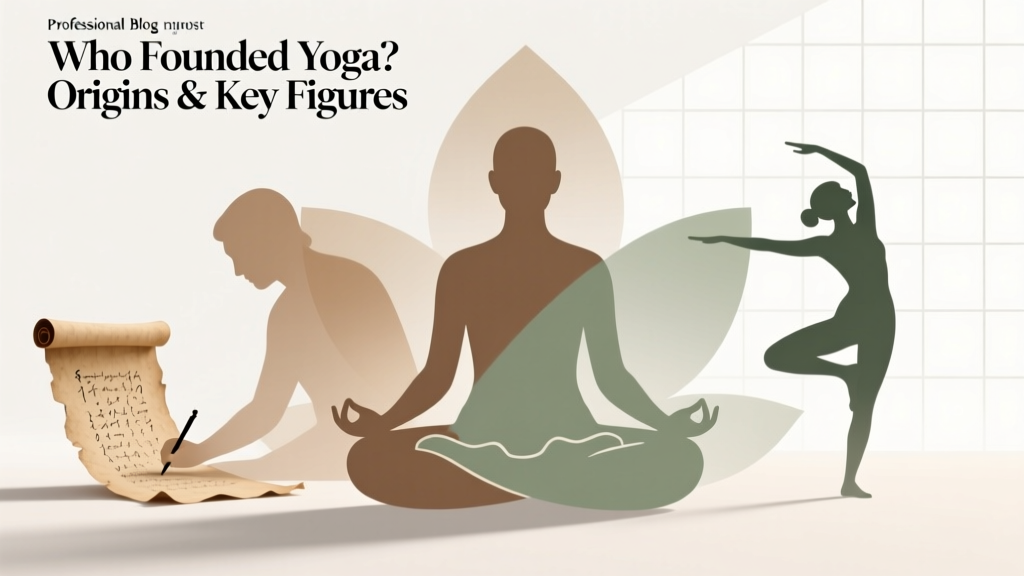
Who Founded Yoga? Origins & Key Figures
Yoga does not have a single founder; it is an ancient practice that evolved over thousands of years in India, with roots tracing back to the Indus-Sarasvati civilization around 3000 BCE. The foundational philosophy was systematized by Sage Patanjali around 2nd century BCE through the Yoga Sutras, earning him the title “Father of Yoga,” though he formalized rather than invented yoga.
Origins and Historical Development of Yoga
Yoga is a spiritual, mental, and physical discipline originating in ancient India. It developed as part of the broader philosophical traditions of Hinduism, Buddhism, and Jainism.
Pre-Vedic and Vedic Periods
- Archaeological evidence from the Indus Valley Civilization (circa 3300–1300 BCE) suggests early forms of yogic postures, seen in seals depicting figures in meditative poses.
- The term “yoga” first appears in the Rig Veda, one of the oldest sacred texts (circa 1500 BCE), referring to ritual practices and breath control.
- The Upanishads (800–500 BCE) expanded on meditation, self-discipline, and the union of Atman (individual soul) with Brahman (universal consciousness).
Classical Yoga: The Role of Patanjali
Sage Patanjali is credited with compiling and organizing existing yoga knowledge into the Yoga Sutras, a 196-aphorism text that outlines the Eight Limbs of Yoga (Ashtanga Yoga).
- Patanjali did not invent yoga but codified its principles into a structured philosophical system.
- His work defined yoga as “chitta vritti nirodha” — cessation of the fluctuations of the mind.
- This classical framework remains central to modern yoga philosophy and teacher training programs worldwide.
Evolution of Modern Yoga
While traditional yoga emphasized meditation and spiritual liberation, modern postural yoga gained popularity in the 20th century through Indian gurus who introduced it to the West.
Key Figures in Globalizing Yoga
- Swami Vivekananda: Introduced yoga philosophy to the West at the 1893 Parliament of the World's Religions in Chicago.
- Tirumalai Krishnamacharya: Known as the “Father of Modern Yoga,” he taught influential figures like B.K.S. Iyengar, Pattabhi Jois, and his son T.V. Desikachar.
- B.K.S. Iyengar: Developed Iyengar Yoga, emphasizing precision, alignment, and use of props.
- Pattabhi Jois: Popularized Ashtanga Vinyasa Yoga, a dynamic and physically demanding style.
| Yoga Style | Founder | Origin Year | Global Practitioners (Est.) | Primary Focus |
|---|---|---|---|---|
| Hatha Yoga | Yogi Swatmarama (codifier) | 15th century CE | 100 million+ | Physical postures and breath control |
| Iyengar Yoga | B.K.S. Iyengar | 1975 | 4 million | Alignment and precision |
| Ashtanga Vinyasa | K. Pattabhi Jois | 1948 | 3 million | Dynamic flow and discipline |
| Vinyasa Flow | Derived from Krishnamacharya | 1930s | 20 million+ | Movement synchronized with breath |
| Bikram Yoga | Bikram Choudhury | 1971 | 1.5 million | Fixed sequence in heated room |
The table illustrates how modern yoga styles emerged primarily in the 20th century under specific teachers, despite yoga’s ancient roots. Hatha Yoga remains the most widespread foundation, while derivative styles like Iyengar and Ashtanga have cultivated global followings through standardized teaching methods.
Philosophical Foundations of Yoga
Yoga is more than physical exercise; it is a holistic path toward self-realization and inner peace.
The Eight Limbs of Yoga (Ashtanga)
- Yama: Ethical standards (non-violence, truthfulness, non-stealing, moderation, non-possessiveness)
- Niyama: Personal observances (cleanliness, contentment, discipline, self-study, surrender)
- Asana: Physical postures for health and stability
- Pranayama: Breath control to regulate life force
- Pratyahara: Withdrawal of senses
- Dharana: Concentration
- Dhyana: Meditation
- Samadhi: State of enlightenment or oneness
Common Questions About the Founder of Yoga
Who is considered the founder of yoga?
No single person founded yoga. Sage Patanjali is often called the “Father of Yoga” for systematizing its philosophy in the Yoga Sutras, but yoga predates him by millennia.
Did Patanjali invent yoga?
No, Patanjali did not invent yoga. He compiled existing oral traditions and practices into a coherent philosophical framework known as the Yoga Sutras, which became foundational to classical yoga.
What is the oldest form of yoga?
The oldest form of yoga is known as Vedic yoga, rooted in the Rig Veda and associated with ritualistic practices, chanting, and meditation aimed at spiritual enlightenment.
How old is yoga?
Yoga is approximately 5,000 years old, with archaeological and textual evidence dating back to 3000–1500 BCE in the Indus-Sarasvati civilization of ancient India.
Who brought yoga to the Western world?
Swami Vivekananda played a pivotal role in introducing yoga philosophy to the West in 1893. In the 20th century, teachers like B.K.S. Iyengar, Pattabhi Jois, and Paramahansa Yogananda popularized its practice globally.
More Articles
 Sports Essentials: Building a Functional Kit
 What Does Apres Ski Mean? Definition & Culture Explained
 Skydiving Weight Limit: What You Need to Know
 How Many People Die Skydiving? Stats & Safety Facts
 Where Can You Go Skydiving? Top Global Locations
 When Does Breckenridge Ski Resort Close in 2025?
 Yoga Poses for Athletic Recovery: Top 8
 What Happened at the CrossFit Games Today? 2025 Results
 How Much Does a Pilates Instructor Get Paid? (2025 Data)
 Basketball Stats That Actually Matter