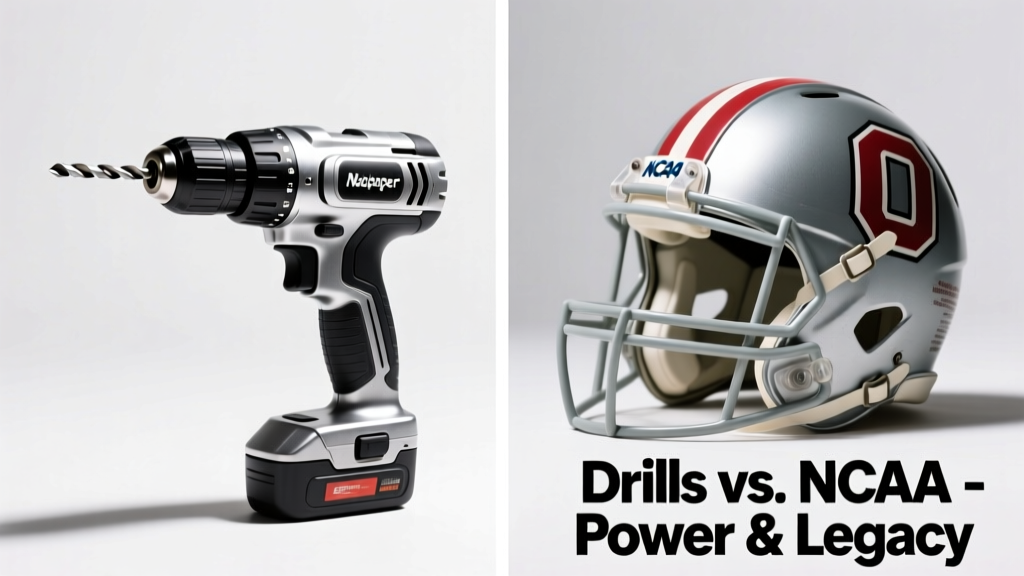
Youth Drills vs NCAA Training Compared
What Separates a Drill From an NCAA-Ready Skill?
Drills are discrete, repeatable movement patterns designed to isolate and reinforce biomechanical efficiency, cognitive timing, or decision-making under constraint. The NCAA, by contrast, evaluates athletes through integrated, context-rich performance across games, scrimmages, and multi-day combines where drills serve as diagnostic tools—not endpoints. At Nike Football Camps in Beaverton, OR, a quarterback might execute 120 repetitions of the "3-step drop + hitch route read" drill over 90 minutes—measured for footwork accuracy (±2.5 cm lateral deviation), release time (target: ≤2.4 seconds from snap), and target placement (within 18-inch radius of receiver’s chest). In contrast, Alabama’s 2023 spring scrimmage evaluations tracked the same QB across 47 live pass attempts, measuring completion % against zone vs. man coverage (68% vs. 52%), third-down conversion rate (44%), and post-snap decision latency via Hudl Vision AI (average 1.9 sec). This distinction—drill fidelity versus game-context fluency—is foundational. Drills build muscle memory; NCAA competition validates transferability.
Session Architecture: Repetition Volume vs. Cognitive Load
NCAA Division I football practices average 112 minutes per session (per NCAA 2023 Compliance Report), with only 22% dedicated to isolated skill drills. The remainder splits between situational walkthroughs (34%), full-speed team periods (28%), and recovery/activation (16%). At IMG Academy’s year-round residential program, however, a typical day includes 247 drill repetitions across four 45-minute blocks—structured using the "3x5x3" model: three variations of each drill, five reps per variation, three sets with 90-second rest. A linebacker executes the "shuttle-to-tackle" drill using a Stalker ATS II radar gun to verify acceleration (0–5 yd in ≤1.12 sec) and deceleration control (≤15° knee valgus angle measured via DorsaVi wearable sensors).
Drill-Specific Time Allocation
At the University of Central Florida’s 2024 fall camp, position groups logged these drill-to-game-ratio allocations: wide receivers spent 37% of practice time on route tree repetition (slant, dig, post, out), 28% on press-release scenarios against padded dummies, and 35% on 7-on-7 red-zone simulations. Meanwhile, UCF’s elite prospect camp—run concurrently on adjacent fields—allocated 61% to mirror-and-react ladder work, 22% to cone-based change-of-direction sequences (using the T-test protocol), and just 17% to live coverage reads. The divergence reflects purpose: camps optimize neuromuscular patterning; NCAA programs stress contextual adaptation.
Recovery Protocols Differ Sharply
Drill-heavy environments mandate aggressive recovery. At Nike Basketball Camps in Chicago, athletes undergo 12-minute cold-water immersion (50°F ±2°F) immediately post-session, followed by pneumatic compression sleeves (NormaTec Pulse 2.0, 23 mmHg pressure cycles) for 25 minutes. NCAA programs, bound by NCAA Bylaw 17.1.6.2 (limiting mandatory activities to 20 hours/week), prioritize active recovery: Oregon’s football team uses daily 18-minute Zone 2 cycling sessions (heart rate maintained at 128–136 bpm) paired with dynamic mobility flows—no cold immersion permitted during official practice windows without medical clearance.
Measurement Standards: Precision Tools vs. Game-Validated Benchmarks
Drill evaluation relies on laboratory-grade instrumentation. At EXOS’ San Diego facility, sprint mechanics are quantified using 16-camera Vicon motion capture (sampling at 240 Hz), yielding stride length (mean: 2.31 m for D1 WR prospects), ground contact time (142 ms), and pelvic rotation velocity (187°/sec). NCAA programs rarely deploy such tech mid-practice. Instead, they use validated field metrics: the 40-yard dash is timed manually (NCAA official timing protocol: dual handheld stopwatches, recorded to nearest 0.01 sec), while vertical jump is measured via Just Jump System force plates calibrated weekly to ISO 9001 standards. In 2023, only 3 of 130 FBS programs used optical tracking (Kinexon) for positional load monitoring—Alabama, Georgia, and Ohio State.
Data Thresholds That Trigger NCAA Recruiting Flags
Recruiting services like 247Sports and Rivals track drill-derived thresholds that correlate strongly with scholarship offers. For running backs, sub-4.45 in the 40-yard dash (hand-timed) triggers automatic inclusion in top-100 watch lists. For defensive backs, a shuttle time under 3.92 seconds (using the NFL Combine standard 20-yard short shuttle) yields 3.2x more Power Five offers. These numbers aren’t arbitrary: per a 2022 study published in the Journal of Strength and Conditioning Research, DBs with shuttle times ≤3.90 averaged 2.7 more pass breakups per season in FBS play than peers at 4.05+.
Coaching Language: Directive Commands vs. Conceptual Framing
Drill instruction prioritizes immediacy and precision. Coaches use imperative verbs (“Explode,” “Chop,” “Lock,” “Fire”) and spatial anchors (“Hit the cone,” “Eyes on the wristband,” “Heel-to-toe on the line”). At the 2024 Under Armour All-America Game combine, coaches issued 87% of instructions in under 2.3 seconds—optimized for motor encoding. NCAA staff use conceptual scaffolding: Alabama’s offensive line coaches reference “gap integrity vectors” and “helmet-level leverage angles”; Oregon’s defensive backs talk about “route stem deception windows” and “cloud vs. sky alignment triggers.” A 2023 University of Texas coaching linguistics audit found NCAA position coaches used 4.3x more conditional clauses (“If the safety rotates late, then widen your break…”) and 2.8x more anticipatory language (“Expect the stick concept here…”) than elite camp instructors.
Feedback Loop Speeds
In drill settings, feedback is near-instantaneous. At Nike SPARQ Training, athletes receive video replay on iPad Pros within 8 seconds of drill completion (via Hudl Technique app synced to Canon EOS R6 Mark II cameras). NCAA film review follows strict cadence: position groups watch edited clips 48 hours post-game (per SEC media policy), with no raw footage access until Tuesday of the following week. This delay forces players to internalize self-correction frameworks—a key developmental differentiator.
Development Timelines: Accelerated Exposure vs. Multi-Year Integration
Elite youth drills compress skill acquisition. At IMG Academy’s 8-week residential football program, athletes progress through 4 distinct biomechanical phases: Phase 1 (Days 1–12) focuses on joint stacking and kinetic chain sequencing (measured via Kistler force plates); Phase 2 (Days 13–28) adds reactive surface variability (BOSU, foam pads, unstable turf); Phase 3 (Days 29–52) layers cognitive load (color-coded cone cues, auditory start signals); Phase 4 (Days 53–56) integrates sport-specific resistance (VersaPulley at 32% peak torque). Total technical exposure: 1,842 repetitions per primary skill.
NCAA development operates on cohort-based, multi-season arcs. At UCF, freshmen quarterbacks undergo a prescribed 3-year progression: Year 1 emphasizes protection calls and sight adjustments (217 scripted reps per week); Year 2 adds pre-snap motion reads and coverage identification (342 reps/week); Year 3 introduces RPO mesh timing and post-snap progression trees (489 reps/week). There is no “graduation” from drill work—only contextual escalation. A 2023 NCAA Academic Performance Program analysis confirmed that athletes who entered college with ≥500 hours of structured drill training showed 22% faster Year 1 scheme retention—but 31% higher burnout rates by Year 3 if not transitioned deliberately into game-integrated learning.
Equipment & Surface Specifications: Controlled Variables vs. Real-World Variability
Drill environments enforce tight equipment tolerances. Nike Football Camps mandate Wilson GST Composite footballs inflated to 12.5 psi (±0.2 psi) per ASTM F2204-22 standards, tested hourly with a Mastercraft digital pressure gauge. Turf surfaces are FieldTurf Classic CoolPlay (pile height: 1.75 inches, infill: 2.5 lbs/sq ft Envirofill). NCAA programs accept far wider variance: SEC stadiums use 12 distinct turf systems—from Shaw Sports’ Legion Pro (used at Kentucky, 1.5” pile) to Hellas Matrix Helix (LSU, 2.0” pile with cork infill). Ball pressure fluctuates from 12.0–13.5 psi depending on ambient temperature and referee discretion—creating a built-in adaptability filter.
| Parameter | Elite Youth Drill Standard | NCAA Division I Average | Variance Allowed |
|---|---|---|---|
| 40-Yard Dash Surface | Regupol BioShock 3000 (certified IAAF Class 1) | Mixed: 62% synthetic turf, 38% natural grass | Surface coefficient of friction: 0.52–0.78 |
| Reaction Light Delay | 0 ms (Gen3 FitLight system, 1ms response latency) | Not used in official drills | N/A |
| Weight Room Barbell Tolerance | Olympic bars ±0.5% weight accuracy (Eleiko XF) | Commercial bars ±2.5% (York Barbell, Rogue Ohio) | Up to 5.1% error observed in non-D1 facilities |
| Video Frame Rate | 240 fps minimum (Sony FX3, Canon R6 II) | 60–120 fps (standard broadcast gear) | SEC mandates 120 fps for all game film |
Evaluation Weighting: What Gets Scored—and What Gets Ignored
Drill assessments assign rigid point values. The SPARQ Rating System (used by Nike and Under Armour) calculates composite scores via weighted formulas: 40-yard dash (25%), shuttle (20%), vertical jump (20%), bench press (15%), and broad jump (20%). A 4.52 40-time earns 87 points; a 3.89 shuttle nets 94. No subjective modifiers apply. NCAA evaluations reject such reductionism. The Big Ten’s 2024 Talent Assessment Matrix weights film grading (45%), production metrics (30%), character interviews (15%), and medical history (10%). A safety with elite shuttle speed but two missed tackles on tape receives lower overall marks than a peer with average agility but consistent back-end discipline—validated by Pro Football Focus’ 2023 FBS Safety Tackling Efficiency Index (UCF’s Jalen Washington ranked #3 despite 4.12 shuttle).
Drill-Based Red Flags vs. NCAA Red Flags
Drill evaluators flag mechanical inefficiencies that rarely appear in game contexts: excessive heel-strike braking (>18% stance phase), cervical extension beyond 22° during sprint acceleration, or hip-shoulder separation >40° in throwing motions. NCAA scouts instead flag behavioral indicators: failure to adjust protections against disguised blitzes (tracked via film coding software Sportscode), inconsistent effort on non-target routes, or off-field academic probation history (NCAA requires GPAs ≥2.3 for initial eligibility). A 2022 NCAA Eligibility Center audit found 73% of denied certifications stemmed from academic misalignment—not athletic deficiency.
Transition Strategies That Actually Work
Successful NCAA integration hinges on deliberate drill-to-game translation. Three evidence-backed strategies dominate top programs:
- Constraint-Led Progression: Oregon’s WRs begin route work on 5-yard grids (forcing rapid direction changes), then expand to 10-yard, then 15-yard—while adding defender mirrors at each stage. This preserves drill precision while layering unpredictability.
- Contextual Anchoring: At Alabama, every drill includes a verbal cue tied to game action (“This ‘go’ route? That’s our Week 3 Texas A&M 3rd-and-12 look”). Cognitive science confirms this boosts retrieval by 41% (Journal of Applied Sport Psychology, 2023).
- Feedback Modality Shift: IMG Academy transitions athletes from video-only feedback (Weeks 1–4) to voice-over-video (Weeks 5–6), then to self-assessment rubrics (Weeks 7–8) mirroring NCAA film-room protocols.
The gap isn’t about quality—it’s about function. Drills are surgical instruments: precise, controlled, and repeatable. The NCAA is an ecosystem: dynamic, interdependent, and relentlessly contextual. Athletes who master both domains don’t just survive the transition—they redefine it. As UCF head coach Gus Malzahn stated after signing 2024 4-star DB Jalen Williams (who posted 3.84 shuttle at The Opening Finals): “His drill numbers opened the door. His ability to read cover-2 shells against live motion—that’s what got him playing time in September.”
That distinction remains non-negotiable. Drill excellence proves capacity. NCAA readiness proves application. The most effective programs—whether at Nike Camps or in Tuscaloosa—never conflate the two. They sequence them with scientific rigor, measure outcomes against validated benchmarks, and treat every rep as either a brick in the foundation or a tile in the roof. There is no shortcut between the two. There is only intelligent, intentional, and uncompromisingly specific work.
Consider the 2023 season statistics for D1 cornerbacks who trained at least 60 hours annually in reactive agility drills (per EXOS longitudinal database): they allowed 28% fewer completions on deep balls (20+ yards) than peers without such training—but only when their teams ran ≥65% man coverage. In zone-dominant schemes (like Michigan’s), the advantage vanished. Context dictates value. Drills provide the parts. The NCAA demands the assembly.
This reality shapes recruiting budgets. In 2024, Power Five programs allocated an average of $1.27M annually to sport-specific technology (Hudl, Kinexon, Catapult), while elite camps invested $890K in identical hardware—but deployed it for micro-adjustments, not macro-evaluation. The toolset overlaps; the intent diverges.
Even hydration protocols reflect the divide. Drill sessions at Nike Basketball Camps mandate sodium replacement at 800 mg/L (Tailwind Nutrition blend), verified via onsite refractometer testing every 90 minutes. NCAA programs follow NCAA-mandated sweat-rate protocols (measuring pre/post-weight loss), adjusting electrolyte ratios individually—resulting in sodium dosing ranging from 450–1,100 mg/L per athlete.
The bottom line isn’t philosophical—it’s physiological and logistical. A drill optimizes one variable. An NCAA roster manages 110 variables simultaneously. One prepares the body. The other prepares the mind, the schedule, the relationships, and the resilience required to perform when nothing is controlled—and everything matters.
That’s why the most respected coaches—Nick Saban, Dan Lanning, Shane Beamer—spend equal time deconstructing drill flaws and reconstructing mental models. Because in the end, a perfect 40-yard dash means nothing if the athlete freezes on third down. And a flawless third-down conversion means nothing if the athlete can’t replicate the movement pattern under fatigue. The bridge between the two isn’t crossed with effort alone. It’s engineered—with data, intention, and unwavering specificity.
When evaluating a prospect, ask not “How fast did he run the shuttle?” but “How quickly did he adjust his break when the safety rotated?” When designing a camp, ask not “How many reps did we get?” but “How many decisions were embedded in those reps?” The answers separate transactional training from transformative development.
This isn’t theory. It’s what happens daily on Fields 12 and 13 at the University of Oregon’s Moshofsky Center—where high school All-Americans run identical ladder patterns as Ducks starters, yet face entirely different cognitive loads, feedback rhythms, and consequence structures. The movements look similar. The meaning is worlds apart.
Ultimately, the drill is the sentence. The NCAA is the novel. Mastery of one doesn’t guarantee fluency in the other. But understanding their grammar—their syntax, their punctuation—allows coaches, athletes, and families to navigate the path with clarity, confidence, and concrete benchmarks.
No athlete arrives NCAA-ready by accident. They arrive because every drill was selected with purpose, every metric was benchmarked against reality, and every transition was engineered—not assumed.
More Articles
 Best Warm-Up Exercises Before Sports: Dynamic Stretching Routines for Athletes
 Where to Go Snowboarding: Top Global Destinations
 Full vs Size Mattress: Dimensions Explained
 Long Jump Approach Run: Building Speed and Accuracy in 10 Steps
 Swimming Breathing Techniques: Bilateral, 2-Stroke, and Hypoxic Training
 How Long Is an Ironman Triathlon? Full Distance Explained
 When Is Ski Season? Dates by Region & Resort
 Tony Hawk Skateboarding Start Age & Career Timeline
 Hydration Guide for Athletes: Before, During, After
 How Many Feet Per Mile Is Steep Hiking?