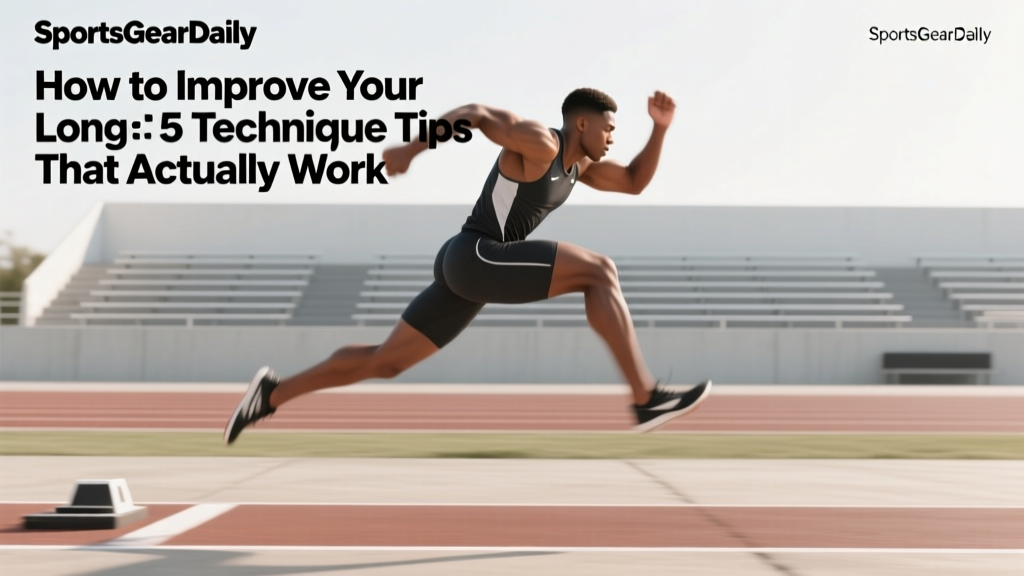
How to Improve Your Long Jump: 5 Technique Tips That Actually Work
The Four Phases of Long Jump
Long jump consists of four distinct phases: the approach run, the takeoff, the flight, and the landing. Each phase contributes to your overall distance, and improving any one of them can lead to significant gains. The approach run builds the speed that will carry you through the air, the takeoff converts horizontal speed into vertical lift, the flight maintains your body position for maximum distance, and the landing ensures you do not lose centimeters at the end.
Most beginners focus exclusively on the takeoff, thinking that jumping higher will automatically mean jumping farther. While takeoff is important, research shows that approach speed is the single biggest predictor of long jump distance. A faster approach gives you more momentum to convert into distance at takeoff. The best long jumpers in the world are also excellent sprinters, with many having 100-meter times under 10.5 seconds.
In this guide, we break down five specific technique improvements that address all four phases. These tips are based on coaching best practices used at the collegiate and elite level, adapted for recreational and developing athletes. Whether your goal is to break 15 feet or 22 feet, these principles apply.
Tip 1: Build a Consistent Approach Run
Your approach run should be 16-22 strides for most athletes, depending on your speed and experience level. Beginners should start with 12-14 strides and gradually increase as they become more comfortable. The key is consistency: you should hit the takeoff board within a few centimeters of the same spot every time.
To develop a consistent approach, mark your starting point and practice running through the board without jumping. Count your strides and adjust your starting mark until you consistently hit the board with your takeoff foot. Practice this at least 20 times per session. Once your approach is reliable, you can focus on building speed progressively through the run rather than sprinting at full speed from the start.
The ideal approach builds speed gradually, reaching maximum controllable speed at the takeoff board. Sprinting at 100 percent from the first stride often leads to deceleration near the board as you struggle to control your speed. Instead, aim for a relaxed acceleration that peaks in the last 4-6 strides before takeoff.
Tip 2: Master the Penultimate Stride
The penultimate stride, the second-to-last step before takeoff, is where the magic happens. This stride should be slightly longer than your normal running stride and slightly lower to the ground. It acts as a lowering mechanism that prepares your center of mass for the powerful upward drive at takeoff.
During the penultimate stride, your hips should drop slightly (about 2-3 centimeters lower than your normal running posture). This lowered position allows you to push up and forward at takeoff, converting horizontal momentum into vertical lift. The last stride before takeoff should be slightly shorter than the penultimate, creating a quick, explosive push-off from the board.
Practice the penultimate-lower technique by doing approach runs at 75 percent speed and focusing specifically on the feel of the last two strides. You should feel a slight sinking on the second-to-last step followed by a powerful upward drive on the final step. Once this feels natural at reduced speed, gradually increase your approach speed while maintaining the same technique.
Tip 3: Optimize Your Takeoff Angle
The optimal takeoff angle for long jump is between 18 and 22 degrees. This is much lower than most beginners expect, as the instinct is to jump as high as possible. However, long jump is primarily about horizontal distance, and too steep an angle wastes the speed you built during your approach.
To achieve the correct angle, focus on driving your free leg (the non-takeoff leg) up and forward rather than straight up. Your knee should drive to hip height while your takeoff leg extends fully. Your torso should be upright or slightly leaning forward at takeoff, not leaning back. A common mistake is throwing the head and shoulders back, which creates a steep angle and reduces distance.
Film yourself from the side during practice jumps to check your takeoff angle. You should see a smooth transition from the running approach to an upward-forward drive. If your body is nearly vertical at takeoff, you are jumping too high. If you are leaning too far forward, you are not getting enough lift and will land too quickly.
Tip 4: Choose the Right Flight Technique
There are three main flight techniques in long jump: the sail, the hang, and the hitch-kick. The sail is the simplest, where you maintain your takeoff position in the air with your free leg extended forward. The hang involves extending both legs forward while arching your back, creating a bow shape. The hitch-kick, used by most elite jumpers, involves a running motion in the air to maintain balance and prepare for landing.
Beginners should start with the sail technique as it requires the least coordination and allows you to focus on maintaining a good body position. As you improve, you can progress to the hang and eventually the hitch-kick. The key principle across all techniques is to prevent your legs from dropping too early, which causes you to land short of your maximum potential distance.
Regardless of which technique you use, keep your eyes focused on a point ahead of you during flight. Looking down causes your body to follow your gaze and drop prematurely. Keep your arms active and use them for balance, extending them forward as you prepare for landing.
Tip 5: Perfect Your Landing
The landing phase is where many beginners lose the most distance. The measurement is taken from the nearest mark in the sand to the takeoff board, so if your hand or hip touches the sand behind your feet, that shorter distance is recorded. The goal is to have your feet land as far forward as possible and then carry your body forward over your feet.
As you prepare to land, extend both legs forward with your knees slightly bent. At the moment your feet contact the sand, push your hips forward and bend your knees to absorb the impact. Your momentum should carry you forward and past your footprints. Avoid reaching back with your hands or sitting backward, as this will dramatically reduce your measured distance.
Practice landing technique separately from full jumps. Stand at the edge of the pit and practice extending your legs forward and falling forward into the sand. Focus on the feeling of your hips passing over your feet before you come to a stop. Once this feels natural, incorporate it into your full approach jumps.
More Articles
 When Is Ski Season? Dates by Region & Resort
 How Much Is a CrossFit Gym Membership? (2025 Rates)
 Where Can You Go Skydiving? Top Global Locations
 How Much Is a Pilates Reformer? (2025 Prices)
 6-Week Soccer Goalkeeper Workout Plan
 When Does Park City Ski Resort Open? 2025-2026 Dates
 How Many Skydivers Die Per Year? 2025 Stats & Safety Facts
 Ultimate Teams Guide: High-Performance in 2026
 What Distances Are in a Triathlon? Full Breakdown
 Youth Drills vs NCAA Training Compared