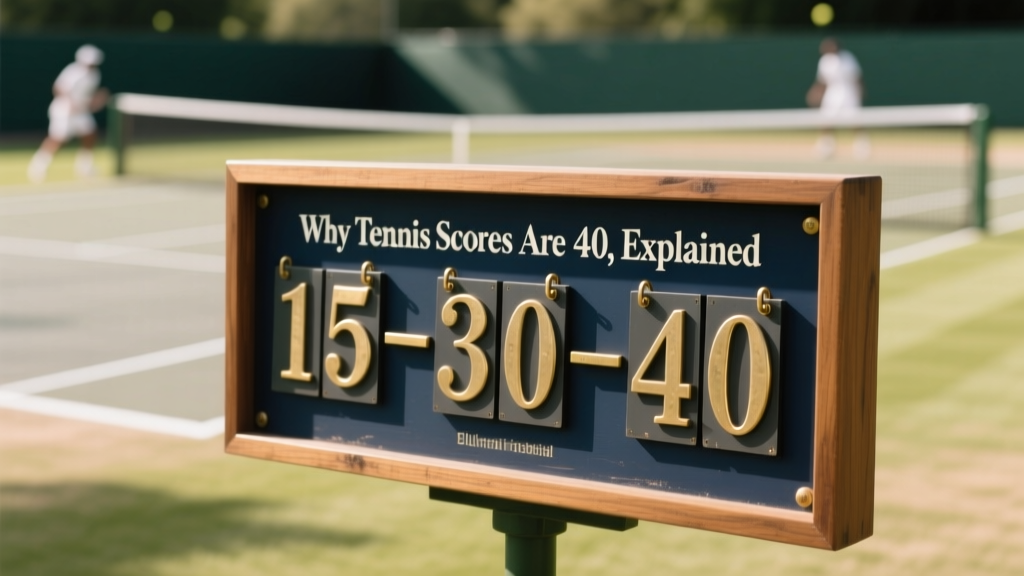
Why Tennis Scores Are 15, 30, 40 Explained
Tennis scoring uses the unique sequence of 15, 30, and 40 due to its origins in medieval French clock-face timekeeping, where each point advanced the hand by 15 minutes. Reaching 45 was simplified to 40 to prevent a game from ending on a score of 60, aligning with the quarter-hour segments of a clock.
Why Does Tennis Use 15, 30, and 40 Instead of 15, 30, 45?
The tennis scoring system is one of the most distinctive in sports. Unlike most games that use sequential numbers, tennis counts points as 15, 30, 40, and then game. This unusual progression has deep historical roots and reflects the sport’s evolution from 12th-century French handball games.
The Clock-Face Theory
One widely accepted theory traces tennis scoring to analog clocks. In medieval France, early versions of real tennis (the precursor to modern lawn tennis) used a clock face to track points. Each point won moved the hand by 15 minutes:
- First point: 15
- Second point: 30
- Third point: 45
- Fourth point: 60 (game)
However, to prevent a game from ending at 60—possibly to allow for deuce and advantage rules—the score of 45 was later shortened to 40. This adjustment kept the game within the 60-minute cycle while allowing room for extra points like deuce (40-40).
Historical Evolution of Tennis Scoring
Tennis originated as "jeu de paume" (game of the palm) in 12th-century France, where players hit the ball with their hands. Over centuries, rackets were introduced, and the game evolved across Europe. The scoring system remained tied to the clock concept even as the sport moved outdoors and standardized.
Standardization in the 19th Century
When Major Walter Clopton Wingfield formalized modern tennis in 1874, he adopted existing scoring conventions. The All England Club, which hosted the first Wimbledon Championships in 1877, further cemented the 15-30-40 system in official rules.
How Modern Tennis Scoring Works
Understanding the logic behind 15, 30, 40 is easier when examining how points build into games, sets, and matches:
- Point: Scored as 15, 30, 40.
- Game: Win four points with a two-point lead.
- Set: Win six games with a two-game lead (or tiebreak at 6-6).
- Match: Best of three or five sets.
Special Rules Around 40-All (Deuce)
When both players reach 40, the score becomes deuce. From this point, a player must win two consecutive points: one for advantage, and another to win the game. This rule likely influenced the shift from 45 to 40—to keep scores under 60 and maintain symmetry on the clock face.
| Year | Event | Scoring System Used | Significance |
|---|---|---|---|
| 1200s | Jeu de Paume in France | Clock-based (15, 30, 45) | Origins of point structure |
| 1500s | Real Tennis in England | 45 changed to 40 | Prevents game end at 60 |
| 1874 | Walter Wingfield's Sphairistike | Adopted 15-30-40 | Early modern standardization |
| 1877 | First Wimbledon Championship | Official use of 15-30-40-deuce | Global codification |
| 1973 | Introduction of tiebreak | Retained 15-30-40 | Modern adaptation without changing core |
The timeline shows how the 15-30-40 system persisted through centuries of change, adapting to new formats while retaining its historical foundation. Even with innovations like the tiebreak, the core scoring method remains unchanged, highlighting its cultural and structural resilience.
Frequently Asked Questions About Tennis Scoring: Why 15, 30, 40?
Why don't tennis scores go to 45 instead of 40?
The shift from 45 to 40 likely occurred to keep scores below 60, aligning with the quarter-hour segments of a clock. This allowed room for deuce and advantage points without exceeding the 60-minute cycle, preserving the clock-face model used in early French tennis.
What is the origin of the word 'love' in tennis scoring?
'Love' means zero in tennis and likely comes from the French word 'l'oeuf' (egg), symbolizing an empty score. English speakers misheard it as 'love,' and the term became standard in scoring.
Why is the score called 'deuce' at 40-40?
The term 'deuce' comes from the French phrase 'deux le jeu,' meaning 'two the game,' indicating that two consecutive points are needed to win. It reflects the requirement to win by two clear points after reaching 40-40.
Do all tennis tournaments use the same scoring system?
Yes, all professional tennis tournaments follow the same point structure: 15, 30, 40, game. While set and match formats vary slightly (e.g., final set tiebreaks), the fundamental scoring progression remains consistent across Grand Slams and ATP/WTA events.
Has tennis always had a tiebreak?
No, the tiebreak was introduced in 1970 by Jimmy Van Alen to prevent excessively long sets. Before that, players had to win by two games, leading to marathon matches. The tiebreak preserved excitement while maintaining fairness, but the 15-30-40 point system remained untouched.
More Articles
 How Many Seasons Did Michael Jordan Play Baseball?
 Who Is the Current Heavyweight Boxing Champion?
 Why College Baseball Has Two First Bases
 Where Baseball Was Invented: Origins and Myths
 Why Chicago Has Two Baseball Teams Explained
 How Many Games in MLB Playoff Baseball? Full Breakdown
 Super Bowl Start Time Pacific Time: What You Need to Know
 Who Is Boxing Tonight? Inoue vs. Goodman Fight Details
 Who Invented Badminton? Origins & History Explained
 How Much Do Tennis Players Make? Earnings Breakdown 2025