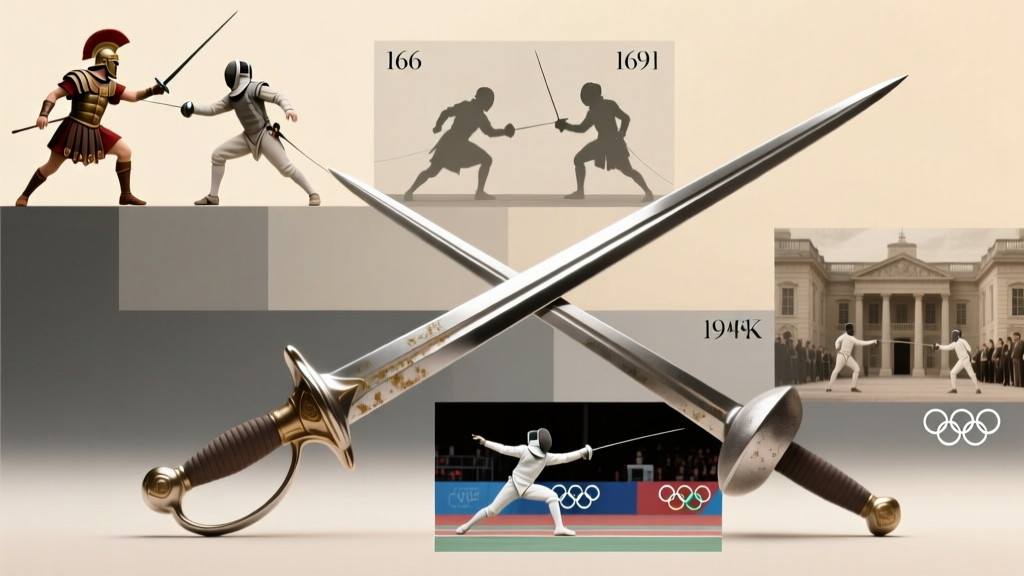
Where Did Fencing Originate? History & Evolution
Fencing originated in ancient civilizations, with its earliest roots in Egypt and Greece, but developed into a formal sport in Renaissance Europe, particularly in Spain and Italy.
The Historical Origins of Fencing
Fencing as a practice dates back thousands of years, evolving from military training and dueling traditions into a modern Olympic sport. While weapon-based combat appears in many ancient cultures, the structured discipline of fencing began taking shape during the 14th and 15th centuries in Europe.
Ancient Foundations
Archaeological evidence from ancient Egypt and Greece shows depictions of sword fighting that resemble early forms of fencing. These were not codified systems but rather practical combat techniques used for warfare or self-defense.
- Egyptian wall carvings from 1190 BCE illustrate organized bouts with blunted weapons.
- Ancient Greek art includes scenes of armed combat resembling épée and foil techniques.
- Roman gladiatorial combat contributed to later European martial traditions.
Renaissance Development in Europe
The true foundation of modern fencing emerged in 15th-century Spain and Italy. Spanish masters like Don Pedro de la Torre wrote some of the earliest known treatises on swordsmanship.
Italian fencing schools in the 16th century systematized techniques using the rapier, emphasizing speed, precision, and footwork—principles still central today.
- Camillo Agrippa published a seminal work in 1553 defining linear geometry in fencing.
- The Italian school influenced French fencing, which later dominated Olympic competition.
- By the 17th century, France established royal academies dedicated to fencing instruction.
Evolution Into a Modern Sport
Fencing transitioned from lethal duels to regulated sport during the 18th and 19th centuries. The invention of the foil, followed by the épée and sabre, allowed safer training and standardized rules.
The establishment of the Fédération Internationale d'Escrime (FIE) in 1913 unified international competition standards, paving the way for global events including the Olympics.
Key Milestones in Fencing History
| Year | Event | Location |
|---|---|---|
| 1190 BCE | Earliest known depiction of fencing-like combat | Deir el-Bahri, Egypt |
| 1553 | Camillo Agrippa publishes foundational fencing treatise | Rome, Italy |
| 1776 | First official fencing manual published in France | Paris, France |
| 1896 | Fencing included in first modern Olympic Games | Athens, Greece |
| 1913 | International Fencing Federation (FIE) founded | Paris, France |
| 1936 | Electric scoring introduced for épée | Berlin, Germany |
| 1956 | Electric scoring adopted for foil | Melbourne, Australia |
| 1988 | Electric sabre officially used in Olympics | Seoul, South Korea |
The timeline shows how fencing evolved from ancient practice to technologically advanced sport. Key innovations like electric scoring dramatically increased accuracy in judging touches. The consistent presence of fencing in the Olympics since 1896 highlights its enduring global appeal.
Global Spread and Competitive Structure
Today, fencing is practiced in over 150 countries and governed by the FIE. Three disciplines define modern competition:
- Foil: A light thrusting weapon targeting the torso; follows right-of-way rules.
- Épée: Heavier thrusting weapon with full-body target area; no priority rules.
- Sabre: Cutting and thrusting weapon targeting everything above the waist.
Nations such as Italy, France, Hungary, Russia, and South Korea have produced dominant fencers across generations.
Common Questions About Where Fencing Originated
Where did fencing originate historically?
Fencing originated in ancient Egypt and Greece as depicted in artwork, but became a formal discipline in 15th-century Spain and Italy, where the first schools and treatises appeared.
Which country invented modern fencing?
Modern fencing was systematized in Italy during the Renaissance and further refined in France, making these two nations the primary architects of today’s sport.
When did fencing become an Olympic sport?
Fencing has been part of every modern Summer Olympics since the inaugural 1896 Games in Athens, making it one of the original Olympic sports.
What are the oldest known fencing manuals?
The oldest surviving comprehensive manual is Camillo Agrippa’s 1553 treatise, which introduced geometric principles to swordplay and laid the groundwork for modern technique.
How did fencing evolve from dueling to sport?
Fencing evolved through the use of lighter weapons like the foil for training, codified rules, and the elimination of lethal intent, shifting focus from combat to athletic competition by the 19th century.
More Articles
 How Baseballs Are Manufactured: Inside the Process
 Who Did Nebraska Volleyball Lose To in 2023?
 What's Inside the Olympic Medalists' Gift Bag?
 Who Played in the First Super Bowl? Teams and Result
 Who Played in Super Bowl 2022? Teams, Score & Highlights
 How Old Is Golfer Tom Watson? (2025 Update)
 Who Has Won All Four Golf Majors?
 Did Michael Jordan Play Major League Baseball?
 Where to Get Tennis Racket Restrung Near You
 How Old Is Freddie Couples the Golfer? (2025 Update)