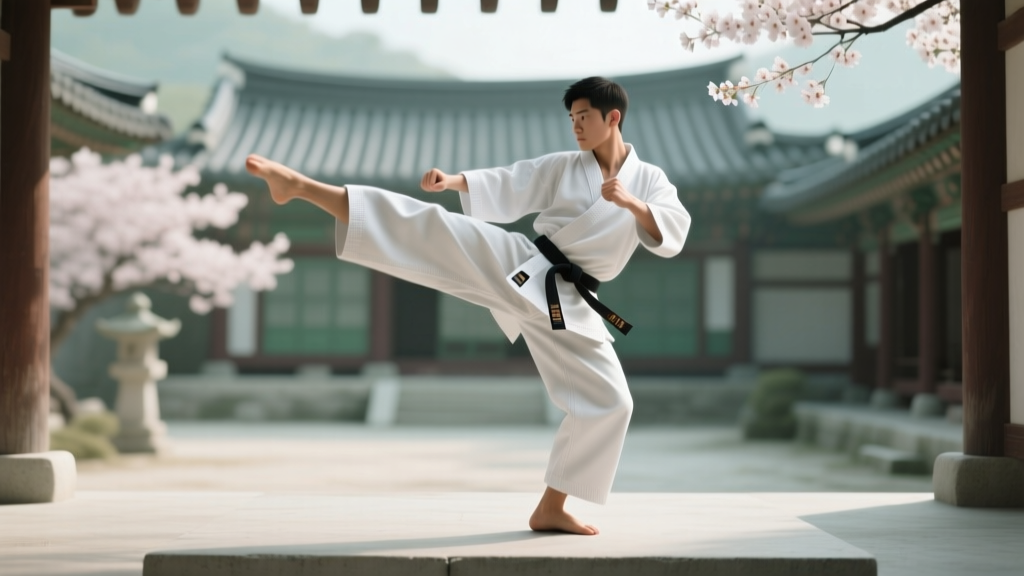
When Was Taekwondo Created? History & Key Facts
Taekwondo was officially created in 1955 as a unified Korean martial art, combining traditional techniques with modern combat sports principles.
The Origins of Taekwondo
Taekwondo emerged in mid-20th century Korea as a systematic unification of indigenous Korean martial arts. While its roots trace back over 2,000 years to ancient fighting styles like Taekkyeon and Subak, the formal creation of Taekwondo occurred in 1955 when South Korean military leaders and martial arts masters agreed on a standardized name and curriculum.
Historical Development Timeline
- 57 BCE–935 CE: Early forms such as Taekkyeon practiced during the Three Kingdoms period
- 1945: After Japanese occupation ended, Korean martial artists began reviving native styles
- 1950s: Nine kwans (schools) operated independently with varying techniques
- April 11, 1955: The term "Taekwondo" was officially adopted by the Korean government
- 1961: Korea Taekwondo Association established to unify training standards
- 1973: World Taekwondo Federation (now World Taekwondo) founded
- 2000: Became an official Olympic sport at Sydney Summer Games
Key Founding Figures
The development of modern Taekwondo involved collaboration among several influential martial artists and generals who sought to create a national identity through physical discipline.
Major Contributors
- General Choi Hong Hi: Credited as co-founder; promoted the International Taekwon-Do Federation (ITF)
- Dr. Un Yong Kim: Instrumental in gaining Olympic recognition through World Taekwondo leadership
- Choi Chang Keun: One of the original masters who helped standardize patterns (poomsae)
Taekwondo Styles and Organizations
Two primary branches define global practice today: World Taekwondo (WT), recognized by the IOC, and International Taekwon-Do Federation (ITF), emphasizing traditional forms.
| Organization | Founded | Headquarters | Global Reach | Olympic Affiliation |
|---|---|---|---|---|
| World Taekwondo (WT) | 1973 | Seoul, South Korea | 211 National Associations | Yes (since 2000) |
| International Taekwon-Do Federation (ITF) | 1966 | Pyongyang, North Korea (original); now split across multiple groups | Approx. 120 countries | No |
| Global Taekwondo Federation (GTF) | 1990 | Canada (current HQ) | Over 50 member nations | No |
The data shows that World Taekwondo has achieved significantly broader institutional adoption, particularly due to its Olympic affiliation and centralized governance. In contrast, ITF remains influential in traditional circles but lacks unified global coordination after organizational splits. WT's growth reflects strategic alignment with international sports bodies.
Evolution into a Global Sport
From its inception in 1955, Taekwondo rapidly expanded beyond Korea through military exchanges and cultural diplomacy. By the 1980s, demonstration events at the Olympics increased visibility, culminating in full medal status in 2000. Today, it is one of the most widely practiced martial arts worldwide, with over 80 million participants across 211 countries.
Frequently Asked Questions About Taekwondo
When was Taekwondo invented?
Taekwondo was formally created on April 11, 1955, when Korean leaders unified various martial arts schools under a single name and system.
Who created Taekwondo?
A group of Korean martial arts masters led by General Choi Hong Hi and supported by the South Korean government developed modern Taekwondo in the 1950s.
Is Taekwondo older than Korea itself?
No, but its ancestral forms—like Taekkyeon—date back to Korea’s Three Kingdoms period (57 BCE–935 CE), making its lineage over two millennia old.
Why was Taekwondo created?
It was developed to unify disparate post-war martial arts schools, promote national identity, and establish a structured self-defense and sport system for military and civilian use.
How did Taekwondo become an Olympic sport?
Through decades of international promotion and standardization by the World Taekwondo Federation, it gained demonstration status in 1988 and became an official Olympic event in 2000.
More Articles
 How Many Games in a Baseball Season? MLB Schedule Explained
 Career Guides Essentials: Practical Tools, Data-Driven Strategies, and Real-World Frameworks for Professional Growth
 A.J. Ferrari Wrestling Career and Achievements
 How Are Pro Bowl Players Selected? Full Breakdown
 How Many Karate Kid Movies Are There? Full List & Timeline
 Who Won Super Bowl 43? Steelers vs Cardinals
 Which Foot to Lead Off for Bowling: Right or Left?
 What Does Ippon Mean in Judo? Full Explanation
 Who Won the 2013 World Series? Red Sox Beat Cardinals
 Where Is the Super Bowl 2025? Location Revealed