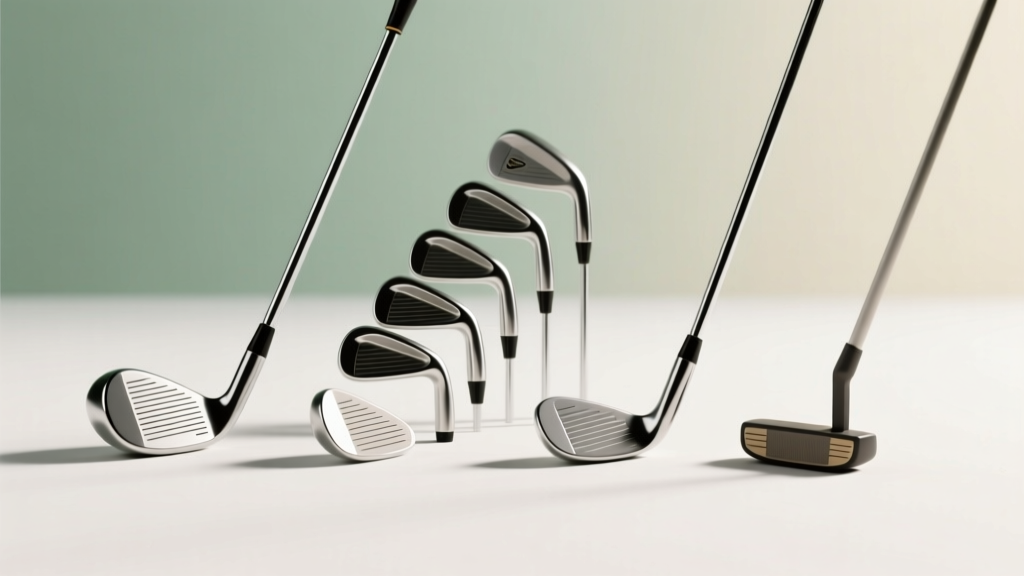
When to Use What Golf Club: A Complete Guide
Choosing the right golf club depends on distance, shot type, and course conditions: woods for long drives, irons for precision mid-range shots, wedges for short game and recovery, and putters on the green.
Understanding Golf Club Types and Their Primary Uses
Selecting the correct golf club is fundamental to improving your score and consistency. Each club is engineered for specific distances and situations. Knowing when to use each club can dramatically improve accuracy, control, and course management.
Types of Golf Clubs
- Drivers and Woods: Used for maximum distance, typically off the tee on par-4s and par-5s.
- Hybrids: Combine features of woods and irons; ideal for long shots from rough or fairway.
- Irons (3–9): Mid-to-short range shots with increasing loft as the number rises.
- Wedges (Pitching, Gap, Sand, Lob): High-lofted clubs for short approach shots, bunker play, and chipping.
- Putter: Used exclusively on the green for rolling the ball into the hole.
Factors That Influence Club Selection
Several variables affect which club you should choose on any given shot:
- Distance to the target
- Lie of the ball (fairway, rough, sand, uphill/downhill)
- Wind and weather conditions
- Obstacles (trees, bunkers, water)
- Your personal carry distance per club
Typical Distances and Recommended Clubs
While individual swing speeds vary, average amateur golfers can use the following chart as a baseline for club selection based on carry distance.
| Club | Average Carry Distance (Yards) – Men | Average Carry Distance (Yards) – Women | Common Use Case |
|---|---|---|---|
| Driver | 200–240 | 160–190 | Long par-4 and par-5 tee shots |
| 3-Wood | 180–215 | 140–170 | Fairway tee shots or second shots on par-5s |
| 5-Hybrid | 160–185 | 125–150 | Replacement for 5-iron; better from rough |
| 7-Iron | 140–160 | 110–130 | Approach shots from mid-distance |
| 9-Iron | 115–130 | 90–105 | Short approach or chip-and-run |
| Pitching Wedge (46°) | 90–110 | 70–90 | Full shots near green or bump-and-run |
| Sand Wedge (56°) | 60–80 (full), 30–50 (half) | 50–70 (full), 25–45 (half) | Bunker shots, high soft landings |
| Lob Wedge (60°) | 40–60 | 35–50 | High flop shots over obstacles |
| Putter | N/A | N/A | Rolling the ball on the green |
The data shows that most amateurs achieve peak distance with drivers and progressively lose yardage with higher-lofted clubs. Hybrids fill critical gaps between long irons and fairway woods, especially for players struggling with thin contact. Wedges offer fine control within 100 yards, where precision matters more than power.
Strategic Club Selection by Situation
Off the Tee
- Par-5s and long par-4s: Use driver for maximum distance.
- Tight fairways or doglegs: Opt for 3-wood or hybrid for accuracy.
- Par-3s: Choose iron or hybrid based on distance and wind.
Approach Shots
- 150 yards: Typically a 7-iron for men, 5-iron for women.
- 100 yards: Pitching wedge or gap wedge with partial swing.
- Within 50 yards: Use sand or lob wedge with controlled swing.
Short Game and Recovery
- Bunkers: Sand wedge with open stance and splash technique.
- Chipping around the green: Use 52°–56° wedge or even a 7-iron for low runners.
- Flop shots: Lob wedge with open face and steep swing.
Common Questions About When to Use What Golf Club
When should I use a hybrid instead of an iron?
Use a hybrid when hitting from the rough, uneven lies, or when you need more forgiveness and launch than long irons provide. Hybrids are easier to hit consistently than 3-, 4-, or 5-irons and are excellent for second shots on par-5s or long par-4s.
What club should I use for a 150-yard shot?
For most male amateurs, a 7-iron covers 150 yards. Female golfers may use a 5-iron or hybrid. Always consider wind, elevation, and your typical carry distance before selecting the club.
When do I use a sand wedge vs. a lob wedge?
Use a sand wedge (54°–56°) for standard bunker shots, pitches, and full short-game shots. A lob wedge (58°–60°) is best for high flop shots over hazards or when you need the ball to stop quickly with minimal roll.
Should I always use a driver off the tee?
No. On tight holes with out-of-bounds or doglegs, prioritize accuracy with a 3-wood or hybrid. Many pros choose shorter clubs to avoid trouble and set up easier approach shots.
How do I know which iron to use for a given distance?
Track your average carry distance for each iron during practice. Use a rangefinder or GPS on the course to determine exact yardage, then match it to your personal data. Consistency comes from knowing your numbers.
More Articles
 How Big Is a Boxing Ring? Sizes Explained
 Who Owns Golf Galaxy? Current Owner Revealed
 2025 MLB Playoff Teams: Who's In and What to Know
 Most Super Bowl Rings by a QB: Tom Brady's 7 Titles
 How Long Does a Tennis Match Last? Average & Record Times
 Where Was Tennis Invented? Origins & History
 How Many Golf Courses Are in the USA? 2025 Data
 When Was the First Super Bowl? Facts & History
 De Minaur Tennis: Career, Stats & 2025 Highlights
 How Many Super Bowls Has Patrick Mahomes Played In?