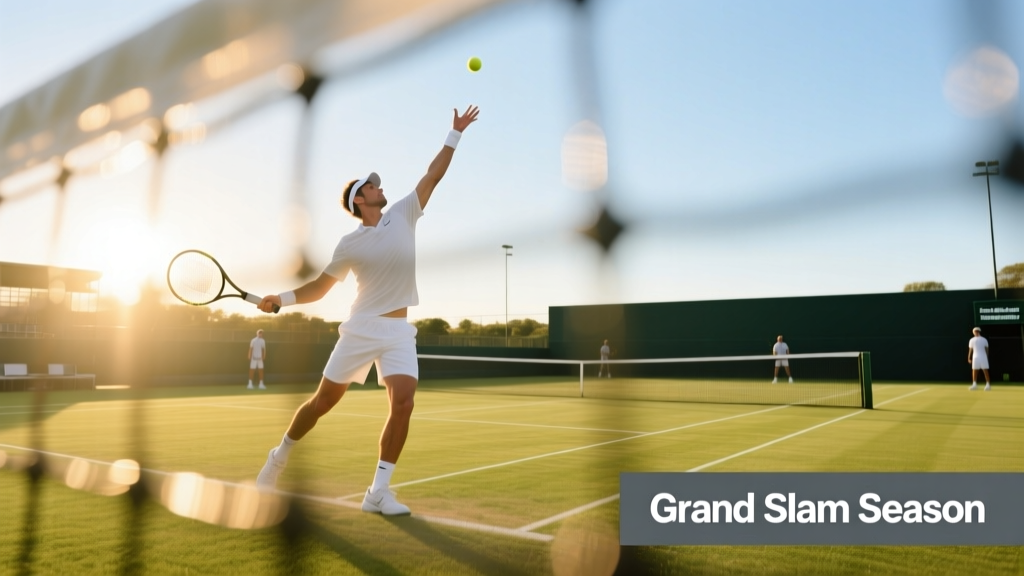
When Is Tennis Season? Pro & Amateur Schedule Explained
Tennis season runs year-round globally, with the professional calendar spanning from January to November, anchored by four Grand Slam tournaments and organized across ATP and WTA tours featuring hard, clay, and grass courts.
Understanding the Tennis Season Structure
The tennis season is uniquely structured compared to other sports, operating nearly year-round. Unlike seasonal sports such as football or basketball, elite tennis players compete across multiple continents throughout the year, transitioning between surfaces and tournament categories.
Key Components of the Tennis Calendar
- Four Grand Slam tournaments serve as the pinnacle events
- ATP (men) and WTA (women) organize tiered tour events
- Three primary court surfaces: hard, clay, and grass
- Season concludes with the ATP and WTA Finals in November
- Off-season typically lasts only 3–5 weeks annually
Grand Slam Tournament Schedule
The four Grand Slam tournaments define the annual tennis narrative. These events attract the highest rankings points, prize money, and global attention. Each Slam is played on a different surface and at a set time each year.
| Tournament | Date (2025) | Location | Surface | Prize Money (USD) | Ranking Points (Winner) |
|---|---|---|---|---|---|
| Australian Open | Jan 13–26 | Melbourne, Australia | Hard | $86,500,000 | 2000 |
| French Open | May 25 – Jun 8 | Paris, France | Clay | $69,250,000 | 2000 |
| Wimbledon | Jun 30 – Jul 13 | London, UK | Grass | $70,000,000 | 2000 |
| US Open | Aug 25 – Sep 8 | New York City, USA | Hard | $75,000,000 | 2000 |
Data shows that while the Australian Open leads in total prize purse, all four Slams award equal ranking points, emphasizing their equal importance in the sport. The sequence of surfaces—hard, clay, grass, then hard—requires players to adapt quickly across the year.
ATP and WTA Tour Breakdown
Beyond the Grand Slams, the ATP and WTA organize multiple tiers of tournaments including Masters 1000 (ATP), WTA 1000, 500, and 250-level events. These occur throughout the season and contribute to player rankings and qualification for year-end championships.
Tournament Categories and Importance
- Masters 1000 / WTA 1000: High-tier events with mandatory participation for top players
- ATP 500 / WTA 500: Mid-tier tournaments offering significant points and prize money
- ATP 250 / WTA 250: Entry-level tour events, often used for player development
- ATP/WTA Finals: Invite-only year-end championships for top 8 singles and doubles teams
Surface Transition and Player Adaptation
The tennis season's progression across surfaces presents unique athletic challenges. Players must adjust footwork, strategy, and physical conditioning as they move from fast hard courts to slow clay and then to low-bounce grass.
Surface Characteristics Overview
- Hard Courts: Most common surface; balanced speed and bounce (e.g., US Open, Australian Open)
- Clay Courts: Slower play with high bounce; favors endurance and topspin (e.g., French Open)
- Grass Courts: Fastest surface with low bounce; emphasizes serve and net play (e.g., Wimbledon)
Regional Tennis Seasons for Amateurs
While professionals play year-round, amateur and recreational tennis seasons vary by region due to climate. In colder regions, outdoor play is limited to spring through fall, while warmer areas support year-round activity.
Typical Regional Schedules
- North America: Outdoor season peaks May–September; indoor facilities extend play
- Europe: Similar to North America, with clay court focus in Southern Europe (Spain, France, Italy)
- Australia: Peak season during Australian Open (January); active year-round in temperate zones
- Asia: Indoor and outdoor play possible most of the year; major events in winter months
Frequently Asked Questions About Tennis Season
When does the professional tennis season start and end?
The professional tennis season officially begins in January with the ATP Cup and the Brisbane International, leading into the Australian Open. It culminates in November with the ATP Finals and WTA Finals, making it a 11-month competitive calendar with only a short off-season.
Are there tennis tournaments held all year round?
Yes, there are professional tennis tournaments almost every week of the year. While the main ATP and WTA tours run from January to November, lower-tier events like ITF World Tennis Tour tournaments continue into December and resume early January, ensuring near-continuous competition globally.
How long is the tennis Grand Slam season?
The Grand Slam season spans from mid-January (Australian Open) to early September (US Open), covering approximately eight months. Each Slam is spaced strategically to allow player recovery and surface transition, with the French Open following Melbourne, then Wimbledon, and finally the US Open.
What months are considered peak tennis season?
Peak tennis season runs from January through September, when all four Grand Slams and most Masters/WTA 1000 events take place. June and July are especially intense with the transition from clay to grass and the scheduling of Wimbledon immediately after Roland Garros.
Do tennis players have an off-season?
Yes, but it’s brief—typically 3 to 5 weeks in December. Top players use this time for rest, rehabilitation, and off-court training. Due to the packed schedule, many players limit their participation in minor events to manage fatigue and injury risk.
More Articles
 When Was Cricket Invented? Origins & History
 Did Jason Kelce Win a Super Bowl? Full Story & Facts
 Super Bowl 1980 Winner: Steelers 4th Title
 Who Has Won the Most Grand Slam Titles in Tennis?
 How Long Are College Baseball Games? (2025 Data)
 Where to Watch Nebraska Volleyball Tonight Live
 Who Bats First in Baseball? Explained with Data
 Who Played in Super Bowl 58? Teams, Score, and MVP
 Olympic Swimming Pool Dimensions: FINA Official Standards and Specifications
 How Many Games in an MLB Season? 162 + Playoffs