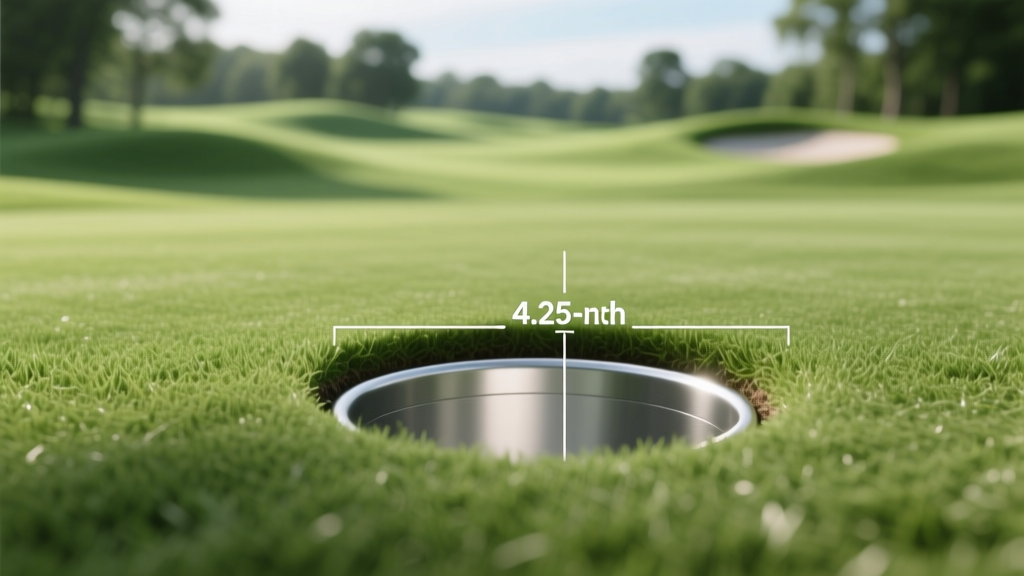
Golf Hole Diameter: What Is the Standard Size?
The standard diameter of a golf hole is exactly 4.25 inches (108 millimeters). This measurement has been uniformly adopted across all levels of play worldwide, as regulated by the Rules of Golf jointly established by the USGA and The R&A.
Understanding the Standard Golf Hole Dimensions
Golf is a game of precision, and even the smallest details—like the size of the hole—are standardized to ensure fairness and consistency. The golf hole, also known as the “cup,” is cut into the green and serves as the target for each shot leading up to a successful putt.
Why Is the Diameter Exactly 4.25 Inches?
The 4.25-inch diameter may seem arbitrary, but it traces back to the earliest hole-cutting tools used in Scotland during the 19th century. Early golf course groundskeepers used a tool similar to a sod cutter that naturally produced holes about 4.25 inches wide. This size proved practical and fair, allowing the ball to drop cleanly while remaining challenging.
- The diameter ensures the golf ball (1.68 inches) can fall into the cup without getting stuck.
- It provides a consistent target across all courses globally.
- The size allows for reliable hole-lining systems and maintenance equipment.
Regulatory Standards and Governing Bodies
The official rules of golf are maintained by two key organizations: the United States Golf Association (USGA) and The R&A (The Royal and Ancient Golf Club of St Andrews). Both bodies agree on the exact specifications for the golf hole.
Official Rules from USGA and The R&A
According to Rule 13.2b(1) of the Rules of Golf, the hole must be:
- 3.94 inches (100 mm) deep, minimum
- 4.25 inches (108 mm) in diameter
- Circular in shape
- Lined with a material no more than 0.25 inches below the surface
Historical Evolution of the Golf Hole Size
While today’s standards are precise, golf hole dimensions were not always uniform. In the early days of golf, particularly at St Andrews, holes were cut using hand tools, resulting in slight variations.
Key Milestones in Hole Standardization
- 1829: First recorded use of a hole-cutting tool at St Andrews.
- 1891: The R&A officially adopts 4.25 inches as the standard hole diameter.
- 1952: USGA formally aligns with the 4.25-inch standard.
- 2019: Updated rules clarify depth and lining requirements.
| Parameter | Standard Value | Unit | Governing Body |
|---|---|---|---|
| Hole Diameter | 4.25 | inches | USGA & The R&A |
| Hole Depth | Minimum 4 | inches | USGA & The R&A |
| Ball Diameter | 1.68 | inches | USGA & The R&A |
| Hole Liner Protrusion | Max 0.25 | inches | The R&A |
| Tolerance (Diameter) | ±0.02 | inches | USGA Equipment Standards |
The data confirms strict global uniformity in golf hole specifications. With a tolerance of only ±0.02 inches, course maintenance teams must use calibrated tools to ensure compliance. This level of precision supports fair competition, especially at professional levels where every putt counts.
Common Questions About Golf Hole Size
What is the official diameter of a golf hole?
The official diameter of a golf hole is 4.25 inches (108 millimeters), as defined by both the USGA and The R&A under the Rules of Golf.
Why is a golf hole 4.25 inches wide?
The 4.25-inch width originated from the diameter of early hole-cutting tools used in Scotland. It became standardized because it allowed the ball to drop cleanly and provided a consistent challenge across courses.
How deep is a golf hole?
A golf hole must be at least 4 inches (101.6 mm) deep, though most are slightly deeper to accommodate hole liners. The standard depth ensures the ball remains securely in the cup after dropping.
Does every golf course use the same hole size?
Yes, all regulation golf courses worldwide use a 4.25-inch diameter hole. This standardization ensures fairness and consistency in play, from local clubs to major championships like The Masters or The Open.
Can a golf hole be smaller than 4.25 inches?
No, a golf hole cannot be smaller than 4.25 inches in official play. Any deviation would violate the Rules of Golf set by the USGA and The R&A, potentially disqualifying scores in tournaments.
More Articles
 How Many Points to Win a Volleyball Match?
 When Was Super Bowl 52? Date, Winner & Key Facts
 Has Mahomes Lost a Super Bowl? Yes, Once in SB LV
 Super Bowl Start Time Today: 6:30 PM ET
 How Old Is Justin Rose? Age, Career & 2025 Stats
 Football Tools Checklist: Essential Equipment for Coaches, Players, and Referees
 How Many Super Bowls Did Brady Lose? 3 Defeats Explained
 Where Can I Play Volleyball Near Me? Top Locations & Tips
 How Many People Watching Super Bowl Now?
 LSU Baseball Game Today Start Time & How to Watch