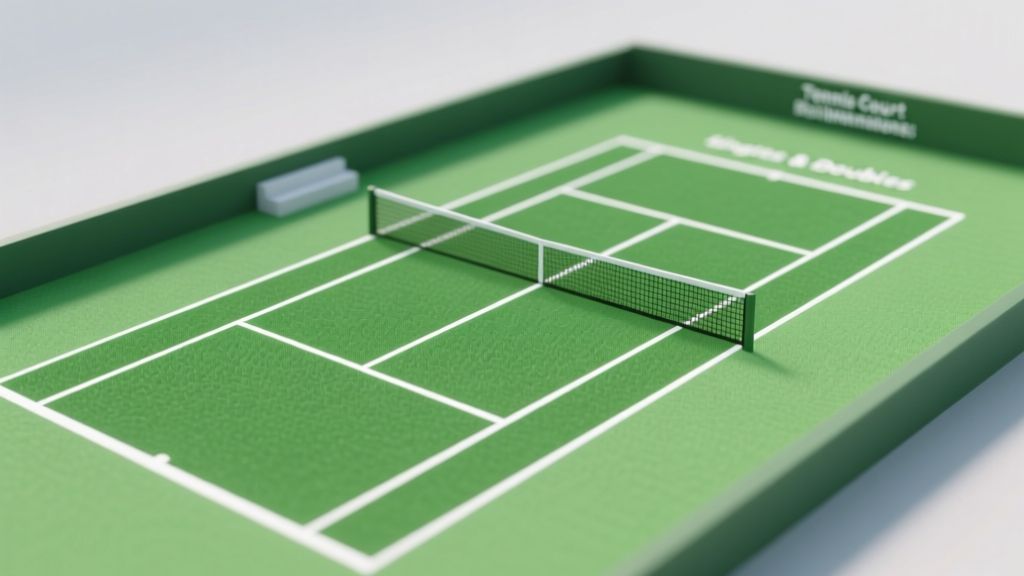
Tennis Court Dimensions: Official Size for Singles & Doubles
A standard tennis court measures 78 feet (23.77 meters) in length. For singles matches, the width is 27 feet (8.23 meters), while for doubles matches, it increases to 36 feet (10.97 meters). The net is 3 feet (0.914 meters) high at the center and slightly higher at the posts.
Understanding Tennis Court Dimensions
Tennis court dimensions are standardized by major organizations such as the International Tennis Federation (ITF) and the United States Tennis Association (USTA). These measurements ensure consistency across recreational, national, and international competitions. Whether you're designing a home court or preparing for professional play, knowing exact dimensions is crucial.
Singles vs. Doubles Court Size
The primary difference between singles and doubles play lies in the usable width of the court:
- Singles court: 78 ft × 27 ft (23.77 m × 8.23 m)
- Doubles court: 78 ft × 36 ft (23.77 m × 10.97 m)
The additional space on the sides in doubles is covered by the alley or tramlines, each measuring 4.5 feet (1.37 m) wide.
Key Areas of the Tennis Court
Each section of the court has specific dimensions and functional roles:
- Baseline: The back boundary line, 78 feet long.
- Sidelines: Define the lateral boundaries; differ for singles and doubles.
- Net: Stretches across the center, supported at 3.5 feet (1.07 m) at the posts and sagging to 3 feet (0.914 m) at the center.
- Service boxes: Two rectangles on each side of the net where serves must land.
- Center service line: Divides the service areas into left and right boxes.
- Ad and Deuce Courts: The two service zones determined by the score (odd or even points).
Breakdown of Service Area Dimensions
The service boxes are critical for legal serves. Each service box measures:
- Length: 21 feet (6.40 m) from net to service line
- Width: 13.5 feet (4.11 m) for both singles and doubles
The center service line ensures symmetry, running perpendicular to the net and dividing the two service courts.
Detailed Measurement Table
| Feature | Imperial (feet) | Metric (meters) |
|---|---|---|
| Court Length | 78 ft | 23.77 m |
| Singles Width | 27 ft | 8.23 m |
| Doubles Width | 36 ft | 10.97 m |
| Alley Width (each) | 4.5 ft | 1.37 m |
| Service Line to Net | 21 ft | 6.40 m |
| Service Box Width | 13.5 ft | 4.11 m |
| Net Height (Center) | 3 ft | 0.914 m |
| Net Height (Posts) | 3.5 ft | 1.07 m |
The data confirms strict uniformity in court layout across sanctioned play. The alley width adds exactly 4.5 feet per side in doubles, and the net height regulation ensures fair play by minimizing sag in the center. These precise figures are essential for tournament compliance and player development.
Surface Types and Their Impact on Dimensions
While surface types—clay, grass, hard, and carpet—do not alter court dimensions, they influence playing style and ball speed. However, all surfaces adhere to the same ITF standards for size and layout. This consistency allows players to transition seamlessly between tournaments like the French Open (clay), Wimbledon (grass), and the US Open (hard court).
Frequently Asked Questions About Tennis Court Dimensions
What are the full dimensions of a tennis court including surrounding space?
While the playing area is 78 ft × 36 ft for doubles, a full tennis facility typically requires additional clearance. The recommended total space is 120 ft × 60 ft to allow for player movement and safety. This extra space is vital for professional and tournament settings.
Are all tennis courts the same size?
Yes, all regulation tennis courts follow the same dimensions set by the ITF. Whether at a local club or Grand Slam venue, the playing area remains consistent: 78 feet long, with widths of 27 feet (singles) or 36 feet (doubles).
How wide is a tennis court singles alley?
There is no alley in singles play. The singles sidelines define the boundary. The 4.5-foot-wide alleys are only used in doubles and extend beyond the singles sidelines on each side.
What is the height of a tennis net at the center?
The net must be 3 feet (0.914 meters) high at the center. It is supported by the net posts at 3.5 feet (1.07 meters), creating a slight downward slope toward the middle due to tension and sag.
Do junior tennis courts have different dimensions?
Yes, junior courts vary based on age group. For children under 10, courts may be 36 ft or 60 ft in length, using red, orange, or green dots on balls to match skill level. Full dimensions are used by age 12 and above in competitive play.
More Articles
 Where Did Baseball Originate From? True Origins Revealed
 How Many Games in a Baseball Season? MLB Schedule Explained
 Who Plays in the Rose Bowl Stadium? Teams & Events
 How Long to Get Blue Belt in BJJ? (Realistic Timeline)
 What Number Was Michael Jordan in Baseball? Answer: 45
 How Many Super Bowls Have the Chicago Bears Won?
 When Was Baseball Invented? Origins & Key Milestones
 NFL Teams That Have Never Won a Super Bowl
 Super Bowl Host Cities & Stadiums (2026)
 Difference Between Pool and Billiards Explained