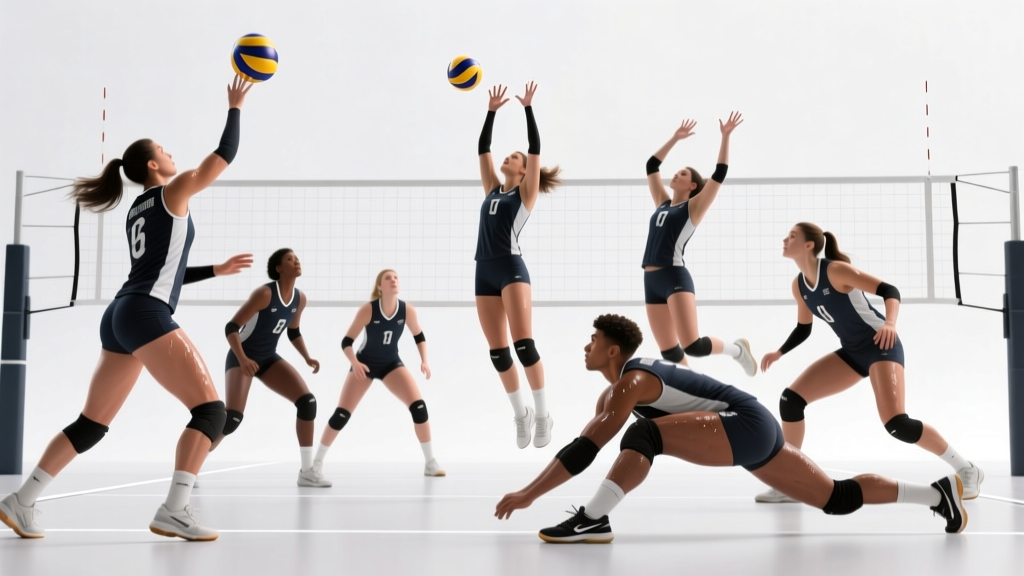
All Volleyball Positions Explained
Volleyball features six standard positions: setter, outside hitter, middle blocker, opposite hitter, libero, and defensive specialist—each with distinct offensive and defensive roles essential to team strategy and rotation.
Understanding the Six Key Positions in Volleyball
Volleyball is a fast-paced team sport that relies on specialized player roles to maximize both offensive power and defensive stability. Each of the six primary positions contributes uniquely during rotations, serving, attacking, setting, and blocking phases. Mastering positional responsibilities is critical for team coordination and competitive success at all levels—from youth leagues to professional and Olympic play.
Primary Roles and Responsibilities by Position
Each volleyball position has specific duties based on location, skill set, and rotational order. Below is a breakdown of core functions players fulfill on the court.
Setter
- Orchestrates the offense by delivering precise second touches (sets) to attackers
- Often referred to as the "floor general" or quarterback of the team
- Must read blockers and make quick decisions under pressure
- Typically sets from the right side (position 2) in a 5-1 system
Outside Hitter (Left Side Hitter)
- Primary offensive weapon, attacks most frequently from the left front (position 4)
- Responsible for hitting out-of-system plays and receiving serve
- Often one of the tallest players with strong jumping and arm swing mechanics
- Performs back-row attacks when rotated to the back line
Middle Blocker (Middle Hitter)
- Executes quick attacks (e.g., slides, 1s, 3s) through the center of the net
- Leads the block scheme, coordinating double and triple blocks
- Requires exceptional timing, vertical jump, and net coverage
- Rotates through all positions but primarily plays near the net
Opposite Hitter (Right Side Hitter)
- Attacks from the right side (position 2), often used when the setter is out of system
- Shields the setter from opposing block pressure
- Frequently responsible for back-row hitting when in the back row
- May not pass serve, allowing focus on attacking and blocking
Libero
- Defensive specialist wearing a contrasting jersey, cannot attack or block above the net
- Excels in passing and back-row digging, enhancing serve-receive stability
- Cannot serve in some leagues but can in FIVB and NCAA (with restrictions)
- Replaces back-row players without counting as a substitution
Defensive Specialist (DS)
- Similar role to libero but follows regular substitution rules
- Used in collegiate and club volleyball where liberos are limited
- Often brought in for tough defensive rotations or late-game situations
- Can be substituted freely in and out depending on league rules
Positional Rotation and Court Coverage
Players rotate clockwise each time their team regains serve after a rally loss. Understanding zone assignments and positional overlap rules is vital to avoid rotation faults.
Rotation Rules Summary
- Front-row players must stay in order: left (4), middle (3), right (2)
- Back-row players align behind them: left (5), middle (6), right (1)
- Back-row players cannot block or attack from in front of the 3-meter line if ball is above net height
- Libero follows special replacement rules and cannot occupy front-row attacking roles
| Position | Avg. Height (Men - Pro) | Avg. Height (Women - Pro) | Primary Role | Key Skills |
|---|---|---|---|---|
| Setter | 1.92 m (6'4") | 1.80 m (5'11") | Playmaker | Hand-eye coordination, decision-making, consistency |
| Outside Hitter | 2.00 m (6'7") | 1.88 m (6'2") | Primary Attacker | Power hitting, footwork, serve receive |
| Middle Blocker | 2.05 m (6'9") | 1.92 m (6'4") | Quick Attack & Blocking | Timing, vertical leap, net awareness |
| Opposite Hitter | 2.02 m (6'8") | 1.90 m (6'3") | Secondary Attacker | Arm strength, back-row hitting, shielding setter |
| Libero | 1.85 m (6'1") | 1.75 m (5'9") | Defensive Anchor | Digging, passing, consistency |
| Defensive Specialist | 1.84 m (6'0") | 1.74 m (5'8") | Bench Defense Support | Reaction speed, floor defense |
Data shows clear trends in physical attributes across positions, with middle blockers being the tallest to maximize blocking reach, while setters and liberos tend to be shorter with superior ball-handling skills. Women's professional averages follow similar patterns but are generally 8–12 cm shorter than male counterparts. These metrics reflect strategic team-building in elite volleyball programs.
Common Questions About Volleyball Positions
What are the six positions in volleyball?
The six standard positions are setter, outside hitter, middle blocker, opposite hitter, libero, and defensive specialist. Each has unique offensive or defensive responsibilities aligned with team strategy and rotation rules.
Can a libero spike the ball?
No, a libero cannot complete an attack hit if the ball is entirely above the top of the net at contact. They may attack from behind the 3-meter line, but are restricted from spiking in the front zone when the ball is elevated.
Which position is the most important in volleyball?
The setter is often considered the most crucial position because they control the tempo and distribution of the offense. However, all positions are interdependent, and elite teams require strength across all roles.
What does the opposite hitter do in volleyball?
The opposite hitter attacks from the right side of the net, provides backup blocking, and reduces pressure on the setter. They often serve as a secondary or emergency setter and are key in out-of-system plays.
How many liberos can a team have?
A team can designate up to two liberos per match under FIVB and NCAA rules, but only one can be on the court at a time. Both can rotate into back-row positions but cannot perform front-row actions like blocking or attacking above the net.
More Articles
 How Long Is a MLB Baseball Game? (2025 Update)
 Terry Bradshaw Super Bowl Wins: 4 Titles Explained
 Who Is the Heavyweight Champion of Boxing in 2025?
 Who Won Super Bowl 56? Full Recap & Stats
 Who Has Most Super Bowl Rings? Tom Brady's Record Explained
 What Size Is a Tennis Ball? Official Dimensions Explained
 How Much Is It to Go Bowling Near Me?
 How Many Super Bowls Did the St. Louis Rams Win?
 When Did Major League Baseball Begin? Key Dates Explained
 Where Was Badminton Created? Origins & History