Beach Volleyball Net Height: Official Rules (2026)
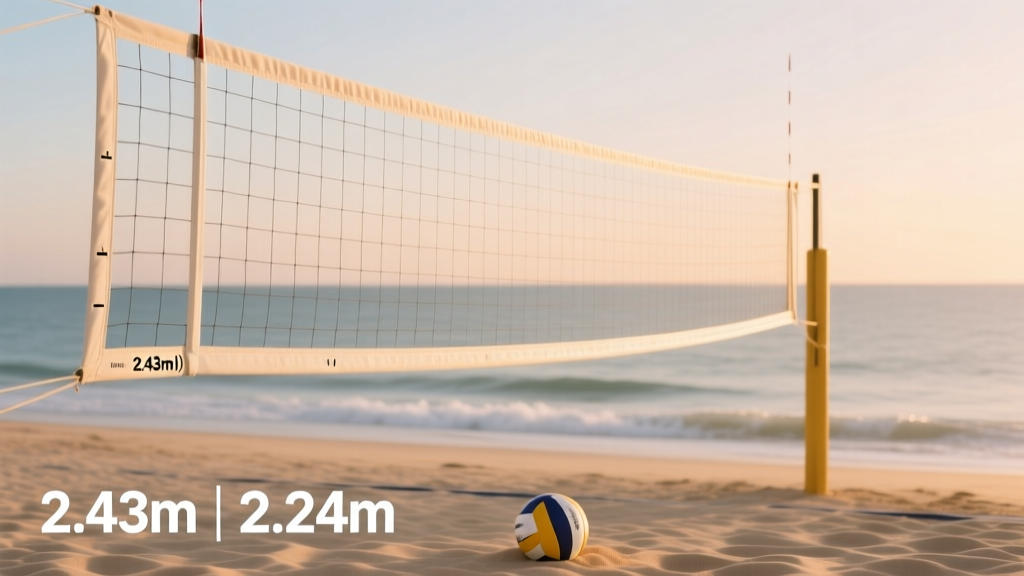
The beach volleyball net height is 2.43 meters (7 feet 11¾ inches) for men and 2.24 meters (7 feet 4¼ inches) for women in official competitions. These standards are set by the Fédération Internationale de Volleyball (FIVB) and apply to all sanctioned international events, including the Olympics and World Championships. The net is slightly lower than indoor volleyball due to the outdoor playing conditions and two-player dynamics. This article explores the exact specifications, regulations, and practical considerations behind beach volleyball net dimensions and setup.
Beach Volleyball Net Height Standards
The official net height in beach volleyball varies based on gender and competition level. While professional tournaments strictly follow FIVB guidelines, recreational play may allow slight adjustments depending on age or skill level.
Standard Net Heights by Category
- Men's Competition: 2.43 meters (7'11¾") at the center of the court
- Women's Competition: 2.24 meters (7'4¼") at the center
- Youth & Junior Play: Often reduced to 2.24m for boys and 2.10m for girls under 18
- Masters (Over 40): Same as standard adult heights unless otherwise specified
The net must be tensioned so that the top band runs horizontally across the court, with the measurement taken at the midpoint between the posts. Slight sagging is permitted but should not reduce the center height below regulation.
Why Are Beach Volleyball Nets Lower Than Indoor?
Several factors contribute to the lower net height in beach volleyball compared to its indoor counterpart (where men play at 2.43m and women at 2.24m—same measurements, different gameplay context).
Key Differences Influencing Net Height
- Sand Surface: Players have less explosive jump power due to unstable footing.
- Two-Person Teams: Requires more coverage per player, making higher jumps riskier.
- Environmental Factors: Wind and sun affect ball trajectory and player movement.
- Game Rhythm: Faster transitions favor control over extreme vertical play.
Despite using the same numerical heights as indoor volleyball, the physical demands of sand make clearing the net more challenging, balancing competitive fairness and athleticism.
FIVB Regulations and Court Setup
The Fédération Internationale de Volleyball (FIVB) governs all international beach volleyball rules, including precise net dimensions and placement.
Net Specifications According to FIVB
- Height at Center: Measured from the top edge of the net tape
- Net Width: 1 meter (39.4 inches)
- Net Length: 8.5 to 9 meters to fit between poles
- Pole Placement: Outside the sidelines, allowing full width of play
- Antenna: Attached at both ends of the net, extending 0.80m above it
- Tension System: Adjustable ratchet or pulley mechanism to maintain consistent height
The antennas mark the lateral boundaries of the playable area—any ball crossing outside them results in a point for the opposing team.
| Category | Net Height (meters) | Net Height (feet/inches) | Regulating Body | Competition Level |
|---|---|---|---|---|
| Men - Senior | 2.43 m | 7 ft 11¾ in | FIVB | Olympics, World Tour |
| Women - Senior | 2.24 m | 7 ft 4¼ in | FIVB | Olympics, World Tour |
| Men - U21 | 2.43 m | 7 ft 11¾ in | FIVB | Youth Championships |
| Women - U21 | 2.24 m | 7 ft 4¼ in | FIVB | Youth Championships |
| Men - Masters (40+) | 2.43 m | 7 ft 11¾ in | AVP / CEV | Professional Tours |
| Women - Masters (40+) | 2.24 m | 7 ft 4¼ in | AVP / CEV | Professional Tours |
| Junior Boys (14–16) | 2.24 m | 7 ft 4¼ in | National Federations | School & Club Leagues |
| Junior Girls (14–16) | 2.10 m | 6 ft 10¾ in | National Federations | School & Club Leagues |
The data confirms uniformity in senior elite categories globally, with minor variations only in youth divisions. National federations often adopt reduced heights for younger players to encourage skill development without excessive physical strain. The consistency across major tours ensures athletes can compete internationally without adaptation delays.
Setting Up a Beach Volleyball Net: Practical Tips
Whether you're installing a permanent system or setting up for casual play, accuracy matters. Here’s how to ensure proper net height and alignment.
Step-by-Step Setup Guide
- Use a Measuring Tape: Always measure from the center of the net, not the poles.
- Level the Court: Ensure the ground is even; uneven surfaces distort height readings.
- Adjust Tension Gradually: Over-tightening can damage the net or pull poles inward.
- Check Antenna Alignment: They must extend vertically and remain inside the sideline.
- Secure Anchors: Use sandbags or ground stakes to prevent shifting during play.
Digital laser tools and portable net stands now help recreational users achieve tournament-grade precision. For home setups, consider adjustable systems that support both men’s and women’s heights.
Frequently Asked Questions About Beach Volleyball Net Height
How tall is the beach volleyball net for men?
The official height of the beach volleyball net for men is 2.43 meters (7 feet 11¾ inches), measured at the center of the court. This standard is used in all FIVB-sanctioned events, including the Olympic Games and professional world tours.
How tall is the beach volleyball net for women?
The beach volleyball net for women is set at 2.24 meters (7 feet 4¼ inches) at the center. This height is identical to indoor women’s volleyball but plays differently due to sand surface and two-player format.
Is the beach volleyball net the same height as indoor?
Yes, the net heights are numerically identical—men at 2.43m and women at 2.24m—but the playing experience differs significantly due to environmental and physical factors like sand resistance and wind exposure.
Does the net height change for junior beach volleyball?
Yes, junior players often use lower nets. For example, boys aged 14–16 typically play at 2.24m, while girls in the same age group may play at 2.10m. Local leagues adjust based on developmental needs.
How do you measure beach volleyball net height accurately?
Measure from the top of the center tape of the net straight down to the playing surface. Use a rigid measuring stick or calibrated tape, ensuring the net is taut and the measurement is taken mid-court, not near the poles where it may be higher.
More Articles
 Who Won the Super Bowl in 2013? Full Recap & Highlights
 How Big Is a Baseball? Official Size & Weight Explained
 How Long Do Tennis Matches Last? By Format & Event
 What Years Did the Bills Go to the Super Bowl?
 How Big Is a Golf Ball in CM? Official Size Explained
 Don Pepper Baseball: Career Stats & Minor League Legacy
 Career Guides Essentials: Practical Tools, Data-Driven Strategies, and Real-World Frameworks for Professional Growth
 Who Has the Most Super Bowl Wins as NFL Coach?
 Where Is the Citrus Bowl Played? Venue & Details
 How Much Do MMA Fighters Earn? (2025 Data)