How Many Sets Are in Tennis? Match Formats Explained
How Many Sets Are in Tennis?
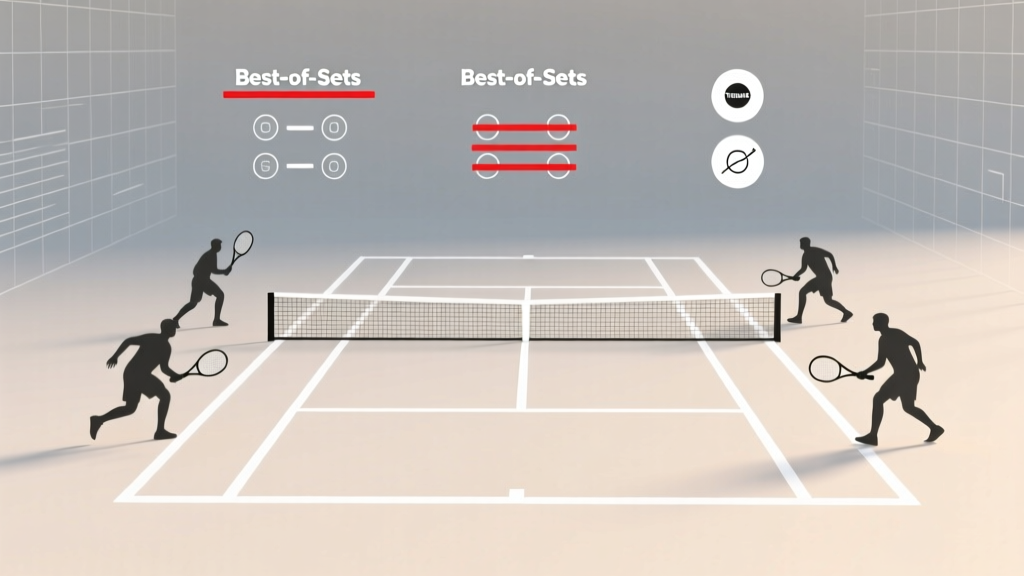
In tennis, a match is typically played as the best of three sets or the best of five sets. Most professional women's matches and recreational games use a best-of-three format, while men's Grand Slam matches are played as best-of-five. A player must win at least two sets to win a best-of-three match, or three sets in a best-of-five.
Understanding Tennis Match Structure
Tennis matches are divided into points, games, and sets. The number of sets required to win a match depends on the tournament and gender category. Winning a set requires a player to win at least six games with a margin of two games, unless a tiebreak is triggered at 6-6.
Common Set Formats in Professional Tennis
- Best of Three Sets: Used in most WTA (women’s) matches and ATP (men’s) regular tour events.
- Best of Five Sets: Reserved for men’s singles at Grand Slam tournaments (Australian Open, French Open, Wimbledon, US Open).
- Final Set Variations: Some tournaments use a deciding set tiebreak at 6-6 or 7-7 to prevent excessively long matches.
Set Rules and Scoring Explained
To win a set, a player must win at least six games and be ahead by at least two games. If the score reaches 6-6, a tiebreak game is usually played (except in some final sets). The first player to reach seven points (by two) wins the tiebreak and the set 7-6.
When Is a Tiebreak Not Played?
At Wimbledon, the final set was historically played without a tiebreak until 2019, when a 12-12 tiebreak rule was introduced. Similarly, the US Open uses a standard tiebreak at 6-6 in all sets, including the final set.
| Tournament | Match Format (Men) | Match Format (Women) | Final Set Tiebreak Rule |
|---|---|---|---|
| Australian Open | Best of 5 | Best of 3 | First to 10 points at 6-6 |
| French Open | Best of 5 | Best of 3 | No tiebreak; win by two games |
| Wimbledon | Best of 5 | Best of 3 | Tiebreak at 6-6 if 12-12 reached |
| US Open | Best of 5 | Best of 3 | Standard 7-point tiebreak at 6-6 |
| ATP Tour Events | Best of 3 | N/A | Standard tiebreak at 6-6 |
| WTA Tour Events | N/A | Best of 3 | Standard tiebreak at 6-6 |
The table highlights key differences in set formats across major tennis events. Men's Grand Slams consistently use best-of-five sets, while women's matches remain best-of-three. Final set rules vary significantly—only the French Open avoids a final set tiebreak entirely, which can lead to extended fifth sets like the famous 2010 Isner–Mahut match.
Historical Changes in Set Formats
The evolution of set formats reflects efforts to balance competitiveness and viewer engagement. In 2022, all four Grand Slams adopted a uniform final-set tiebreak rule (first to 10 points at 6-6), except Roland Garros, which still requires players to win by two games in the final set. This decision preserves clay-court tradition but risks marathon matches.
Frequently Asked Questions About Tennis Sets
How many sets do you need to win in a best-of-three match?
A player needs to win two sets to win a best-of-three match. The first to win two sets wins the match, even if the opponent has won one.
How many sets in a Grand Slam tennis match?
Men's singles matches at Grand Slam tournaments are best-of-five sets, meaning a player must win three sets. Women's singles are best-of-three sets.
What happens if a set goes to 6-6?
If a set reaches 6-6, a tiebreak is usually played. The first player to reach seven points (with a two-point margin) wins the tiebreak and the set 7-6. Exceptions exist in final sets at certain tournaments.
Can a tennis match end in a draw?
No, tennis matches cannot end in a draw. Players continue until one wins the required number of sets. Unlike team sports, there is no time limit; matches proceed until completion.
Why do men play best of five and women best of three?
This distinction is rooted in historical tradition and physical demands. However, there is ongoing debate about equality in format. Some argue women should have the option to play best-of-five, while others emphasize scheduling and recovery considerations.
More Articles
 Fastest Tennis Serve: 263.4 km/h by Sam Groth
 Who Makes the Best Golf Irons in 2025?
 Is Softball Harder Than Baseball? Expert Analysis
 Where Is the PGA Tournament This Weekend? Location & Info
 Last 10 Super Bowl Halftime Performers (2016–2025)
 Lions Super Bowl History: Have They Ever Made It?
 Why Do Volleyball Players Tape Their Fingers?
 Super Bowl Schedule: How Often Does It Happen?
 What Year Did the Broncos Win the Super Bowl?
 Where to Buy Golf Clubs: Best Places in 2025