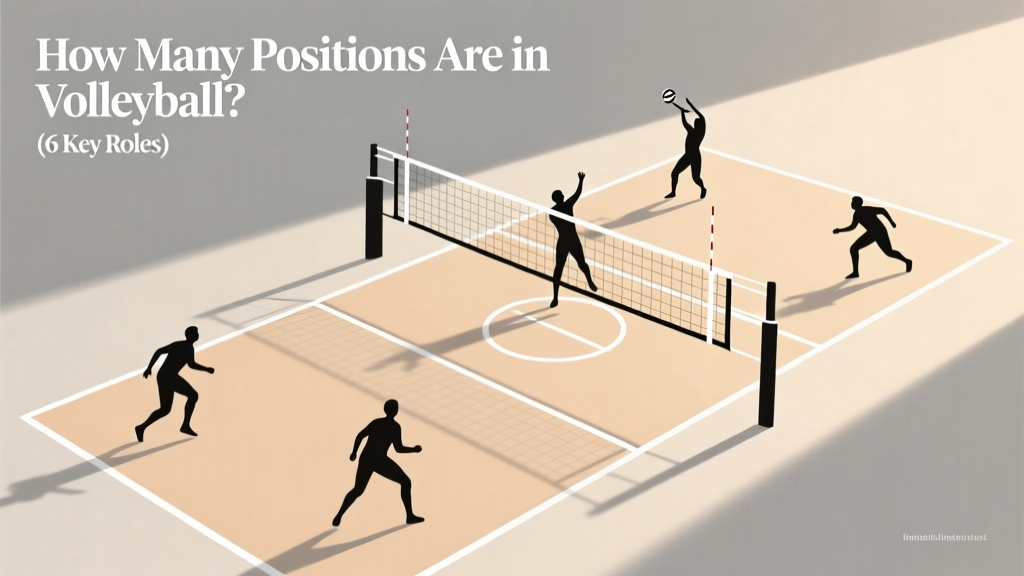
How Many Positions Are in Volleyball? (6 Key Roles)
There are six primary positions in volleyball: setter, outside hitter, middle blocker, opposite hitter, libero, and defensive specialist. Each position has distinct responsibilities that contribute to team strategy and performance on the court.
Understanding Volleyball Positions
Volleyball is a fast-paced team sport that relies heavily on specialized player roles. Knowing how many positions are in volleyball and what each entails is essential for players, coaches, and fans alike. The standard indoor volleyball team consists of six players on the court at any given time, each occupying one of six defined positions.
Core Roles and Responsibilities
- Setter: Orchestrates the offense by delivering precise passes to hitters.
- Outside Hitter: Primary attacker who hits from the left side of the net.
- Middle Blocker: Key defender at the net; excels in quick attacks and blocks.
- Opposite Hitter: Attacks from the right side and often faces fewer double blocks.
- Libero: Defensive expert who wears a different jersey and cannot attack or block.
- Defensive Specialist (DS): Substitutes for back-row players; enhances passing and digging.
Position Rotation and Court Coverage
In indoor volleyball, players rotate clockwise each time they regain serve. This rotation ensures every player cycles through both front-row and back-row roles, except for the libero, who follows special substitution rules.
Front Row vs Back Row Duties
The front-row players (positions 4, 3, and 2) are primarily responsible for attacking and blocking, while back-row players (positions 5, 6, and 1) focus on defense, reception, and controlled sets from behind the 10-foot line.
| Position | Avg. Height (Men) | Avg. Height (Women) | Primary Role | Back-Row Play? |
|---|---|---|---|---|
| Setter | 1.92 m (6'4") | 1.80 m (5'11") | Playmaking, setting | Yes |
| Outside Hitter | 2.00 m (6'7") | 1.87 m (6'2") | Primary attacker | Yes |
| Middle Blocker | 2.05 m (6'9") | 1.90 m (6'3") | Blocking, quick attacks | Yes |
| Opposite Hitter | 2.02 m (6'8") | 1.89 m (6'2") | Right-side attack | Yes |
| Libero | 1.85 m (6'1") | 1.75 m (5'9") | Defense, reception | No (restricted) |
| Defensive Specialist | 1.84 m (6'0") | 1.74 m (5'8") | Back-row support | No |
The data shows clear trends in physical attributes across positions, with middle blockers being the tallest on average, reflecting their need for reach at the net. Conversely, liberos and defensive specialists tend to be shorter and more agile, optimized for floor defense. These distinctions highlight how position-specific demands shape player selection at elite levels.
Specialized Roles: Libero and Defensive Specialist
The libero, introduced in 1998 by FIVB, plays a critical role in back-row stability. Wearing a contrasting jersey, the libero cannot serve, block, or attack the ball above the net. They enhance serve-receive accuracy and reduce defensive errors.
Key Libero Rules
- Must wear a different colored jersey.
- Cannot complete an attack if the ball is entirely above the top of the net.
- Unlimited substitutions with the back-row player in position 6.
- Cannot serve in most high school and collegiate leagues (varies by region).
Frequently Asked Questions About Volleyball Positions
How many playing positions are there in volleyball?
There are six official playing positions in indoor volleyball: setter, outside hitter, middle blocker, opposite hitter, libero, and defensive specialist. Each serves a unique tactical function within the team structure.
Can a libero spike the ball?
No, a libero cannot attack the ball if it is entirely above the height of the net. However, they can legally hit the ball from behind the 10-foot line or if the ball is below the top of the net.
What is the most important position in volleyball?
The setter is often considered the most important position because they control the tempo and distribution of the offense. A skilled setter directly influences scoring efficiency and team coordination.
Do all six volleyball positions rotate?
Yes, all players except the libero rotate positions clockwise when their team gains serve. The libero follows specific substitution rules and only replaces back-row players without counting toward regular rotation.
Which volleyball position requires the tallest player?
The middle blocker typically requires the tallest player due to their responsibility for blocking and quick attacks at the net. On professional teams, middle blockers are often the tallest athletes on the roster.
More Articles
 When Will We Know Who Is in the Super Bowl 2025?
 What Channel Is the PGA Golf Tournament On Today?
 Who Won the First Super Bowl? Packers Victory in 1967
 What MMA Fights Are On Tonight? (Oct 25, 2025)
 Who Is Boxing This Weekend? Top Fights & Schedule
 How Much Does It Cost to Ship Golf Clubs?
 When Did the Packers Last Win the Super Bowl?
 When Is Super Bowl 59? Date, Time, Location 2025
 Where to Watch Major League Baseball in 2025
 How Many Super Bowls Has Mahomes Won? (2025 Update)