
Judo Scoring: Ippon, Waza-ari & Penalties (2026)
Judo scoring is based on a hierarchical system where an ippon (full point) immediately wins the match, while lesser scores like waza-ari (half-point) and yuko (quarter-point, now deprecated) accumulate under specific rules. As of 2025, the International Judo Federation (IJF) emphasizes ippon and waza-ari to determine victory through throws, holds, submissions, or penalties.
Understanding the Judo Scoring System
The objective in judo is to score an ippon—a decisive point that ends the match instantly. If no ippon is scored, the contest continues until one competitor earns enough cumulative half-points (waza-ari) or gains superiority via penalties or time control.
How Points Are Awarded in Judo
- Ippon: Awarded for a clean throw with force, speed, and control onto the opponent’s back, or for holding an opponent on their back for 20 seconds, or for a successful submission (armlock or choke).
- Waza-ari: Given for a throw that lacks one criterion for ippon (e.g., partial back contact), or for holding an opponent for 15–19 seconds. Two waza-ari equal one ippon (called waza-ari awasete ippon).
- Yuko: Previously used for minor throws, this score was officially removed from elite competition by the IJF in 2017 to simplify scoring and encourage dynamic techniques.
- Koka: An even smaller score, discontinued in 2008.
Scoring Through Throws: Ippon vs. Waza-ari
A throw earns ippon if it meets all three criteria: sufficient force, correct direction (onto the back), and full control. Judges assess whether the technique demonstrates clear dominance.
Criteria for Ippon on a Throw
- The opponent lands largely on their back
- The action is executed with strength and speed
- The attacker maintains balance and control throughout
If any one of these elements is missing—such as landing on the side instead of the back—a waza-ari may be awarded.
Victory by Mat Techniques: Osaekomi (Hold-Downs)
When a competitor pins their opponent to the mat with control, the referee begins timing. The goal is to hold both shoulders or scapulae to the mat for a sustained period.
Hold-Down Duration and Scoring
| Duration | Score Awarded |
|---|---|
| 20 seconds | Ippon |
| 15–19 seconds | Waza-ari |
| 10–14 seconds | No score (but advantage may be given) |
Once a pin reaches 20 seconds, the match ends immediately. Referees use electronic timers synchronized with the contest clock.
Submission Holds: Armlocks and Chokeholds
Submissions are valid ways to earn an ippon. These techniques must be applied legally and safely within competition rules.
Legal Submission Methods
- Shime-waza (Chokes): Permitted for senior competitors; prohibited in juniors. Must cause opponent to submit or go unconscious (referee stops match at loss of consciousness).
- Kansetsu-waza (Armlocks): Only allowed at the elbow joint. Other joint locks are forbidden.
Upon tap-out or verbal submission, the match ends and ippon is awarded. If a choke causes unconsciousness, the referee awards ippon and medical staff intervene immediately.
Penalty-Based Scoring: Shido and Hansoku-make
Judo uses a penalty system to enforce active engagement and fair play. Penalties can lead to automatic defeat or influence scoring indirectly.
Penalty Tiers and Consequences
| Penalty (Shido) | Consequence |
|---|---|
| First | Verbal warning (no point awarded) |
| Second | Opponent receives shido (equivalent to yuko, though not scored directly) |
| Third | Opponent awarded waza-ari |
| Fourth | Automatic disqualification (hansoku-make) |
Data shows that elite matches increasingly end via penalty accumulation rather than throws. The fourth shido results in immediate loss, making discipline crucial. Recent IJF rule updates emphasize reducing passive gripping and stalling, increasing the strategic weight of penalties.
Real-World Judo Scoring Data (2024–2025 Season)
An analysis of top-tier competitions reveals trends in how points are earned across weight classes and genders.
| Scoring Method | % of Victories (Men) | % of Victories (Women) | Average Time to Score |
|---|---|---|---|
| Ippon (Throw) | 38% | 42% | 2m 14s |
| Ippon (Hold/Submission) | 16% | 19% | 3m 08s |
| Waza-ari Accumulation | 12% | 10% | 3m 52s |
| Hansoku-make (Penalty Loss) | 22% | 20% | 3m 31s |
| Referee Decision (Golden Score) | 12% | 9% | 4m 17s |
Data indicates that over 40% of women’s victories come via ippon, highlighting technical dominance. Men’s matches see higher penalty-based outcomes (22%), reflecting aggressive tactics. Submission-based ippons are more common in lighter weight categories due to increased ground control efficiency.
Frequently Asked Questions About Judo Scoring
What is the highest score in judo?
The highest score in judo is ippon, which immediately ends the match and results in victory for the athlete who scored it. It can be achieved through a perfect throw, a 20-second pin, or a legal submission.
Do two waza-ari make an ippon?
Yes, two waza-ari scores accumulate into a full ippon, known as waza-ari awasete ippon. This rule has been consistently applied since the early 2000s and remains in effect as of 2025.
Is yuko still a valid score in judo?
No, yuko was officially removed from elite judo competitions by the International Judo Federation (IJF) in 2017. The aim was to promote more dynamic and high-risk techniques by simplifying the scoring system.
Can you win judo without scoring a point?
Yes, a judoka can win without scoring an ippon or waza-ari by forcing their opponent to receive four penalty marks (shido), resulting in disqualification (hansoku-make). This is considered a valid victory.
What happens if no one scores in judo?
If neither competitor scores during regulation time, the match enters golden score overtime. In this sudden-death period, the first athlete to score any point wins. If no points are scored, the winner is decided by the referees based on superiority (aggression, attempts, penalties).
More Articles
 Where Is the Peach Bowl Held? Venue Details & History
 Volleyball Stats and Rules Comparison
 Difference Between Pool and Billiards Explained
 Is Softball Harder Than Baseball? Expert Analysis
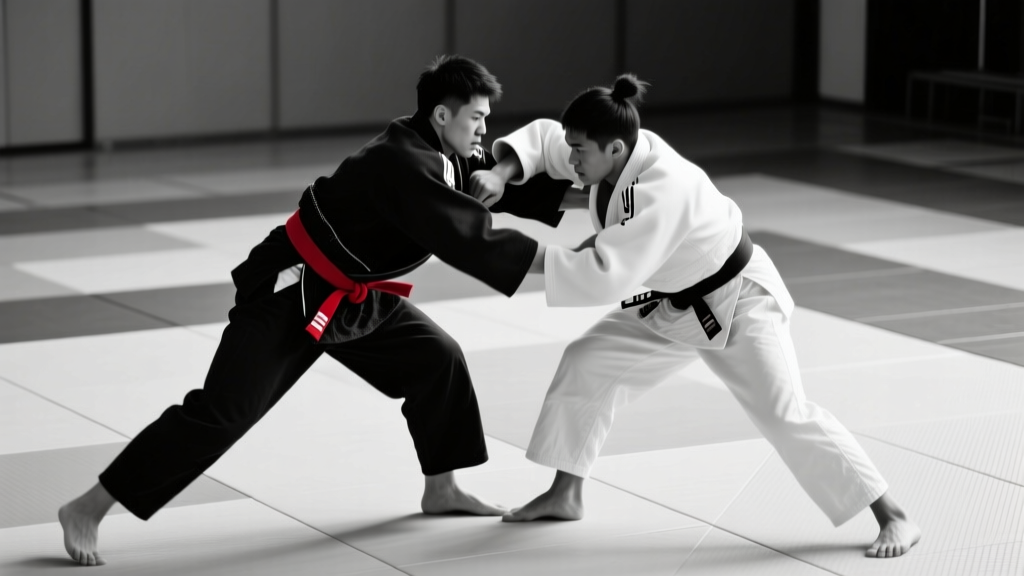 How Is Judo Scored? Ippon, Waza-Ari & Penalties Explained
 Why Is Tennis Scored 15, 30, 40?
 How Many Ounces Is a Baseball? Official Weight Explained
 Arm Wrestling Muscles: Key Muscles Used (2026)
 Billiards Near Me: Find Local Pool Halls & Prices
 How Many Games in an MLB Season? 162 + Playoffs