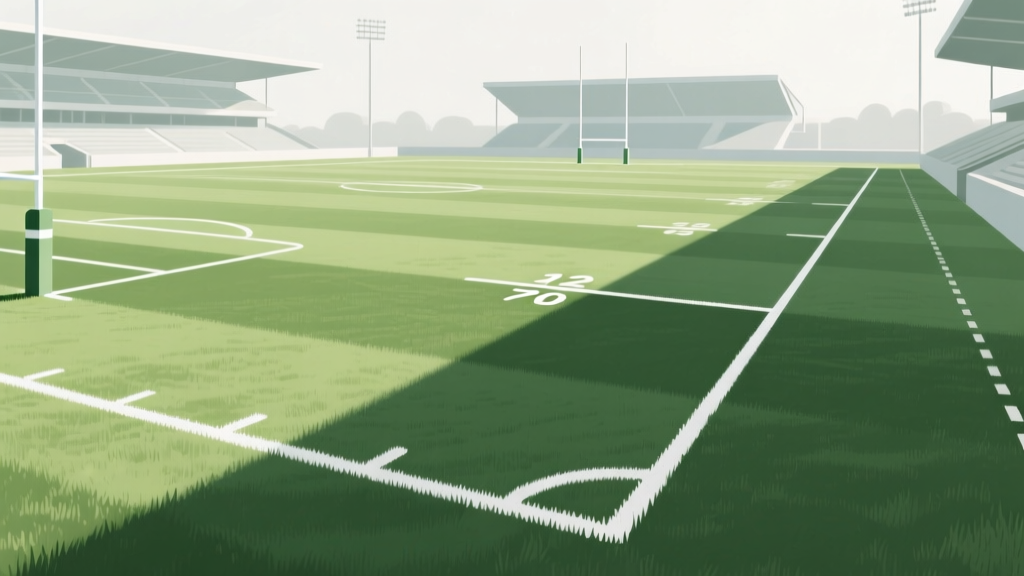
How Big Is a Rugby Field? Full Dimensions Explained
A standard rugby field is 100 meters (109.4 yards) long and 70 meters (76.5 yards) wide, with additional in-goal areas at each end measuring 6 to 22 meters deep. This results in a total field length of up to 144 meters and a playing area of approximately 7,000 square meters.
Understanding Rugby Field Dimensions
Rugby union fields adhere to strict regulations set by World Rugby, the sport’s governing body. These dimensions ensure consistency across professional and amateur matches worldwide. The field, often referred to as the 'pitch,' consists of two main sections: the playing area and the in-goal areas.
Key Features of a Rugby Pitch
- The distance between the two try lines is exactly 100 meters.
- The width of the pitch ranges from 68 to 70 meters, with 70 meters being standard for international play.
- In-goal areas extend behind each try line and can be between 6 and 22 meters deep.
- The maximum total length of a rugby field, including in-goal areas, is 144 meters.
- Boundary lines include the touchlines (sides) and dead-ball lines (ends).
Comparison Across Rugby Formats
While rugby union has standardized dimensions, other forms of rugby such as rugby sevens and rugby league have slightly different requirements. Understanding these differences helps clarify field usage across competitions.
| Variation | Length (m) | Width (m) | In-Goal Depth (m) | Total Area (approx. m²) |
|---|---|---|---|---|
| Rugby Union (International) | 100 | 70 | 10–22 | 9,100–11,340 |
| Rugby Union (Minimum) | 94 | 68 | 6 | 6,788 |
| Rugby Sevens | 100 | 70 | 10–22 | 9,100–11,340 |
| Rugby League | 100 | 68 | 6–11 | 7,880–8,780 |
The data shows that while rugby union and sevens share identical field dimensions, rugby league fields are slightly narrower and have shorter in-goal zones, resulting in a smaller total surface area. International rugby union pitches are designed for high-speed gameplay and strategic positioning, requiring larger in-goal areas for try-scoring opportunities.
Markings and Zones on a Rugby Field
The layout of a rugby field includes several critical markings that define gameplay:
- Halfway line: Divides the pitch into two equal halves.
- 10-meter lines: Used during kick-offs and defensive alignment.
- 22-meter lines: Key for tactical kicking and determining advantage.
- 5-meter and 15-meter lines: Guide scrum and lineout positioning.
- Goal posts: Positioned at the center of each try line, with H-shaped design.
Field Surface and Maintenance Standards
Professional rugby fields are typically natural grass, though hybrid systems (natural grass reinforced with synthetic fibers) are increasingly common. Elite venues like Twickenham and Eden Park use advanced drainage and under-soil heating to maintain playable conditions year-round. World Rugby mandates that surfaces must be non-slip, durable, and free of hazards to minimize injury risk.
Frequently Asked Questions About Rugby Field Size
How big is a rugby field in feet?
A standard rugby field is 328 feet long (100 meters) and 230 feet wide (70 meters), with in-goal areas adding up to 72 feet in depth at each end.
Is a rugby field bigger than a football (soccer) field?
Rugby fields are similar in size to soccer fields. FIFA allows soccer pitches between 100–110m long and 64–75m wide, overlapping closely with rugby’s 100m x 70m standard. However, rugby fields often have deeper in-goal areas, increasing total space.
Why do rugby fields have varying in-goal depths?
In-goal depth can range from 6 to 22 meters depending on stadium design and available space. Larger in-goal areas allow more room for defensive plays and grounding the ball, affecting game strategy.
Are all rugby union fields the same size?
No, while international matches require exact dimensions (100m x 70m), domestic or amateur fields may be slightly smaller within regulated limits (minimum 94m x 68m). In-goal areas also vary, affecting total field size.
How does field size affect rugby gameplay?
Larger fields encourage expansive, open play and endurance, while smaller dimensions favor physical, close-quarter tactics. Field size influences player fitness demands, kicking strategies, and defensive organization.
More Articles
 How Many Super Bowls Has Tom Brady Lost? (Full Record)
 What Channel Is the Golf Tournament On Today?
 Where Is Jude Bellingham From? Birthplace and Origins
 What Channel Does the Super Bowl Come On in 2025?
 Who Won the 1977 Super Bowl? Raiders Defeated Vikings
 Where to Watch Burmese Boxing Online in 2025
 Will Tiger Woods Play Golf Again in 2025?
 Dan Marino Super Bowl Wins: Answer & Career Breakdown
 Rose Bowl Capacity: How Many People Fit?
 Which Team Has Lost Most Super Bowls?