How Big Is a Tennis Court? Official Dimensions Explained
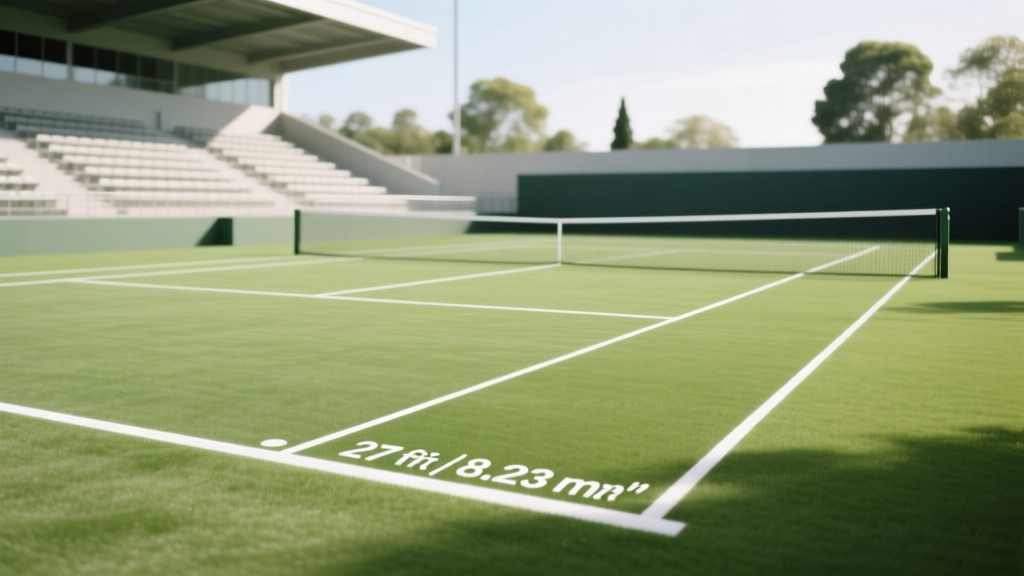
A standard tennis court is 78 feet (23.77 meters) long and 27 feet (8.23 meters) wide for singles matches, while doubles courts extend to 36 feet (10.97 meters) in width. This precise measurement ensures consistency across professional and recreational play.
Dimensions of a Tennis Court
The size of a tennis court is strictly regulated by the International Tennis Federation (ITF) to maintain fairness and uniformity in competition. Whether you're setting up a residential court or planning a tournament venue, knowing exact dimensions is crucial.
Standard Measurements
- Length: 78 feet (23.77 m)
- Singles Court Width: 27 feet (8.23 m)
- Doubles Court Width: 36 feet (10.97 m)
- Service Line Distance from Net: 21 feet (6.40 m)
- Net Height at Center: 3 feet (0.914 m)
- Total Playing Area (including surrounding space): Approximately 120 x 60 feet (36.58 x 18.29 m)
Court Layout and Key Zones
Understanding the layout helps players improve positioning and strategy. Each zone serves a specific function during gameplay.
Key Areas on a Tennis Court
- Baseline: The back boundary line where players often start rallies.
- Service Boxes: Two rectangles on each side of the net where serves must land—divided into deuce and ad courts.
- Net: Stretches across the center, dividing the court into two equal halves.
- Alley (Tramlines): The extra 4.5-foot (1.37 m) strips used only in doubles play.
- Center Mark: Indicates the midpoint of the baseline, separating the left and right service boxes.
| Measurement | Feet | Meters |
|---|---|---|
| Overall Length | 78 ft | 23.77 m |
| Singles Court Width | 27 ft | 8.23 m |
| Doubles Court Width | 36 ft | 10.97 m |
| Distance from Net to Service Line | 21 ft | 6.40 m |
| Net Height at Posts | 3.5 ft | 1.07 m |
| Net Height at Center | 3 ft | 0.914 m |
| Backstop Clearance (recommended) | 21–35 ft | 6.4–10.7 m |
| Side Clearance (recommended) | 12–20 ft | 3.66–6.10 m |
The data confirms standardized court dimensions globally, with slight variations only in surrounding clearance recommendations. These measurements ensure optimal player movement and competitive fairness across all levels of play.
Differences Between Singles and Doubles Courts
While the length remains unchanged, the width differs significantly between singles and doubles formats.
- In singles, the alley areas are out of bounds.
- In doubles, the full 36-foot width is utilized, giving teams more coverage but also creating larger gaps to defend.
- The service boxes remain identical in both formats.
This distinction affects strategy—doubles players often employ aggressive net play due to narrower lateral spacing per player.
Space Requirements for Installation
When building a tennis court, total area needed exceeds the playing surface to allow safe movement beyond boundaries.
- Minimum recommended total area: 120 feet long by 60 feet wide (36.58 x 18.29 m)
- Back clearance behind baselines: 21–35 feet (6.4–10.7 m)
- Side clearance: 12–20 feet (3.66–6.10 m)
- Fencing or windscreen height typically ranges from 10 to 12 feet (3.05–3.66 m)
These clearances prevent interference from obstacles and enhance player safety during dynamic rallies.
Frequently Asked Questions About Tennis Court Size
How big is a tennis court in square feet?
A standard doubles tennis court covers 2,808 square feet (78 ft × 36 ft). A singles court is slightly smaller at 2,106 square feet (78 ft × 27 ft), though most permanent installations accommodate the wider doubles configuration.
What is the difference between a singles and doubles tennis court width?
A singles court is 27 feet (8.23 m) wide, while a doubles court is 36 feet (10.97 m) wide. The additional 9 feet (2.74 m) is split equally as alleys on both sides, each measuring 4.5 feet (1.37 m) wide.
How tall is a tennis net?
The net is 3.5 feet (1.07 m) high at the posts and sags slightly to 3 feet (0.914 m) at the center. This tensioned design ensures fair play and consistent ball bounce over the middle of the court.
Can a tennis court be smaller for recreational use?
Yes, backyard or training courts may be scaled down, especially in length or clearance zones. However, official matches require full ITF-compliant dimensions. Reduced-size courts are common for junior programs using modified nets and balls.
Are all tennis courts the same size worldwide?
Yes, all professional and sanctioned amateur tennis courts follow the same ITF regulations. Whether at Wimbledon, the US Open, or a local club, the playing surface is uniformly 78 feet long, with widths adjusted only for singles (27 ft) or doubles (36 ft).
More Articles
 Who Created Taekwondo? The Founder Revealed
 What Season Is Baseball? MLB Schedule Explained
 What Channel Is the Baseball Game On Today? (Oct 2025)
 Who Invented Table Tennis? Origins and Key Figures
 Where Did Boxing Originate? History & Evolution Explained
 Who Is the Boxing Heavyweight Champion in 2025?
 A Rod Baseball Stats: Career Home Runs, AVG, and Legacy
 Who Makes MLB Baseballs? Rawlings Facts
 Where to Watch Bellator MMA Live in 2025
 How Many Golf Courses Are in America? (2025 Data)