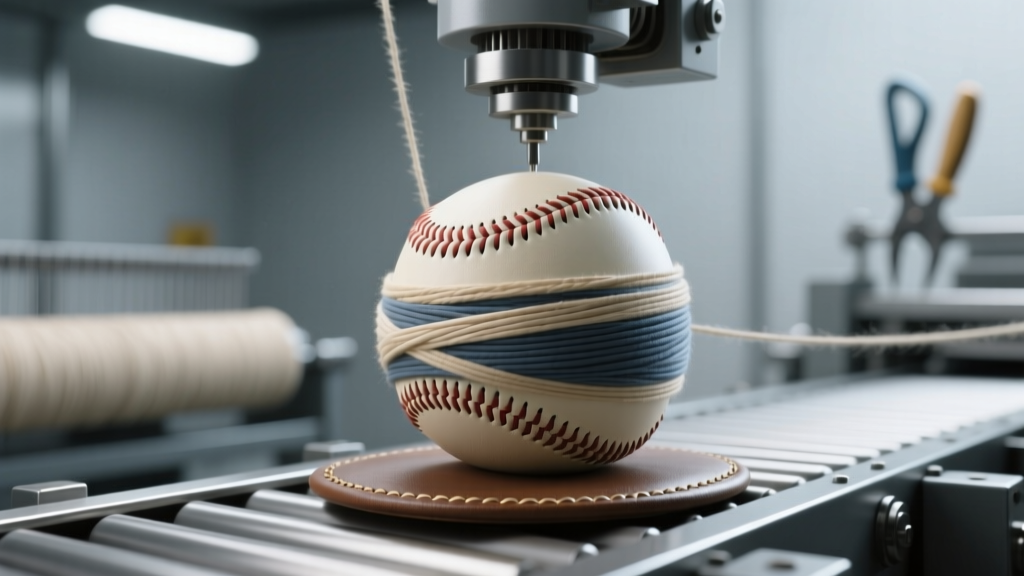
How Is a Baseball Made? Inside the Manufacturing Process
A baseball is made with a cork-and-rubber core wrapped in layers of wool and cotton yarn, then stitched by hand with 108 double-stitches of red waxed thread using horsehide or cowhide leather for the cover. This precise construction ensures durability, consistent performance, and adherence to Major League Baseball (MLB) standards.
Core Structure: The Heart of the Ball
The foundation of every baseball is its core, designed to provide resilience and energy transfer upon impact.
Components of the Core
- Cork center: A small sphere of compressed cork gives the ball its initial firmness.
- Rubber casing: The cork is encased in two layers of black rubber, enhancing bounce and compression response.
This layered core allows the ball to retain shape under high-velocity impacts while contributing to its liveliness during play.
Yarn Windings: Precision Layering for Performance
After the core is formed, multiple layers of tightly wound yarn are applied to control elasticity and weight distribution.
- First layer: Gray wool yarn – provides cushioning and shock absorption.
- Second layer: White wool yarn – adds resilience and helps maintain roundness.
- Third layer: Cotton yarn – stabilizes the outer dimensions before the leather cover is applied.
The tension and thickness of each yarn layer are carefully controlled to meet exact specifications set by professional leagues.
Leather Cover and Stitching Process
The exterior of a baseball consists of two figure-eight shaped leather pieces stitched together by hand.
Key Features of the Cover
- Material: Premium cowhide (used in MLB) or horsehide (older standard).
- Stitching: 108 double-stitches (216 individual stitches) of red waxed thread.
- Dye: Leather is treated with a water-resistant finish and dyed white.
Each ball is stitched by hand to ensure uniform seam height, which affects aerodynamics and pitcher grip.
Manufacturing Standards and Quality Control
Official baseballs must meet strict dimensional, weight, and performance criteria.
| Specification | MLB Standard | NCAA Standard | Youth League |
|---|---|---|---|
| Diameter | 2.86–2.94 in (7.3–7.5 cm) | 2.86–2.94 in | 2.75–2.85 in |
| Circumference | 9.00–9.25 in (22.9–23.5 cm) | 9.00–9.25 in | 8.50–8.75 in |
| Weight | 5.00–5.25 oz (142–149 g) | 5.00–5.25 oz | 4.75–5.00 oz |
| Core Material | Cork + rubber | Cork + rubber | Synthetic or rubber |
| Leather Type | Cowhide | Cowhide or composite | Composite or synthetic |
| Stitch Count | 108 double-stitches | 108 double-stitches | 88–108 |
The data shows that MLB and NCAA balls have nearly identical physical dimensions, ensuring consistency at elite levels. Youth league balls are slightly smaller and lighter, accommodating younger players. The use of synthetic materials in amateur balls reduces cost while maintaining playability.
Evolution of Baseball Construction
Baseballs have evolved significantly since the 1800s, when they were often handmade with inconsistent materials like rubber scraps and string.
- Early 1900s: Introduction of standardized cork centers improved uniformity.
- 1970s: Shift from horsehide to cowhide for better durability in all weather conditions.
- Modern era: Hand-stitching remains unchanged, preserving tradition and performance quality.
Today’s manufacturing process blends craftsmanship with precision engineering to produce high-performance game balls.
About How a Baseball Is Made: Common Questions
How many stitches are on a baseball?
A regulation baseball has exactly 108 double-stitches, totaling 216 individual stitches. These are sewn by hand using red waxed thread to ensure durability and consistent seam height.
Why are baseballs hand-stitched instead of machine-made?
Hand-stitching ensures tighter control over tension and seam consistency, which affects how the ball moves through the air. Machine stitching can create uneven seams that alter pitch behavior and reduce accuracy.
What kind of leather is used in MLB baseballs?
Major League Baseball uses premium cowhide sourced from Tennessee. The leather is thick, durable, and treated for water resistance, providing superior grip and longevity compared to synthetic alternatives.
How long does it take to make one baseball?
It takes approximately 15–20 minutes to assemble and stitch one baseball by hand. Factoring in curing, inspection, and packaging, the full production cycle per ball spans several hours.
Are all baseballs the same across leagues?
No, baseballs vary by league. MLB balls use cowhide covers and cork-rubber cores, while youth leagues may use synthetic leather and softer cores. NCAA balls closely mirror MLB specs but allow some material variations.
More Articles
 Super Bowl 2025 Start Time Central Time
 How Old Is Djokovic Tennis Player? Age & Career Stats 2025
 How Big Is a Baseball Diamond? Full Dimensions Explained
 Step Stool and Ladder Buying Guide: Safety First
 Where Was Rugby Invented? The True Story
 When Was the First Super Bowl Played? Full History & Facts
 Where Is TGL Golf Played? Venue & Location Details
 How Old Is Golfer Bubba Watson in 2025? Age & Career Update
 How Big Is a Volleyball Court? Official Dimensions Explained
 When Did New Orleans Win the Super Bowl? Full Story