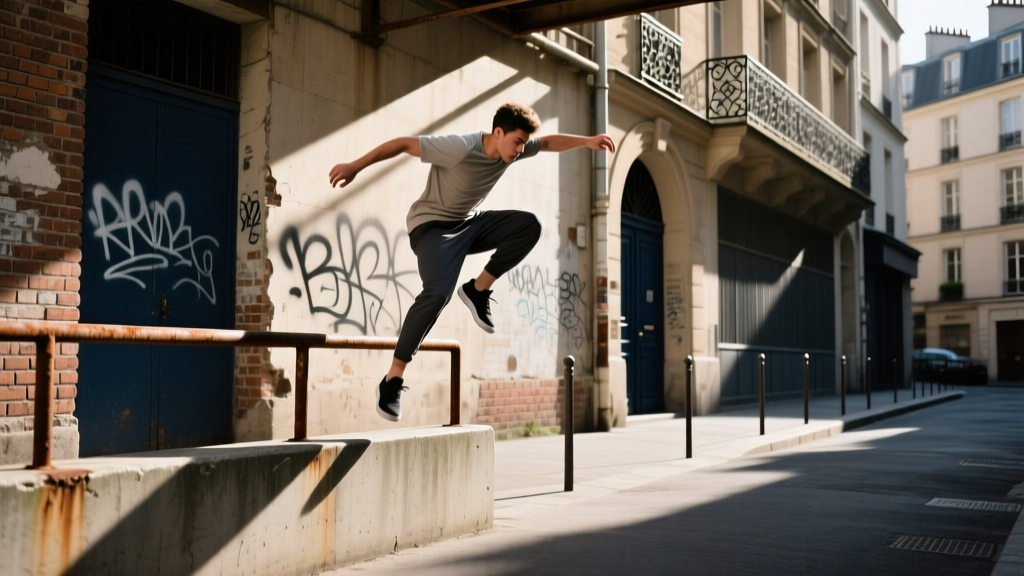
Where Did Parkour Originate? The True Story
Parkour originated in France during the late 1980s, developed by David Belle and inspired by military obstacle course training and the teachings of Georges Hébert.
The Origins of Parkour: A Historical Overview
Parkour, a dynamic physical discipline focused on efficient movement through urban environments, traces its roots to France in the late 20th century. It emerged from a blend of military training, natural method fitness, and urban exploration.
Key Influences Behind Parkour's Development
- Military obstacle course training methods used by French soldiers
- Georges Hébert’s “Natural Method,” emphasizing practical, functional movement
- African indigenous physical practices observed by Hébert in the early 1900s
- Youth culture in suburban Paris seeking alternative forms of expression
- Influence of martial arts, gymnastics, and freerunning aesthetics
David Belle and the Birth of Modern Parkour
David Belle, born in 1973 in Paris, is widely recognized as the founder of modern parkour. His father, Raymond Belle, was a firefighter and soldier trained in French military methods influenced by Hébert’s philosophy. David adapted these techniques into a new form of movement focused on efficiency, speed, and overcoming obstacles.
Formation of the Yamakasi Group
In the early 1990s, David Belle joined with nine other practitioners—including Sebastien Foucan and Chau Belle-Dinh—to form the group known as Yamakasi. The name, derived from Lingala (a Bantu language), means “strong in body and spirit.” This group popularized parkour through demonstrations, films, and public performances.
Geographical Spread and Global Recognition
From its origins in Lisses and Sarcelles (suburbs of Paris), parkour rapidly gained international attention in the early 2000s due to viral videos, documentaries, and media coverage.
Countries Where Parkour Gained Early Popularity
- United Kingdom: London became a hub for European parkour communities by 2002
- United States: Growth accelerated after 2004 via YouTube and stunt films
- Russia: Urban youth adopted parkour as both sport and social protest
- Japan: Strong integration with ninja-inspired movement and acrobatics
- Brazil: Favela youth embraced parkour as an outlet for creativity and resilience
| Country | First Known Parkour Group | Year Established | Notable Contributors | Urban Centers |
|---|---|---|---|---|
| France | Yamakasi | 1997 | David Belle, Sebastien Foucan | Paris, Lisses, Sarcelles |
| UK | Leamington Parkour Crew | 2002 | Tim Shieff, Ozzie Wright | London, Birmingham |
| USA | Freerunning USA | 2003 | Ryan Doyle, Daniel Ilabaca | New York, Los Angeles |
| Russia | Moscow Freeflow | 2004 | Alexey Misyuk, Denis Vorobyov | Moscow, St. Petersburg |
| Japan | Ninja Run Tokyo | 2005 | Takumi Nemoto, Ken Saito | Tokyo, Osaka |
The data shows that parkour spread quickly across Europe and North America within a decade of its formalization. France remained the epicenter until 2003, after which the UK and USA saw exponential growth due to digital media exposure. Russia and Japan developed unique stylistic interpretations, blending local traditions with core parkour principles.
Evolution into Freerunning and Sportification
Divergence Between Parkour and Freerunning
While parkour emphasizes efficiency and directness, freerunning incorporates acrobatic elements like flips and spins for artistic expression. This distinction became prominent around 2003 when Sebastien Foucan promoted freerunning independently.
Institutional Recognition and Competitive Formats
- 2017: International Gymnastics Federation (FIG) launched Parkour World Championships
- 2020: Parkour events included in some regional Olympic qualifying frameworks
- 2023: Over 100 countries report active parkour organizations
Frequently Asked Questions About Parkour Origins
Where did parkour originate?
Parkour originated in France in the late 1980s, primarily developed by David Belle in the suburbs of Paris, drawing from military training and Georges Hébert’s Natural Method.
Who invented parkour?
David Belle is credited with founding modern parkour in the 1990s, building upon his father Raymond Belle’s military and physical training background rooted in French colonial practices.
What does the word ‘parkour’ mean?
The term ‘parkour’ comes from the French word ‘parcours,’ meaning “a path” or “an obstacle course.” It refers to moving efficiently over and around barriers in one’s environment.
Is parkour French or Japanese?
Parkour is French in origin, despite common misconceptions linking it to Japanese ninja culture. While some movements resemble ninja techniques, parkour was developed in France using Western military and physical education principles.
How did parkour become popular worldwide?
Parkour gained global popularity through viral internet videos in the early 2000s, documentaries like “Jump London” (2003), and inclusion in movies such as “Casino Royale” (2006). Social media platforms like YouTube significantly accelerated its reach.
More Articles
 Who Invented Ice Hockey? Origins and Key Figures
 Where Was Field Hockey Invented? Origin & History
 What Do MotoGP Riders Wear on Their Hands?
 How Fast Can the Average Human Sprint?
 Olympic Sports List: All Summer and Winter Events Explained
 How Many Meters in a Mile Swimming? Exact Conversion & Laps
 How Many Calories Does Rock Climbing Burn?
 Where Did Field Hockey Originate? Origins & History
 How Thick Is an Ice Hockey Rink?
 How Many Gallons in an Olympic Swimming Pool?