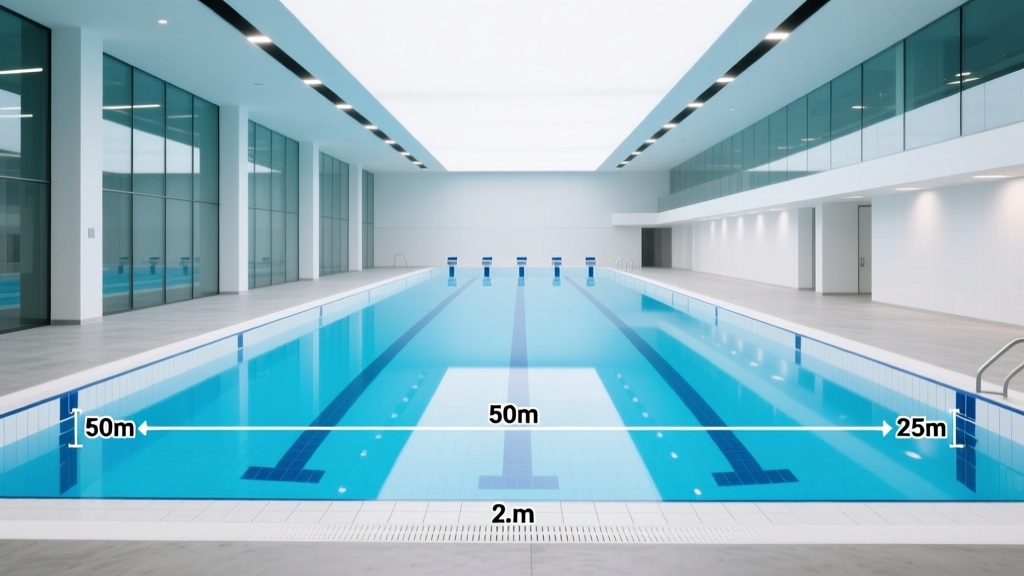
Olympic Swimming Pool Size: Exact Dimensions 2025
An Olympic swimming pool is precisely 50 meters long, 25 meters wide, and a minimum of 2 meters deep, creating a standardized volume of 2,500 cubic meters. This regulation size is mandated by World Aquatics (formerly FINA) for all official Olympic and international competitions.
What Defines an Olympic Swimming Pool?
The dimensions of an Olympic swimming pool are strictly regulated to ensure fairness, consistency, and world-class performance across global competitions. These pools are used during the Summer Olympics, World Championships, and other elite aquatic events.
Key Characteristics of Olympic Pools
- Length: Exactly 50 meters
- Width: 25 meters
- Lane count: 10 lanes (competition uses middle 8)
- Lane width: 2.5 meters each
- Minimum depth: 2 meters (recommended 3 meters for wave reduction)
- Water temperature: Maintained between 25°C and 28°C (77–82°F)
- Volume: Approximately 2,500 cubic meters (660,000 gallons)
Standardized Dimensions Across Competitions
World Aquatics (formerly known as FINA) sets the exact specifications that must be followed for any pool hosting Olympic or world-level events. Even slight deviations disqualify a pool from official use.
Why Are There 10 Lanes But Only 8 Used?
Although Olympic pools have 10 lanes, only the center 8 are used during competition. The two outer lanes act as buffers to absorb waves and turbulence, reducing drag for swimmers in lanes 1 and 8. This improves fairness and helps minimize resistance from pool edges.
| Feature | Specification | Notes |
|---|---|---|
| Length | 50 meters | Measured between touch pads |
| Width | 25 meters | Allows for 10 lanes at 2.5m each |
| Depth | Minimum 2 m, ideal 3 m | Deeper pools reduce surface turbulence |
| Lane Count | 10 total | 8 used in finals and heats |
| Lane Width | 2.5 meters | Uniform spacing with lane ropes |
| Water Temperature | 25–28°C (77–82°F) | Regulated for athlete comfort and safety |
| Volume | ~2,500 m³ (~660,000 US gal) | Based on 50m × 25m × 2m |
| Backstroke Flags | 1.8–2.5 meters from wall | Help swimmers judge turns |
The table above outlines the precise technical standards required for Olympic swimming pools. Depth and lane configuration are especially critical—deeper water minimizes wave reflection, improving swimmer speed and reducing injury risk. Consistent lane width ensures equal hydrodynamic conditions across all competitors.
Differences Between Olympic, Short Course, and Recreational Pools
Not all competitive pools are Olympic-sized. Understanding the distinctions helps clarify training environments and competition formats.
- Olympic Pool (Long Course): 50m length, used in Summer Olympics and World Championships.
- Short Course Pool: 25m length, commonly used in collegiate and winter competitions.
- Recreational Pool: Varies widely; often shorter than 25m and not built to competition standards.
Races held in 25m pools are considered "short course" and often yield faster times due to increased push-off opportunities from turns. However, Olympic records are only recognized in 50m pools.
Maintenance and Technology Behind Olympic Pools
Beyond size, Olympic pools incorporate advanced engineering to support elite performance.
Water Quality and Circulation
Pools use high-efficiency filtration systems, UV/ozone sanitation, and precise chemical balance to maintain crystal-clear water. Proper circulation prevents stagnant zones and ensures even temperature distribution.
Wave Reduction Features
- Overflow gutters on all sides to capture splashing water
- Energy-absorbing lane ropes with multiple discs
- Deep basins to dissipate turbulence downward
Frequently Asked Questions About Olympic Swimming Pools
How big is an Olympic swimming pool in feet?
An Olympic swimming pool is 164 feet long, 82 feet wide, and at least 6.5 feet deep. The total volume equals about 660,000 US gallons (approximately 2.5 million liters).
How many lanes are in an Olympic pool?
An Olympic pool has 10 lanes, each 2.5 meters wide. During competition, only the middle 8 lanes are used, with the outer lanes serving as buffers to reduce wave interference.
What is the depth of an Olympic swimming pool?
The minimum depth is 2 meters (6.5 feet), but most modern Olympic pools are 3 meters (nearly 10 feet) deep. Greater depth reduces surface turbulence and improves swimmer performance.
Why is an Olympic pool 50 meters long?
The 50-meter length is an international standard established by World Aquatics to unify competition conditions globally. It defines "long course" swimming and is used for Olympic Games and World Championships.
Can public pools be Olympic-sized?
Yes, some public or university facilities include Olympic-sized pools, though they are expensive to build and maintain. These venues often host national or regional competitions and serve elite training programs.
More Articles
 How Much Is a MotoGP Bike? Cost Breakdown 2025
 How Long Should I Jump Rope? Expert Guidelines
 Rules vs Reality: Performance Data Check
 When Do Ice Skating Rinks Close? Hours & Seasons Explained
 Have Any Swimmers Died Crossing the English Channel?
 Best Football for Play: Performance, Safety, and Age-Appropriate Selection Guide
 Most Expensive Sports to Play: Equipment Costs Ranked from Budget to Elite
 How Long Is a Swimming Pool? Sizes Explained
 How Fast Do F1 Cars Go? Top Speed & Acceleration Explained
 How Many Pushups in a Row Is Good? By Age & Fitness Level