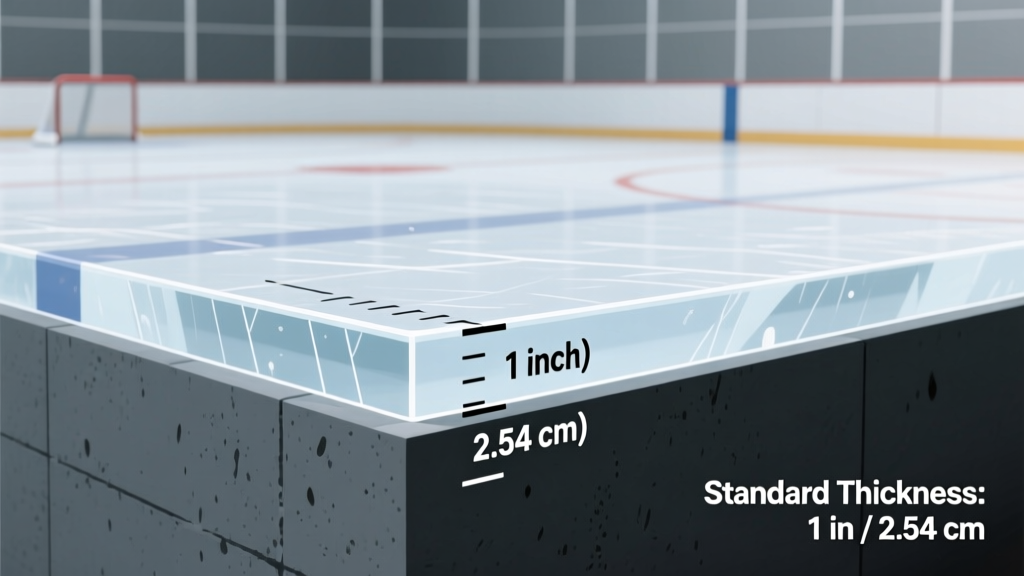
How Thick Is Hockey Rink Ice? Standard Measurements
The standard ice thickness for a professional hockey rink is approximately 1 inch (2.54 cm), with most rinks maintaining a range between 0.75 to 1.25 inches (1.9 to 3.2 cm) depending on climate, usage, and league standards. This optimal thickness balances durability, player safety, and energy efficiency in refrigeration.
Understanding Hockey Rink Ice Thickness
Ice thickness is a critical factor in maintaining a high-performance hockey rink. Too thin, and the surface risks cracking or chipping; too thick, and it becomes energetically expensive to maintain and may affect skating quality. The ideal ice depth supports fast, smooth skating while resisting damage from skates and pucks.
Why Ice Thickness Matters
- Ensures consistent skating performance
- Reduces risk of cracks and gouging during play
- Improves energy efficiency of refrigeration systems
- Maintains structural integrity under heavy use
- Supports proper puck glide and bounce
Factors Influencing Ice Depth
Several variables affect how thick the ice should be on a hockey rink:
Climate and Ambient Temperature
Rinks in warmer climates often require slightly thicker ice to resist melting and maintain stability. Indoor arenas have more control over conditions, allowing for thinner, more consistent ice layers.
Type of Facility
Professional NHL arenas prioritize speed and consistency, typically using thinner ice (~1 inch). Recreational rinks may opt for slightly thicker ice to withstand varied skill levels and less precise maintenance.
Usage Frequency
High-traffic rinks, such as those hosting multiple games or public skate sessions daily, may increase ice thickness slightly to reduce resurfacing frequency and surface wear.
Standard Ice Thickness Across Leagues
Different leagues and organizations follow specific guidelines to ensure competitive fairness and safety. Below is a detailed comparison of ice thickness standards and related data.
| League / Facility Type | Average Ice Thickness (inches) | Average Ice Thickness (cm) | Refrigerant Temp (℉) | Surface Temp (℉) | Maintenance Frequency |
|---|---|---|---|---|---|
| NHL Arenas | 1.0 | 2.54 | 12 | 24 | After every period |
| IIHF International | 1.1 | 2.79 | 14 | 25 | Every 20 mins gameplay |
| College (NCAA) | 1.0–1.2 | 2.54–3.05 | 13 | 24.5 | Per game basis |
| Recreational Public Rinks | 1.25 | 3.18 | 16 | 26 | Daily or as needed |
| Olympic Venues | 1.1 | 2.79 | 12.5 | 24.8 | After each session |
The data shows that professional and elite-level rinks maintain tighter tolerances around 1 inch, prioritizing performance and consistency. Recreational rinks tend toward thicker ice (up to 1.25 inches) to endure unpredictable usage patterns. Lower refrigerant temperatures correlate with thinner, harder ice, which is preferred in competitive settings.
How Ice Thickness Is Measured and Maintained
Ice thickness is typically measured using a specialized ice gauge—a calibrated drill bit or probe inserted through the surface. Maintenance involves layering water gradually over a chilled concrete slab embedded with coolant pipes.
Step-by-Step Ice Formation Process
- Concrete slab is cooled to below freezing
- Thin base layer of water is sprayed and frozen
- Markings and logos are painted onto the ice
- Additional layers are added until desired thickness is reached
- Top layer is resurfaced regularly with a Zamboni
Common Questions About Hockey Rink Ice Thickness
How thick is the ice on a professional hockey rink?
The ice on a professional hockey rink, such as in the NHL, is typically 1 inch (2.54 cm) thick. This thickness provides an optimal balance between speed, durability, and energy efficiency.
Do Olympic rinks have thicker ice than NHL rinks?
Olympic rinks generally have slightly thicker ice at about 1.1 inches (2.79 cm), compared to the NHL’s standard 1 inch. This minor increase helps maintain surface integrity during intensive international competition schedules.
Can outdoor hockey rinks have the same ice thickness?
Outdoor rinks often require thicker ice—typically 3 to 4 inches (7.6–10.2 cm)—to remain stable under fluctuating weather conditions and lack of climate control. Natural freezing processes also demand greater depth for safety.
Why isn’t hockey ice thicker for safety?
Thicker ice doesn’t significantly improve safety and increases cooling costs. The concrete slab beneath the ice provides structural support, so the ice itself only needs to be thick enough to resist wear and maintain a smooth playing surface.
How often is hockey ice resurfaced?
Professional rinks are resurfaced after every period (every 20 minutes of play) using a Zamboni. Recreational rinks may resurface once per session or as needed based on usage and condition.
More Articles
 How Fast Did Michael Phelps Swim? Speed Breakdown
 How Long Is a Formula 1 Race? Duration Explained
 Pool Laps for a Mile: Exact Numbers by Size
 When Was Field Hockey Created? History & Origins
 How High Does Simone Biles Jump? Up to 6 Feet
 What Year Was Swimming Added to the Olympics?
 How High Can a Human Jump? Record & Average Heights
 Where Can I Swim Laps Near Me? Top Options & Tips
 Size Safety Tips: How Proper Sizing Prevents Injury
 Tennis Scoring System: Points, Games, Sets & Tiebreaks Explained (2026)