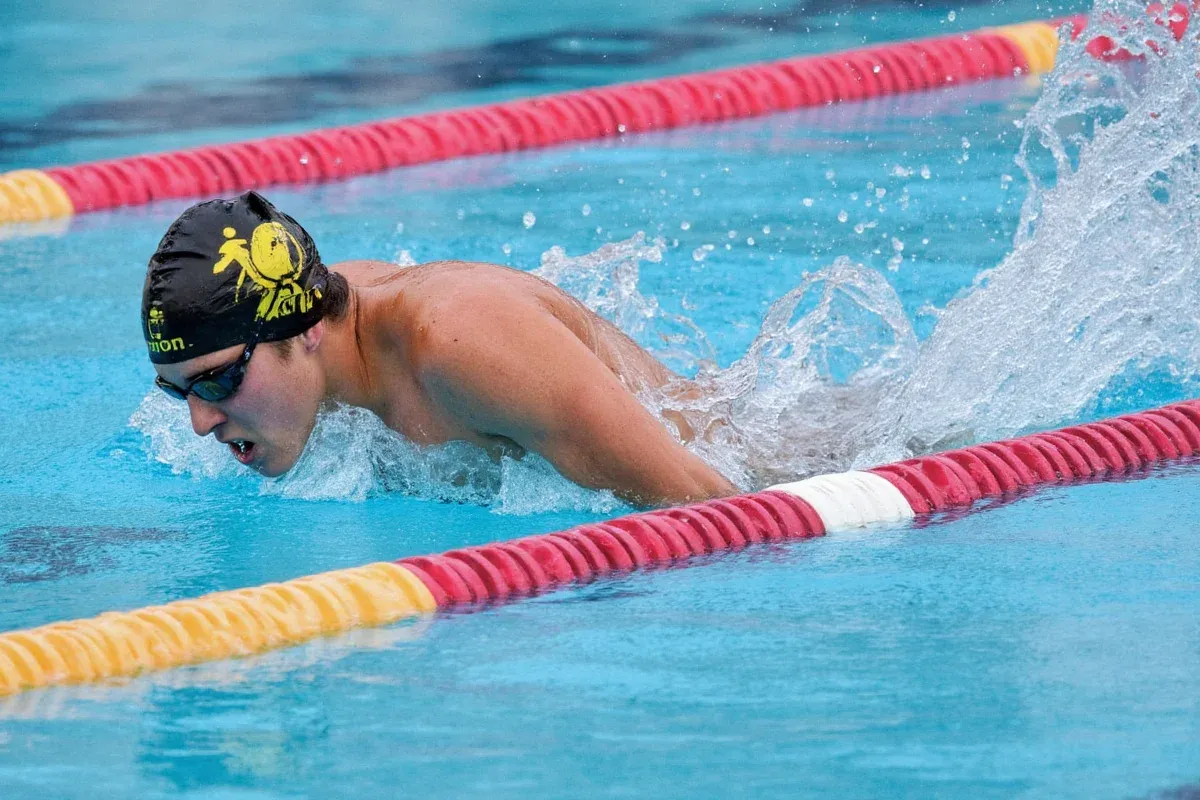
How Many Yards in a Mile Swimming? Exact Numbers
In swimming, there are 1,760 yards in a mile. This standard measurement is used in U.S. pools and competitions, particularly in short course yards (SCY) events. However, it’s important to note that a true international mile (1,609.34 meters) differs slightly, and in long course meters (LCM), swimmers often refer to the 1,500-meter race as “the metric mile.” Understanding the distinction between yard and meter pools, as well as how “mile” is used contextually in swimming, is essential for training, competition, and tracking progress.
Understanding the Mile in Swimming
The term “mile” in swimming can be confusing because it doesn’t always refer to the exact statute mile of 1,760 yards (or 1,609.34 meters). Instead, competitive swimming uses standardized distances that approximate the mile depending on the pool type: short course yards (SCY), short course meters (SCM), or long course meters (LCM).
What Does “Mile” Mean in Pool Swimming?
- In U.S. high school and collegiate swimming (short course yards), the “mile” is 1,650 yards, not 1,760.
- This distance is considered the standard one-mile swim event despite being 110 yards short of a true mile.
- In international competitions (long course meters), the 1,500-meter freestyle is known as the “metric mile.”
- The actual number of laps required depends on the pool length: 25-yard, 25-meter, or 50-meter pools.
Yards vs. Meters: Key Differences in Competitive Swimming
Swimming pools are measured in either yards or meters, which affects how many lengths make up a “mile.” Most U.S.-based competitions use short course yards (25-yard pools), while international events like the Olympics use 50-meter (long course) pools.
Common Pool Lengths and Equivalent Distances
| Poll Type | Pool Length | Laps for 1,650 Yards | Laps for 1,500 Meters | Total Distance (miles approx.) |
|---|---|---|---|---|
| Short Course Yards (SCY) | 25 yards | 66 laps (1,650 yd) | N/A | 0.94 miles |
| Short Course Meters (SCM) | 25 meters | N/A | 60 laps (1,500 m) | 0.93 miles |
| Long Course Meters (LCM) | 50 meters | N/A | 30 laps (1,500 m) | 0.93 miles |
The table shows that the 1,650-yard and 1,500-meter swims are nearly equivalent in distance, both approximating 0.93–0.94 miles. Despite not being a full mile, these races are labeled “the mile” in their respective formats due to tradition and competitive structure.
Why Isn’t a Swimming “Mile” Exactly 1,760 Yards?
The 1,650-yard swim is widely accepted as the “mile” in U.S. swimming circles, even though it falls short of the full 1,760-yard mile. This simplification likely originated from early 20th-century pool design and scheduling convenience.
- Most competitive pools in the U.S. are 25 yards long.
- 1,650 yards equals exactly 66 lengths (33 laps), making it easy to track.
- A full 1,760-yard mile would require 70.4 lengths—an impractical number for race organization.
- The 1,650-yard distance closely matches the 1,500-meter race used internationally.
As a result, swimmers and coaches adopted 1,650 yards as the de facto “mile,” balancing practicality with approximation.
How to Calculate Laps for a Mile Swim
To determine how many laps equal a “mile” swim, you must know your pool’s length and whether you’re using yards or meters.
Steps to Calculate Laps per Mile
- Determine the pool length: 25 yards, 25 meters, or 50 meters.
- Decide which “mile” distance you’re targeting: 1,650 yards or 1,500 meters.
- Divide the total distance by the pool length to get the number of lengths.
- Divide lengths by 2 to get the number of laps (1 lap = 2 lengths).
For example: In a 25-yard pool, 1,650 ÷ 25 = 66 lengths = 33 laps.
Frequently Asked Questions About the Mile Swim
How many yards are in a mile swimming?
There are 1,760 yards in a true statute mile. However, in competitive swimming, the “mile” event is typically 1,650 yards, especially in short course yards (SCY) pools.
Is the 1,650-yard swim the same as a mile?
No, 1,650 yards is approximately 0.94 miles, falling 110 yards short of a full mile. It is called “the mile” for competitive purposes but is not a full statute mile.
How many laps is a mile in a 25-yard pool?
In a 25-yard pool, 1,650 yards (the standard “mile” swim) is 66 lengths or 33 laps. For a true 1,760-yard mile, it would be 70.4 lengths (35.2 laps).
What is the metric mile in swimming?
The metric mile refers to the 1,500-meter freestyle event, commonly swum in 50-meter (Olympic-size) pools. It is the longest standard freestyle race in Olympic competition and is equivalent to about 0.93 miles.
Why do swimmers call 1,650 yards a mile?
Swimmers call 1,650 yards a mile because it’s the closest practical distance to a mile that fits evenly into 25-yard pools (66 lengths). It also aligns closely with the 1,500-meter race, maintaining consistency across pool types and levels of competition.
More Articles
 Sports Stats Guide: Practical Frameworks and Benchmarks
 Who Has Won the Most Super Bowls in a Row?
 Golf Mistakes: Why Good Players Lose Strokes
 Sports Injury Prevention: 12 Evidence-Based Tips to Stay Safe (2026)
 Calories Burned Swimming by Stroke (2026)
 How Many Laps in a Mile Swimming? By Pool Size
 Where to Buy Swim Goggles: Best Online & In-Store Options
 Who Won the High Jump Today? Mahuchikh & Barshim Claim Gold
 Field Hockey Match Duration: Official Times (2026)
 How Fast Are K1 Go Karts? Top Speed Revealed