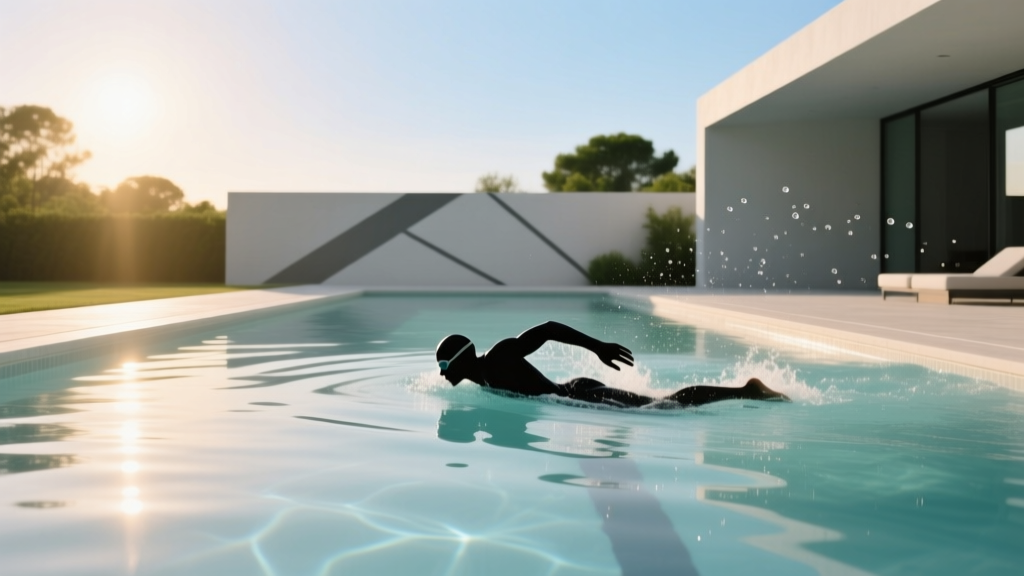
How Many Swimming Laps Is a Mile?
A mile of swimming equals 66 laps in a standard 25-yard pool, 33 lengths in a 50-meter Olympic pool, or 72 lengths in a 25-meter short course pool. The exact number depends on the pool’s length and whether you count a lap as one length or a round trip.
Understanding Swimming Laps vs. Lengths
One common source of confusion when calculating how many swimming laps make a mile is the definition of a “lip.” In competitive swimming, a length refers to swimming from one end of the pool to the other. A lap, however, can mean either one length or two (down and back), depending on context.
Common Definitions
- Lap (gym/fitness context): Often means down and back = 2 lengths
- Lap (competitive swimming): Usually synonymous with one length
- Mile: 1,609.344 meters or 1,760 yards
To avoid confusion, most swim programs and coaches use “lengths” rather than laps when tracking distance.
How Pool Size Affects Lap Count
The number of lengths required to swim a mile varies significantly based on the pool size. Common pool configurations include 25-yard, 25-meter, and 50-meter pools. Here's how they compare:
| Pool Type | Length | Meters in a Mile | Lengths for 1609m | Rounded Laps |
|---|---|---|---|---|
| Olympic Pool | 50 meters | 1,609.34 | 32.19 | 33 |
| Short Course (SCM) | 25 meters | 1,609.34 | 64.37 | 65 |
| Short Course Yards (SCY) | 25 yards | 1,760 | 70.4 | 70–71 |
| Long Course Meters (LCM) | 50 meters | 1,609.34 | 32.19 | 33 |
| 25-Meter Pool (Imperial) | 25 meters | 1,760 yards | 68.58 | 69 |
Data shows that swimmers in 25-yard pools must complete over 70 lengths to reach a mile, while those in 50-meter Olympic pools need only 32–33. The difference between meter and yard pools adds complexity, especially in international competitions where SCM (25m) and LCM (50m) dominate.
Calculating Your Mile Swim
To calculate how many laps equal a mile in your local pool, follow these steps:
Step-by-Step Calculation
- Determine your pool’s length (in meters or yards)
- Use 1,609.34 meters or 1,760 yards as the mile standard
- Divide total distance by pool length
- Round up to ensure you meet or exceed the mile
For example: In a 25-yard pool, 1,760 ÷ 25 = 70.4, so aim for 71 lengths to complete a full mile.
Why Swimmers Use 1650m Instead of 1609m
In practice, many swimmers refer to the “mile” as 1650 meters in a 25-meter or 50-meter pool, even though it’s slightly longer than a true mile. This convention comes from competitive swimming events, where the 1650-yard freestyle is the standard “mile” race in U.S. collegiate (NCAA) and high school meets.
- 1650-yard freestyle: Equal to 66 lengths in a 25-yard pool
- 1650-meter swim: 66 lengths in a 25-meter pool or 33 in a 50-meter pool
- It’s easier to track than 1609m and widely accepted as “the swimmer’s mile”
Training Tips for Completing a Mile Swim
Swimming a full mile continuously is a significant endurance challenge, especially for beginners. Consider these training strategies:
- Break it into intervals: Swim 10 x 100 yards with rest to build stamina
- Use a pace clock: Track your split times every 100 yards/meters
- Focus on technique: Efficient stroke reduces fatigue over long distances
- Incorporate drills: Add kick sets or pull buoy segments to vary effort
- Track progress: Use a waterproof fitness tracker or smartwatch
Frequently Asked Questions About Swimming Laps in a Mile
How many laps in a 25-yard pool is a mile?
70.4 lengths, or 71 if rounding up. Since each length is 25 yards, 1,760 yards (a mile) divided by 25 equals 70.4. Most swimmers complete 71 lengths to ensure they’ve covered the full distance.
Is 1650 meters the same as a mile?
No, 1650 meters is about 1,805 yards, which is 45 yards longer than a statute mile (1,760 yards). However, it’s commonly called “the swimmer’s mile” in U.S. competitions due to its use in 1650-yard races.
How many laps is a mile in an Olympic pool?
In a 50-meter Olympic pool, one mile requires 32.19 lengths. Swimmers typically complete 33 lengths to surpass the mile distance. This is equivalent to 16.5 laps if counting a lap as down and back.
What is the difference between SCM and LCM pools?
SCM stands for Short Course Meters (25m pool), used in winter competitions. LCM is Long Course Meters (50m pool), used in summer Olympics and World Championships. Times are generally faster in LCM due to fewer turns.
Does swimming a mile burn more calories than running a mile?
Running a mile typically burns more calories (about 100) than swimming a mile (around 60–80), but swimming provides greater resistance and low-impact cardiovascular benefits, making it ideal for cross-training and joint health.
More Articles
 How Many Players on an Ice Hockey Team?
 What to Wear at a Rock Climbing Gym
 How Thick Is Hockey Ice? NHL Standard Revealed
 Best Home Gym Equipment Under $500: 2026 Budget Setup Guide
 Size Safety Tips: How Proper Sizing Prevents Injury
 How Fast Do Race Walkers Walk? Elite Speeds Revealed
 How Much Does a Canoe Cost? (2025 Prices)
 Where Did Ice Hockey Originate? The True Story
 How Much Does Renting a Jet Ski Cost? (2025 Rates)
 Tennis Elbow Brace Guide: Pick the Right One