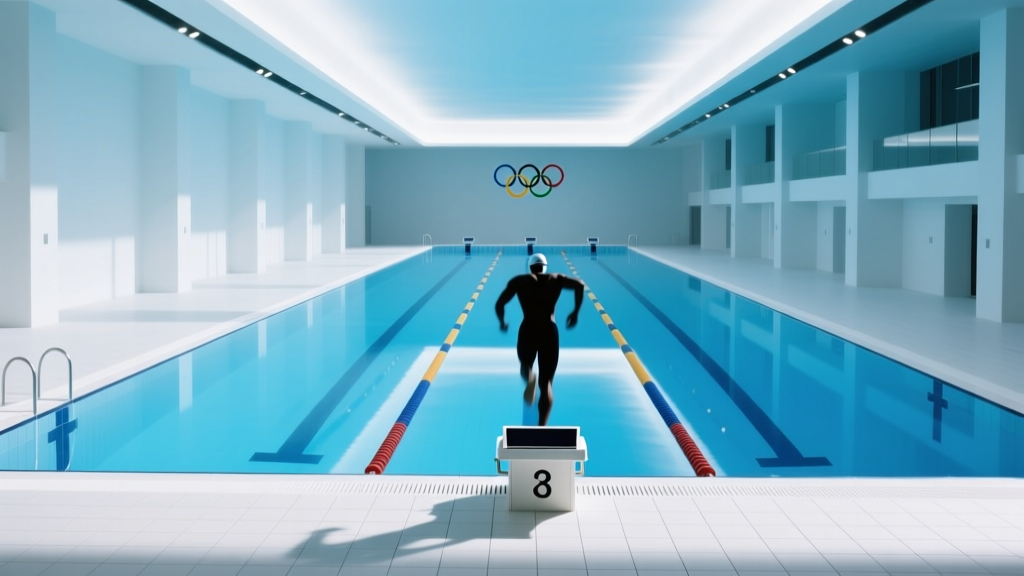
How Many Meters Is an Olympic Swimming Pool?
An Olympic swimming pool is exactly 50 meters in length, as regulated by the international governing body for aquatic sports, World Aquatics (formerly FINA). This standard length is used for all long-course Olympic and international competitions.
What Is the Standard Size of an Olympic Swimming Pool?
The dimensions of an Olympic swimming pool are strictly defined to ensure fairness and consistency in competition. The key measurement is the 50-meter length, which distinguishes it from short-course pools (25 meters). In addition to length, other standardized dimensions include width, depth, number of lanes, and lane width.
Key Features of an Olympic Pool
- Length: 50 meters
- Width: 25 meters
- Number of Lanes: 10 lanes (8 competition lanes + 2 buffer lanes)
- Lane Width: 2.5 meters each
- Minimum Depth: 2.0 meters
- Water Temperature: 25–28°C (77–82°F)
- Volume of Water: Approximately 2.5 million liters
Why Is the Pool 50 Meters Long?
The 50-meter length has been the global standard for long-course competitive swimming since the early 20th century. It allows swimmers to build speed and endurance over a full sprint or distance event. This length also enables precise timing and record comparisons across venues.
Historical Development
Prior to standardization, pools varied significantly in size. The first modern Olympics in 1896 held swimming events in open water. By 1908, dedicated pools were introduced, and by 1924, the 50-meter pool became the official standard recognized by FINA (now World Aquatics).
Impact on Performance
A consistent 50-meter length ensures that world records are comparable regardless of location. Variations in pool dimensions could affect hydrodynamics, turn efficiency, and swimmer performance—making standardization critical for elite competition.
Differences Between Olympic, Short-Course, and Other Pools
Not all competitive pools are 50 meters long. Understanding the differences helps clarify training and competition formats.
- Olympic Pool (Long Course): 50 meters — used in the Olympics, World Championships, and other major international events.
- Short-Course Pool: 25 meters — commonly used in winter competitions and regional meets.
- Yard Pools: Often 25 yards — primarily used in the United States collegiate and high school systems.
Swimming times differ between 50m and 25m pools due to more turns in short course, which allow swimmers to gain speed off walls.
| Feature | Olympic Pool | Short-Course Pool | U.S. High School Pool |
|---|---|---|---|
| Length | 50 meters | 25 meters | 25 yards (~22.86 meters) |
| Competition Type | Long Course | Short Course | Short Course (Yards) |
| Lanes | 10 (8+2) | 8–10 | 6–8 |
| Lane Width | 2.5 m | 2.5 m | 2.0–2.5 m |
| Depth | ≥2.0 m | ≥1.8 m | Variable |
| Major Events | Olympics, World Aquatics Championships | World Short Course Championships | NCAA, State Meets |
The data highlights how Olympic pools are larger and more strictly regulated than other types. The extra two buffer lanes reduce wave interference, improving swimmer performance and timing accuracy. These design elements are essential for elite-level racing.
Common Questions About Olympic Swimming Pools
How many meters is an Olympic swimming pool?
An Olympic swimming pool is exactly 50 meters in length, as mandated by World Aquatics for all long-course competitions including the Olympic Games.
Is an Olympic pool always 50 meters?
Yes, for official competitions such as the Olympics and World Championships, the pool must be 50 meters long. Any deviation would disqualify the venue from hosting such events.
How many laps in an Olympic pool is 1500 meters?
In a 50-meter Olympic pool, 1500 meters equals 30 laps (one lap being one length of the pool) or 15 round-trip swims.
Do Olympic pools have waves?
Olympic pools are designed to minimize waves using deep water (at least 2 meters), energy-absorbing lane ropes, and overflow gutters. These features reduce turbulence and improve swimmer performance.
Can public pools be Olympic-sized?
Some public or university pools are built to Olympic specifications, but they are expensive to construct and maintain. Most public pools are shorter (25 meters or 25 yards) due to space and cost constraints.
More Articles
 When Was Ice Hockey Invented? Origins & History
 Science-Backed Tips for Sports Performance
 Where Can I Go Swimming Near Me? Top 2025 Spots
 Team Performance Tips: Evidence-Based Strategies
 Ultimate Tennis Guide: Rules, Equipment, Technique, Strategy, and Player Development
 Where Was Ice Hockey Invented? The True Origin Revealed
 How Much Do MotoGP Bikes Cost in 2025?
 What Muscles Do Rowing Machines Work? Full Breakdown
 Where to Buy Swimming Clothes: Best Stores & Brands 2025
 Safe Chlorine Level to Swim In: Max ppm Guidelines