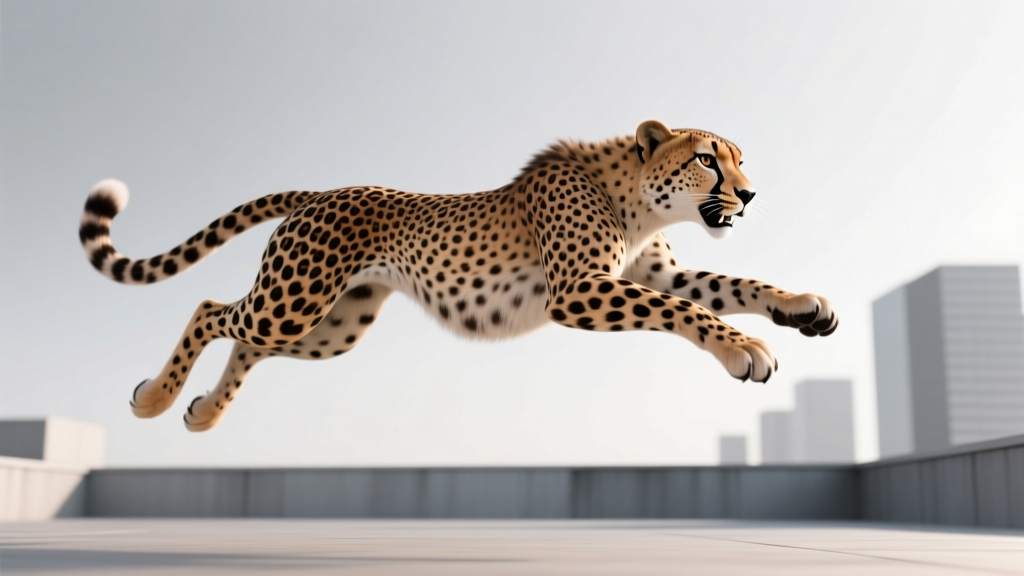
How High Can a Cheetah Jump? Facts & Data
A cheetah can jump vertically up to 2 meters (6.5 feet) from a standing position, and horizontally cover distances of up to 7 meters (23 feet) in a single leap, making it one of the most explosive jumpers in the animal kingdom.
Understanding the Cheetah's Jumping Ability
The cheetah (Acinonyx jubatus) is renowned for its speed, but its jumping capability is equally impressive when considering its biomechanics and hunting strategy. While not primarily known as a climber like leopards, cheetahs use powerful bursts of acceleration and precise leaps to intercept fast-moving prey such as gazelles and impalas.
Vertical vs. Horizontal Jump Performance
Cheetahs do not jump high into trees, but they are capable of significant vertical lifts when chasing prey or navigating terrain. Their horizontal jumps are more common and critical during high-speed chases.
- Vertical jump: Up to 2 meters (6.5 feet)
- Horizontal leap: Up to 7 meters (23 feet)
- Jumps typically occur at speeds exceeding 80 km/h (50 mph)
- Muscle composition optimized for explosive force, not endurance
Anatomy Behind the Leap
The cheetah’s body is fine-tuned for rapid acceleration and agile maneuvering, which directly supports its jumping power.
Key Physical Adaptations
- Long, muscular hind legs: Generate tremendous propulsion
- Flexible spine: Acts like a spring, extending and contracting during strides and jumps
- Non-retractable claws: Provide traction similar to sprinting shoes
- Lightweight frame: Reduces inertia, enabling quick takeoffs
- Tail: Functions as a rudder for balance mid-air
Hunting Strategy and Jump Usage
Cheetahs rely on short bursts of speed and calculated jumps rather than prolonged chases. Jumping plays a role in sudden directional changes and closing the final gap to prey.
How Jumping Fits Into the Hunt
- Stalking within 10–30 meters before initiating chase
- Reaching top speed in under 3 seconds
- Using mid-stride leaps to adjust trajectory
- Final lunge to trip or knock down prey
- Rarely jumps above ground level unless navigating rocks or small inclines
| Attribute | Cheetah | Leopard | Lion | Human (Elite Athlete) |
|---|---|---|---|---|
| Max Vertical Jump (m) | 2.0 | 3.0 | 1.2 | 1.25 |
| Max Horizontal Jump (m) | 7.0 | 6.0 | 3.5 | 8.95 |
| Top Speed (km/h) | 112 | 58 | 80 | 37 |
| Acceleration (0–60 km/h) | 3 seconds | 4 seconds | 5 seconds | 6 seconds |
| Muscle Fiber Type | Fast-twitch dominant (90%) | Fast-twitch (75%) | Fast-twitch (70%) | Fast-twitch (up to 80%) |
The data shows that while cheetahs don’t have the highest vertical jump among big cats, their combination of speed, acceleration, and horizontal leap distance is unmatched. Their muscle fiber composition explains their explosive capability, though it limits sustained activity. Compared to humans, cheetahs trade absolute jumping distance for dynamic mid-run agility.
Comparative Jumping in Big Cats
Unlike leopards, which climb and jump into trees with ease, cheetahs are built for open plains. Their jumping is functional rather than acrobatic.
- Cheetahs rarely climb; limited shoulder mobility and non-retractable claws reduce tree access
- Leopards can drag prey twice their weight up trees using climbing strength
- Lions jump primarily to attack, not to navigate terrain
- Cheetah’s jumps are integrated into running mechanics, not isolated movements
Frequently Asked Questions About Cheetah Jumping
Can a cheetah jump higher than a human?
Yes, a cheetah can jump up to 2 meters vertically, surpassing most elite human athletes, whose maximum vertical jump is around 1.25 meters. However, trained humans can achieve longer horizontal jumps—up to nearly 9 meters in the long jump—compared to a cheetah’s 7-meter leap.
Why don’t cheetahs climb trees like leopards?
Cheetahs have non-retractable claws that lack the grip needed for climbing, and their shoulder structure is adapted for speed, not arboreal movement. They rely on sight from elevated ground but prefer staying on open terrain where they can fully utilize their speed.
How does a cheetah use jumping during a hunt?
A cheetah uses short, powerful leaps during high-speed chases to adjust course and close the gap with prey. The final jump often aims to trip the animal by striking its hindquarters, leading to a quick takedown.
What muscles allow a cheetah to jump so far?
The cheetah’s powerful gluteal, quadriceps, and hamstring muscles in its hind legs generate the force for jumping. Its flexible spine and long tendons act like springs, storing and releasing energy efficiently during each stride and leap.
Can a cheetah jump over a fence?
Yes, a cheetah can easily clear a standard 2-meter (6.5-foot) fence if motivated. In wildlife reserves, enclosures must be designed with this in mind, often using electrified or curved-top fencing to prevent escape.
More Articles
 Can All Jet Skis Go in the Ocean? Key Facts
 How Many Players on a Water Polo Team? Full Breakdown
 Why Is There a Libero in Volleyball? Rules, Purpose & History Explained (2026)
 Where to Buy Swimming Clothes: Best Stores & Brands 2025
 How Long Is a Water Polo Game? Full Timing Explained
 How Many Laps Is 800 Meters Swimming?
 Fastest Jet Ski in the World: Top Speeds & Models
 Basketball Court Dimensions: NBA, FIBA, College & High School Standards (2026)
 What Muscles Do Cable Seated Rows Work?
 Olympic Pool Depth: How Deep Is It?