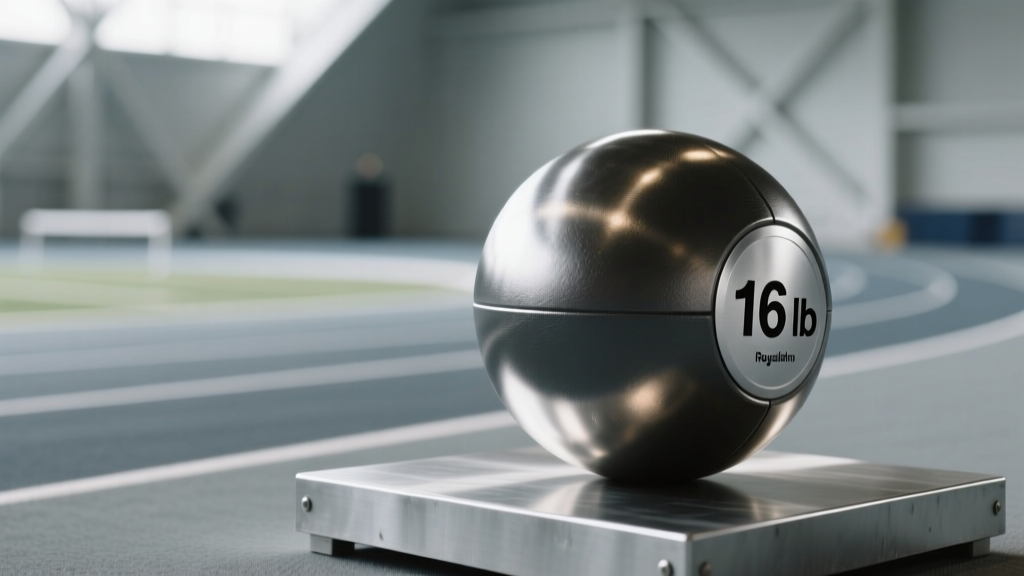
How Heavy Is a Shot Put? Official Weights by Category
A shot put weighs 7.26 kilograms (16 pounds) for men and 4 kilograms (8.8 pounds) for women in official competition. These standardized weights are regulated by World Athletics and used in events such as the Olympics, World Championships, and collegiate track and field meets. The weight difference reflects physiological distinctions between male and female athletes, ensuring fair and competitive performance across levels.
What Is Shot Put?
Shot put is a track and field event where athletes 'put' (push rather than throw) a heavy spherical object — the shot — as far as possible from a designated circle. It is one of the oldest forms of organized athletic competition, dating back to ancient times, and has been part of the modern Olympic Games since 1896 for men and 1948 for women.
Key Characteristics of the Event
- The athlete must launch the shot using one hand from the shoulder.
- The throw is executed from within a 2.135-meter (7-foot) diameter circle.
- The shot must land within a designated sector (typically 34.92° arc) to be valid. \li>The technique involves either the glide or the spin method.
Standard Shot Put Weights by Category
The weight of the shot varies based on gender, age group, and competition level. While elite adult competitions follow strict international standards, youth and high school divisions use lighter implements to accommodate developing athletes.
| Category | Weight (kg) | Weight (lbs) | Diameter (cm) | Governing Body |
|---|---|---|---|---|
| Men's Senior (Olympic/World Athletics) | 7.26 | 16 | 110–130 | World Athletics |
| Women's Senior (Olympic/World Athletics) | 4.00 | 8.8 | 95–110 | World Athletics |
| High School Boys (USA) | 6.00 | 13.2 | 100–120 | NFHS |
| High School Girls (USA) | 4.00 | 8.8 | 95–110 | NFHS |
| U18 Men (World Athletics) | 5.00 | 11.0 | 100–120 | World Athletics |
| U18 Women (World Athletics) | 3.00 | 6.6 | 90–100 | World Athletics |
| Masters Men (Age 35+) | 7.26 | 16 | 110–130 | World Masters Athletics |
| Masters Women (Age 35+) | 4.00 | 8.8 | 95–110 | World Masters Athletics |
The data shows that while elite senior categories maintain consistent shot weights globally, developmental categories use reduced weights to support safe progression. This ensures younger athletes can learn proper technique without excessive strain. Notably, U18 women use a 3 kg shot, significantly lighter than the senior 4 kg standard, reflecting strength development timelines.
Materials and Design of the Shot
Shots are typically made of iron, brass, or stainless steel. The surface must be smooth and free of seams or protrusions that could aid grip. Competitive shots are solid spheres with no moving parts.
Material Comparison
- Iron: Most common in schools and training due to low cost.
- Brass: Used in professional meets for durability and consistent feel.
- Stainless Steel: Resists rust and offers longer lifespan; preferred in outdoor facilities.
The density of the material ensures the shot maintains a compact size despite its weight. Regulation diameter ranges ensure usability across skill levels while preventing overly small or large grips.
Why Are Shot Put Weights Standardized?
Standardization ensures fairness, safety, and comparability across competitions worldwide. Without uniform equipment, records could not be validated, and athlete progression would be inconsistent.
Benefits of Weight Standards
- Enables accurate record-keeping and world rankings.
- Supports athlete development through predictable training loads.
- Reduces injury risk by preventing inappropriate weight usage.
- Facilitates global competition equity.
Frequently Asked Questions About Shot Put Weight
How heavy is a men's shot put in the Olympics?
A men's shot put in the Olympics weighs exactly 7.26 kilograms (16 pounds). This weight has been standardized by World Athletics and is used in all major international competitions including the Olympic Games and World Championships.
How heavy is a women's shot put in competition?
A women's shot put in official competition weighs 4 kilograms (8.8 pounds). This standard applies to elite events such as the Olympics, World Championships, and most national-level meets.
What is the weight of a high school shot put?
In the United States, high school boys typically use a 6 kg (13.2 lbs) shot put, while girls use a 4 kg (8.8 lbs) shot. Some states may allow variations for freshman or junior varsity athletes, but 6 kg and 4 kg are the most common.
Is the shot put heavier than the discus?
No, the shot put is lighter than the discus. A men’s discus weighs 2 kg (4.4 lbs), but it has much greater momentum due to its size and rotational throwing style. Although the discus is lighter, it requires different mechanics and explosive power over a longer motion.
Why is the shot put so heavy?
The shot put is designed to test maximum power, strength, and technique in a short explosive movement. Its weight challenges an athlete’s ability to generate force quickly. The standardized weight ensures consistency in measuring human performance across time and geography.
More Articles
 How Thick Is Ice Hockey Ice? NHL Standards Explained
 Where to Buy Swim Goggles: Best Online & In-Store Options
 Tennis String Tension: Power vs Control
 Para Swimming Classification Explained
 Will Ferrell Ice Skating: Truth Behind Blades of Glory
 What Happens If You Knock Over a Hurdle?
 Who Created Water Polo? The True Origin Story
 Why Do Swimmers Wear Swim Caps? Key Reasons Explained
 How Much Is a Jet Ski Rental? (2025 Prices)
 When Was Ice Hockey Founded? Key Dates & History