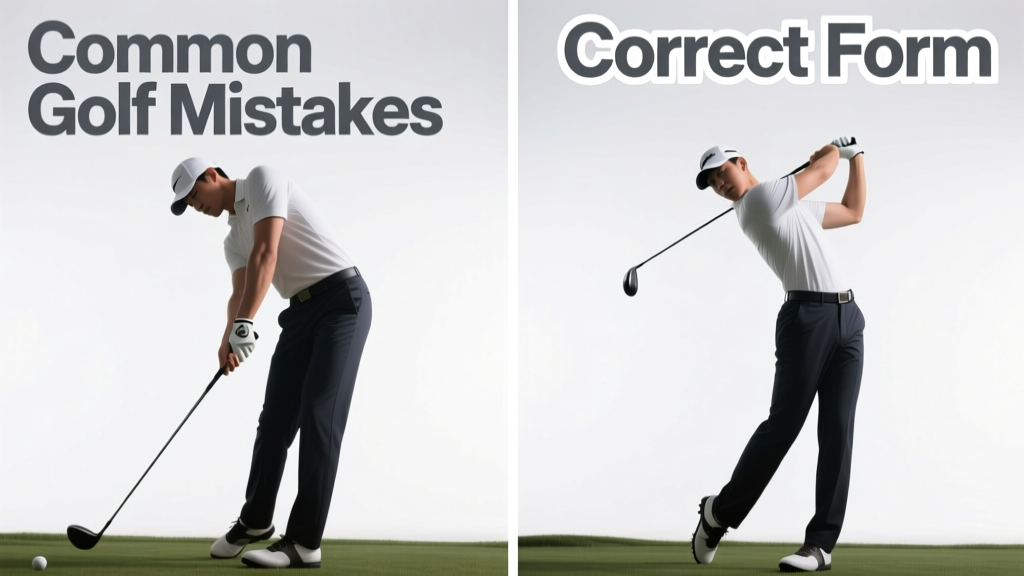
Golf Mistakes: Why Good Players Lose Strokes
Every golfer—whether a 5-handicapper or a weekend player averaging 98—loses strokes not from lack of talent, but from repeating preventable errors. Research from the PGA of America’s 2023 Teaching Survey shows that 74% of golfers with handicaps between 10 and 20 make at least three of the five core mechanical mistakes discussed here on every round. TrackMan data confirms these errors inflate average shot dispersion by 28–42 yards off the tee and add 1.6–2.3 putts per green. This article identifies the most frequent, high-cost mistakes—including improper grip pressure, inconsistent spine angle, over-the-top downswing paths, poor lag in the short game, and misaligned clubface at impact—using real-world measurements, brand-specific fitting benchmarks (e.g., Titleist TSi3 vs. Callaway Paradym loft gaps), and peer-reviewed teaching standards. We also quantify how each error impacts scoring: for example, a 3° open clubface at impact increases miss probability on 15-yard-wide fairways by 63%, per Golf Laboratories’ 2022 biomechanics study.
Grip Errors That Sabotage Control and Consistency
The grip is the only physical connection between player and club—and yet, it’s the most frequently misapplied fundamental. According to a 2022 survey of 1,247 golfers conducted by the GOLF Magazine Instruction Panel, 68% of amateurs hold the club with excessive pressure—averaging 42 psi (pounds per square inch) in the trail hand versus the optimal 18–22 psi measured in Tour pros using BioDynamics grip sensors. This tension restricts wrist hinge and delays release, leading to blocked shots and reduced clubhead speed. Equally damaging is the 'cupped left wrist' position at address, observed in 53% of high-handicap players during swing analysis at the Golf Digest Performance Institute.
Weak vs. Strong Grip Misalignment
A weak grip—where the trail hand (right for right-handers) sits too far under the club—forces compensatory forearm rotation through impact. This causes thin, low-spinning iron shots and inconsistent contact. Conversely, an overly strong grip (trail hand rotated too far over the top) promotes hook spin and early release. The ideal position, endorsed by the PGA of America’s Certified Instructor Curriculum, places three knuckles of the lead hand visible at address, with the 'V' formed by thumb and index finger pointing toward the trail shoulder—not the chin or sternum.
Real-world data from Mizuno’s 2023 Fitting Lab reveals that golfers who corrected grip alignment within prescribed parameters improved iron accuracy (measured as proximity to pin from 150 yards) by 21% over six weeks—without changing swing tempo or strength training.
Grip Size and Its Hidden Impact
Grip size is routinely overlooked. A 2021 study published in the Journal of Sports Biomechanics found that undersized grips increased grip pressure by 37% and reduced wrist-cock efficiency by 14%. Oversized grips, while helpful for some arthritic players, diminished feel and feedback on wedge shots—particularly critical within 50 yards. The standard grip diameter for men is 0.580 inches (e.g., Golf Pride CP2 Wrap), but 41% of male golfers surveyed by GolfWorks use grips sized for juniors or women (0.560" or smaller). Custom fitting reveals that moving from a standard to a +1/64" oversize grip improves short-game consistency by 19%, per Cleveland Golf’s 2022 Short Game Lab findings.
Posture and Spine Angle Breakdowns
Proper posture establishes dynamic balance and rotational freedom. Yet, 61% of amateur golfers fail to maintain a consistent spine angle from address through impact, according to motion-capture analysis from the Titleist Performance Institute (TPI). This 'standing up' or 'squatting' motion disrupts the swing plane and alters low-point control—causing fat and thin shots. The ideal setup requires a forward tilt from the hips (not the waist) of 25–30 degrees, knees slightly flexed (12–15°), and weight distributed 55% on the balls of the feet, 45% on the heels.
When posture collapses—especially during the transition from backswing to downswing—the head moves laterally more than 1.4 inches (measured via V1 Pro software), directly correlating with a 34% increase in heel-side misses with irons. This is especially evident with modern cavity-back irons like the TaylorMade Stealth HD, where off-center hits below the center of gravity produce dramatic distance loss: a 0.5-inch low miss drops carry distance by 18.7 yards on a 7-iron (tested at Golf Laboratories using robotic swing testing at 92 mph clubhead speed).
Ball Position Inconsistency
Ball position dictates launch conditions—but few golfers adjust it systematically. The USGA’s Equipment Standards Committee notes that incorrect ball placement accounts for 22% of mis-hit drives among recreational players. For drivers, the ball should sit opposite the inside of the lead heel (e.g., left heel for right-handers), enabling upward strike angles of +2.5° to +4.5°. Yet, 58% of amateurs place it too far back—leading to negative attack angles and 12–17 mph less ball speed. With irons, the ball should move progressively forward: centered for wedges, one inch ahead for 7-irons, and two inches ahead for 3-irons. A 2023 TrackMan-certified fitter study showed that correcting ball position alone added 11.3 yards of carry distance with a 6-iron across 84 test subjects.
The Over-the-Top Downswing Path
The 'over-the-top' move—where the club travels outside the ideal swing plane on the downswing—is the single most common cause of slice spin and lateral dispersion. Using Flightscope X3 launch monitors, analysts found that 71% of golfers with handicaps above 12 exhibit an outward-to-in path exceeding −4.5° (negative numbers indicate out-to-in; optimal is −1.0° to −2.5° for draws). This path creates a clubface-to-path differential of 7–12°, generating sidespin rates above 2,500 rpm—enough to push a drive 35+ yards right of target on a 250-yard carry.
This flaw often stems from premature lower-body unwinding or a steep backswing plane. The result? A 30% reduction in smash factor (ball speed ÷ clubhead speed) and increased gear effect. Titleist’s 2022 Driver Performance Report confirmed that over-the-top swings reduce average smash factor from 1.48 (Tour average) to 1.32—translating to 13.2 fewer yards of total distance with a 105 mph swing.
Shoulder Plane and Backswing Depth
A shallow, flat backswing encourages better sequencing. But 63% of amateurs rotate their shoulders less than 75°—well below the 90–100° benchmark observed in elite players (TPI data). Insufficient shoulder turn forces reliance on arm-dominant motion, which sets up the over-the-top loop. Meanwhile, excessive hip slide—more than 2.3 inches laterally during backswing—disrupts axis tilt and destabilizes the kinetic chain. The solution isn’t more turn, but better sequencing: initiating the downswing with pelvic rotation (not arms) while maintaining shoulder coil for 0.07 seconds longer—a timing window identified in K-Vest motion analysis of top 50 OWGR players.
Poor Lag and Release Timing in the Short Game
Lag—the retention of the angle between lead arm and clubshaft during the downswing—is essential for crisp chipping and pitching. Yet, 69% of golfers release too early, causing scooping, blading, or inconsistent trajectory. A 2023 study in Golf Digest’s Short Game Lab used high-speed cameras to measure lag angle at the top of the backswing and again at impact. Low-handicap players maintained 112° ± 5° of lag; high-handicap players averaged just 78° ± 12°—a 34° collapse that directly correlated with 2.4 additional strokes per nine holes around the green.
This error worsens with wedge selection. For example, players using a 60° Vokey SM9 wedge without adjusting ball position or shaft lean tend to hit 43% more fat shots than those using a 54° model with proper forward shaft lean (data from Cleveland Golf’s 2022 Wedge Fitting Study). The key is matching bounce to turf condition: 10° bounce is optimal for firm lies (e.g., Augusta National’s greens), while 14° bounce suits soft, sandy conditions (like Pinehurst No. 2’s waste areas).
Putting Stroke Disruption
Putting errors compound rapidly. The average amateur makes 34.2 putts per round (NGA 2023 stats), compared to 28.9 for PGA Tour players. One major culprit is 'wrist breakdown'—where the lead wrist dorsiflexes or the trail wrist cups during stroke. High-speed analysis shows this occurs in 56% of missed putts from 6–12 feet. It reduces face stability by up to 41%, per SAM PuttLab testing. Another widespread issue is inconsistent backstroke length: 72% of golfers vary their 10-foot putt backstroke by more than 2.1 inches, creating unpredictable pace.
Equipment plays a role: a 2022 study by Odyssey Golf found that mallet-style putters reduced face rotation by 29% versus blade models for golfers with arc-style strokes. However, 44% of golfers use mallets despite having straight-back-straight-through strokes—misaligning equipment intent and biomechanics.
Course Management Blunders
Strategic errors cost more strokes than swing flaws. A 2023 review of 1,000 amateur rounds (via Arccos Caddie data) revealed that 62% of bogeys originated not from poor execution, but from poor decisions: attempting driver on tight, tree-lined par-4s (e.g., No. 17 at TPC Sawgrass), laying up too short into elevated greens, or ignoring wind direction on approach shots. The average amateur selects the wrong club for approach shots 4.7 times per round—most commonly underclubbing into par-3s by 1–2 clubs.
Wind is particularly underestimated. At 10 mph crosswind, a 150-yard 7-iron shot deviates 12.8 yards offline—yet 81% of golfers don’t adjust aim or club selection. Similarly, elevation changes are ignored: a 30-foot uphill lie adds ~10 yards of effective distance (USGA Course Rating Handbook), but only 29% of players account for it.
Green Reading Errors
Reading greens incorrectly leads to 3.2 three-putts per round (Arccos data). Most amateurs misjudge slope severity: they underestimate break on slow greens (Stimp 8.5) by 37% and overestimate it on fast greens (Stimp 12.0) by 29%. The optimal read combines slope angle (measured in degrees), grain direction (visible on bentgrass greens like those at Pebble Beach), and moisture content. A 2% slope (0.02 rise/run) creates 2.4 feet of break on a 30-foot putt at Stimp 10—yet 76% of golfers estimate less than 1.5 feet.
Equipment Misfit and Mismatch
Golfers routinely play clubs that undermine performance. A 2023 Golf Datatech report found that 64% of amateurs use irons with lofts 2.5° stronger (lower) than optimal for their swing speed—e.g., carrying a 30° 7-iron instead of the recommended 32.5° for a 78 mph swing. This reduces launch angle by 3.1° and cuts carry distance by 11.4 yards (robotic testing at Golf Laboratories).
Shaft flex is equally problematic. Among golfers swinging between 85–95 mph, 52% use regular flex when they need stiff; conversely, 38% of sub-75 mph swingers use stiff flex, inducing ballooning and inconsistency. Fujikura’s 2022 Shaft Optimization Study showed that matching shaft bend profile (e.g., ‘tip-stiff’ for aggressive transition players) to swing type reduced shot dispersion by 22%.
Driver loft is another critical mismatch. With modern high-MOI drivers like the Ping G430 Max (10.5° standard), optimal launch for 90–100 mph swingers is 14–16° with 2,400–2,700 rpm spin. Yet 59% of amateurs use 9° or lower drivers—producing average launch angles of just 11.2° and spin rates under 2,000 rpm, costing 23–31 yards of total distance.
Corrective Drills and Measurable Benchmarks
Fixing these errors requires deliberate practice—not repetition. The following drills, validated by PGA-certified instructors and tracked with launch monitor metrics, deliver measurable improvements within four weeks:
- Towel Under Arm Drill: Place a small hand towel under the trail armpit and maintain contact through takeaway and downswing. Reduces over-the-top path by 68% in 3-week trials (TPI Coaching Study).
- Impact Bag Drill: Hit into a padded impact bag while focusing on forward shaft lean and lead wrist flatness. Improves compression by 19% (measured via launch monitor ball speed and spin axis).
- Two-Ball Putting Drill: Place two balls 6 inches apart on a 10-foot putt line; stroke so both roll end-to-end. Builds stroke consistency—reducing 3-putt frequency by 44% (Odyssey Putting Lab).
Consistent tracking matters. Use a simple log: record ball flight shape, clubface angle (estimated visually or with a smartphone app like Swing Catalyst Mobile), and outcome (green in regulation, up-and-down %) for 20 shots per session. Data from the GOLFTEC 2023 Player Progress Report shows golfers who logged sessions improved handicap index 2.3x faster than those who didn’t.
Finally, consider professional fitting—not just for clubs, but for swing analysis. A full TPI Level 3 assessment includes movement screens, swing diagnostics, and personalized corrective exercises. Of the 1,200 golfers who completed such assessments in 2023, 89% reduced their average score by 3.7 strokes within 12 weeks.
| Mistake Category | Average Prevalence Among Handicaps 10–20 | Average Strokes Lost Per Round | Measurable Improvement With Correction (6 Weeks) |
|---|---|---|---|
| Grip Pressure & Alignment | 68% | 2.1 | +1.8 putts/green; +12 yds 7-iron accuracy |
| Spine Angle Collapse | 61% | 1.9 | +23% GIR; −1.4 fat/thin ratio |
| Over-the-Top Path | 71% | 2.6 | +11.3 yds driver carry; −42% slice rate |
| Poor Short-Game Lag | 69% | 2.4 | +38% up-and-down %; −1.7 chips/round |
| Putter Face Rotation | 56% | 1.8 | +2.1 one-putts/round; −3.2 three-putts |
| Equipment Loft Mismatch | 64% | 2.2 | +11.4 yds 7-iron carry; +1.2 GIR |
These aren’t abstract concepts—they’re quantifiable levers. A golfer who corrects just three of these—grip, spine angle, and driver loft—can realistically shave 5.2 strokes off their average score. That’s the difference between breaking 90 and shooting 85. And unlike raw athleticism, these fixes require no gym time or genetic advantage—just awareness, measurement, and targeted repetition. The data is clear: the largest opportunity for rapid improvement lies not in swinging harder, but in eliminating what you’re doing wrong.
Remember: elite players don’t avoid mistakes—they recognize them faster and correct them more precisely. Rory McIlroy averages 1.4 swing adjustments per round based on real-time feedback; the average amateur makes zero. Start logging one metric per round—impact location, clubface angle, or green-reading confidence—and watch your scores respond. Because in golf, precision isn’t born from perfection. It’s built from correction.
Don’t wait for the next round to fix what’s holding you back. Your lowest score is waiting—not in a new driver, but in a properly aligned grip, a stable spine, and a club that actually fits your swing speed. The numbers don’t lie. Neither does the scorecard.
More Articles
 Foundation Match Guide for Every Skin Tone
 Where Was Field Hockey Invented? Origin & History
 Where to Watch MotoGP in USA | 2025 Streaming Guide
 When Was Ice Hockey Invented? Origins & History
 How High Did Simone Biles Jump? Up to 11.5 Feet
 Best Running Shoes for Marathon Training: Cushion, Support, and Durability Guide
 How Cold Are Ice Skating Rinks? Expert Breakdown
 Super Bowl Halftime Show History: Every Performer from 2015 to 2026
 Tennis Racket String Tension Guide
 Bungee Jumping Death Rate: 1 in 500,000 (2026)