Badminton Court Dimensions: Official Size, Net Height, and Markings Explained
Official Court Size
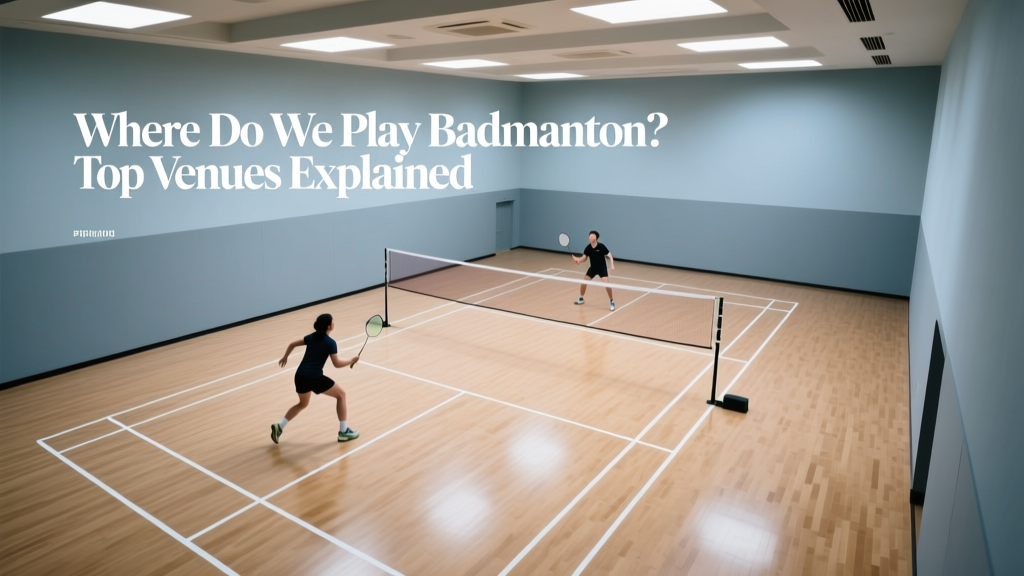
The official badminton court measures 13.4 meters (44 feet) in length and 6.1 meters (20 feet) in width for doubles play. For singles, the court is the same length but narrower at 5.18 meters (17 feet). The court is divided into two equal halves by the net, with each half measuring 6.7 meters (22 feet) from the net to the back boundary line.
The court must have a clear space above it of at least 9 meters (approximately 30 feet) for international competitions, and at least 7.6 meters (25 feet) for general play. This ceiling height ensures that high clears and serves are not obstructed. In multi-purpose gymnasiums, the ceiling height is often the limiting factor for whether the space can be used for badminton.
The court surface should be flat, horizontal, and non-slippery. Wooden sprung floors are preferred for competitive play as they provide good grip and shock absorption. Synthetic surfaces are common in modern facilities and provide consistent playing characteristics. Concrete or tile floors are not recommended as they provide insufficient shock absorption and increase the risk of joint injuries.
Net Height and Specifications
The badminton net is 760mm (2 feet 6 inches) deep and spans the full width of the court. The top of the net must be 1.524 meters (5 feet) high at the center and 1.55 meters (5 feet 1 inch) high at the posts, which are located on the doubles sidelines. The slight dip in the center is natural and allowed within the specifications.
The net is made of fine, dark-colored cord with a mesh size between 15mm and 20mm. The top of the net is edged with a 75mm white tape doubled over a cord or cable that runs through the tape and is stretched firmly to the posts. The posts must be vertical and remain fixed to the ground, maintaining the net at the correct tension throughout play.
For outdoor badminton, wind can significantly affect the net height and shuttlecock flight. While there is no official specification for outdoor courts, recreational players should aim to set the net at the standard height and be aware that wind conditions will affect play. Many outdoor nets come with adjustable height settings to compensate for uneven ground.
Service Lines and Court Markings
The badminton court has several important lines that define different areas of play. The short service line is located 1.98 meters (6 feet 6 inches) from the net on each side. During a serve, the shuttle must pass over this line and land beyond it in the opponent's service court. A serve that lands short of this line is a fault.
The long service line differs between singles and doubles. In singles, the long service line is the back boundary line itself, meaning the full length of the court is in play for serves. In doubles, the long service line is 0.76 meters (2 feet 6 inches) inside the back boundary line. This shorter service area in doubles reflects the different tactical demands of the doubles game.
The center line divides each half of the court into left and right service courts. It extends from the short service line to the back boundary line (or long service line in doubles). During service, the shuttle must land in the diagonally opposite service court. All lines on the court are 40mm wide and should be easily distinguishable from the court surface, typically white or yellow on a dark surface.
Singles vs Doubles Court Differences
The key difference between singles and doubles courts is the width. In singles, the court uses the inner sidelines (5.18m wide), while doubles uses the outer sidelines (6.1m wide). This 0.46m (18-inch) difference on each side significantly changes the tactical dynamics of the game, with doubles requiring more lateral coverage.
The service court dimensions also differ. In singles, the service court is bounded by the center line, the inner sideline, the short service line, and the back boundary line. In doubles, the service court is bounded by the center line, the outer sideline, the short service line, and the doubles long service line (0.76m inside the back boundary). This means the doubles service court is wider but shorter than the singles service court.
When marking a court for both singles and doubles play, all lines should be clearly visible. The standard practice is to use different colors for singles and doubles lines, or to make the singles lines a different width. In multi-purpose halls where badminton lines share the floor with other sports markings, the badminton lines are typically white or yellow and 40mm wide.
Setting Up a Home or Backyard Court
If you want to set up a badminton court at home, you will need a flat area of at least 15m x 8m to allow for the court dimensions plus some clearance around the edges. Mark the lines using chalk, tape, or paint, and set up a portable net system at the correct height. Many sporting goods stores sell complete backyard badminton sets that include a net, posts, boundary lines, rackets, and shuttlecocks.
For indoor home courts, a basement or garage with sufficient ceiling height (at least 7m) can work well. Ensure the floor is flat and provides adequate grip. Rubber gym flooring or interlocking foam tiles can provide a suitable surface over concrete. Good lighting is essential, with overhead lights positioned to avoid shining directly into players' eyes during overhead shots.
While a home court may not meet all official specifications, it provides an excellent space for practice and casual play. Focus on getting the net height correct and the court proportions approximately right. The most important thing is to have a safe, enjoyable space to play and improve your skills.
More Articles
 Safe Chlorine Level to Swim In: Max ppm Guidelines
 How Long Is a Formula 1 Race? Duration Explained
 How High Does Ronaldo Jump? 78 cm Vertical Revealed
 Michael Jordan Vertical Jump: 48-Inch Explained
 Where Can I Rent Jet Skis Near Me? Top Spots & Tips
 How Fast Does Michael Phelps Swim? Speed Breakdown
 When Did Michael Phelps Start Swimming? Key Facts
 How Many Meters in a Mile Swim? Exact Conversion
 Who Invented Ice Hockey? Origins and Key Figures
 How Thick Is Ice Skating Rink Ice? Expert Breakdown