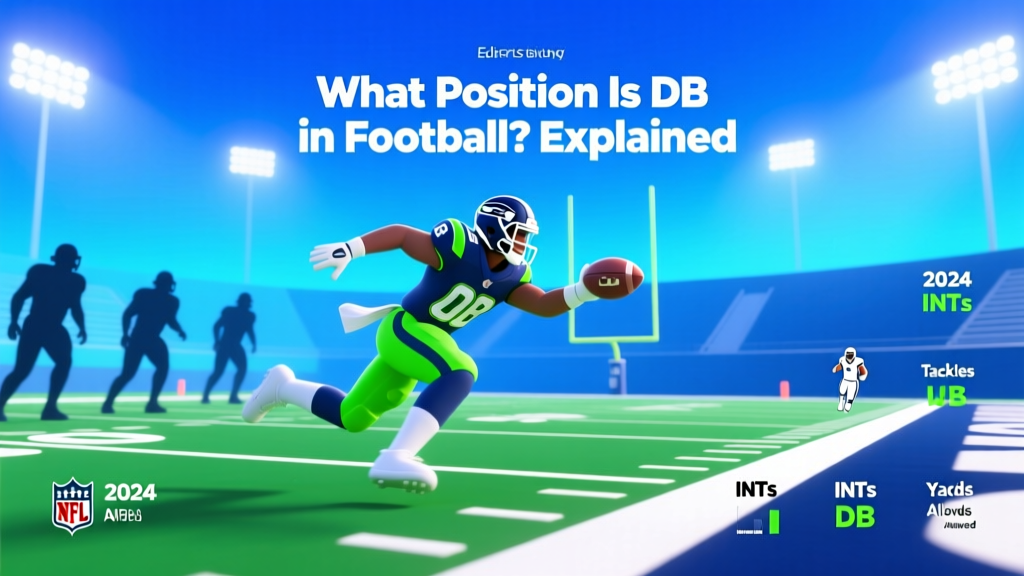
What Position Is DB in Football? Explained
In football, 'DB' stands for defensive back, a key position in the defensive secondary responsible for pass coverage, tackling, and intercepting passes. Defensive backs include cornerbacks and safeties, who align near the sidelines and deep zones to prevent big gains and support run defense.
What Does DB Mean in Football?
The abbreviation 'DB' refers to defensive back, a category of defensive players positioned behind the linebackers whose primary role is to defend against passing plays. DBs are essential in modern football due to the increasing emphasis on aerial attacks. They operate in the secondary defense and must possess speed, agility, and strong reading skills to react to quarterbacks’ decisions.
Types of Defensive Backs
- Cornerback (CB): Lines up opposite wide receivers, often on the line of scrimmage. Their main duties include press coverage, zone defense, and disrupting passing lanes.
- Safety: Positioned deeper in the defensive backfield. Safeties are split into two roles:
- Free Safety (FS): The last line of defense; excels in ball tracking and deep coverage. \li>Strong Safety (SS): Aligns closer to the offensive strength; combines coverage ability with physicality for run support.
Responsibilities of a DB
Defensive backs are tasked with multiple critical functions during a game. Their responsibilities vary based on formation, opponent tendencies, and game situation.
Primary Roles of a Defensive Back
- Man-to-man or zone pass coverage
- Breaking up or intercepting passes
- Tackling ball carriers after receptions
- Providing run support from the back end
- Blitzing the quarterback on occasion
- Reading quarterback eyes and route combinations
Skills Required to Excel as a DB
Success at the DB position requires a unique blend of physical and mental attributes. Elite defensive backs combine athleticism with football IQ.
Essential Attributes for Defensive Backs
- Speed and Acceleration: Crucial for keeping up with fast wide receivers.
- Change of Direction: Ability to mirror routes and make sharp cuts.
- Ball Skills: Includes hands, timing, and awareness to catch interceptions.
- Physical Toughness: Needed for jamming receivers at the line and tackling runners.
- Mental Processing: Quick recognition of formations, play-action fakes, and route concepts.
DB Performance Metrics and NFL Data (2024 Season)
Statistical performance helps evaluate the effectiveness of defensive backs. Key metrics include interceptions, pass deflections, tackles, and quarterback ratings when targeted.
| Player | Team | Interceptions | Pass Deflections | Tackles | Forced Fumbles |
|---|---|---|---|---|---|
| Marlon Humphrey | Baltimore Ravens | 5 | 14 | 68 | 2 |
| Derek Stingley Jr. | Houston Texans | 4 | 12 | 54 | 1 |
| Denzel Ward | Cleveland Browns | 3 | 15 | 59 | 0 |
| Xavier McKinney | New York Giants | 4 | 10 | 76 | 1 |
| Jaire Alexander | Green Bay Packers | 2 | 9 | 45 | 1 |
The data shows that top-performing DBs like Marlon Humphrey and Derek Stingley Jr. excel not only in interceptions but also in pass deflections and tackling. High tackle counts among safeties like Xavier McKinney reflect their dual role in run defense. Cornerbacks such as Denzel Ward demonstrate elite coverage with fewer tackles but more breakups.
Frequently Asked Questions About DB in Football
What does DB stand for in American football?
DB stands for defensive back, a position group that includes cornerbacks and safeties who are primarily responsible for defending against pass plays.
What is the difference between a cornerback and a safety?
Cornerbacks typically cover wide receivers near the line of scrimmage and are faster and more agile. Safeties play deeper in the secondary, with free safeties focusing on deep coverage and strong safeties offering more run support.
Do DBs have to be good tacklers?
Yes, defensive backs must be reliable tacklers. Even though they focus on pass coverage, they frequently need to bring down receivers after catches and support against the run.
Can a DB become a linebacker?
While rare, some hybrid players (like nickelbacks or box safeties) line up close to the line of scrimmage and perform linebacker-like duties. Full position changes depend on size, strength, and skill set.
Who are some of the best DBs in NFL history?
Legends include Deion Sanders, Champ Bailey, Ed Reed, and Charles Woodson. These players combined elite coverage, ball-hawking skills, and leadership to define excellence at the position.
More Articles
 When Does Football Season Start 2025? Key Dates
 Did Matthew McConaughey Play Football? The Truth Revealed
 What Time Does Sunday Football Start? NFL Kickoff Times
 What Does a Wide Receiver Do in Football?
 What Does FBS Mean in College Football?
 Where Is the 2025 College Football Championship Played?
 Did Robert Saleh Play Football? Yes, in College
 Where to Watch Michigan vs Oregon Football 2025
 Football Helmet Fit Guide: Size It Right in 2026
 Best Badminton Data: Precision Metrics, Equipment Specifications, and Performance Benchmarks That Matter